
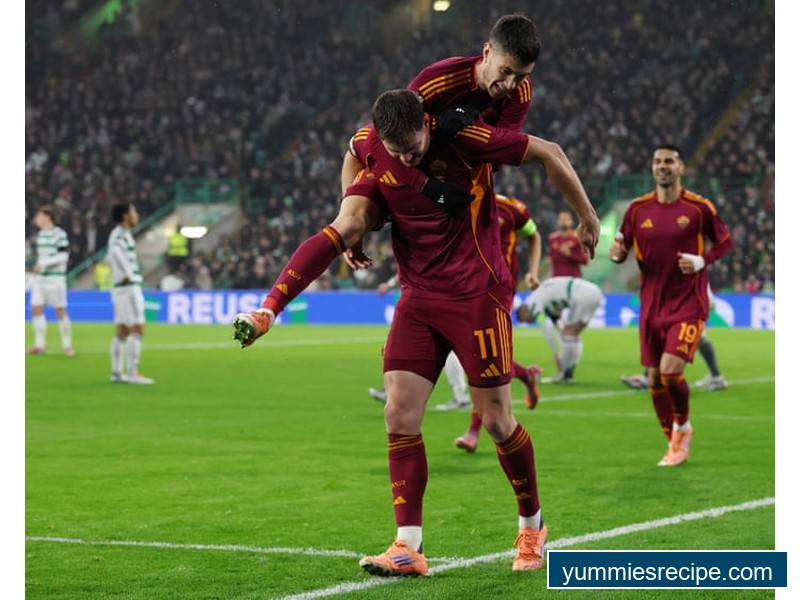
The net had barely ceased its violent trembling before the collective groan of sixty thousand souls sucked the air right out of Parkhead. Lewis Ferguson, a man who knows the visceral geometry of Scottish football better than most, had already wheeled away toward the corner flag, arms outstretched, celebrating a strike that felt less like a goal and more like an execution. It was the twelfth minute. It was 0-1. But in the grand, terrifying narrative of Wilfried Nancy’s fledgling tenure, it felt like the final scene of a tragedy that hadn’t even been afforded a prologue.
European nights under the lights in Glasgow are sold on a mythos of thunder, passion, and the capacity to rattle the continent's elite. Yet, as Roma cantered—truly, there is no other word for it—to a victory that secured them six points from six in the city this season, the atmosphere shifted from hostility to a morbid curiosity. We were watching a tactical dissection.
The Nancy Paradox: Idealism Meets Reality
To understand the severity of this defeat, you have to look past the scoreboard and stare directly into the eyes of the system. Wilfried Nancy arrived in Glasgow trailing clouds of glory from MLS, a manager lauded for aesthetic purity and complex positional play. But football is a cruel editor of reputations. Two matches is a microscopic sample size, yes. However, when those two matches result in back-to-back losses where the team looks not just beaten, but structurally incoherent, alarm bells don't just ring; they scream.
"Two matches is not an adequate window in which to judge a manager. Nonetheless, these are worrying times for Wilfried Nancy and Celtic. Seriously worrying, in truth."
The issue isn't that Celtic lost to Roma. Roma are European pedigree. The issue is the naivety. Nancy’s setup demanded a high line and intricate passing triangles in areas where Roma’s press was most ferocious. It was like watching a man try to dismantle a bomb with a hammer.
Tactical Breakdown: The Midfield Vacuum
What Ferguson’s double highlighted wasn't just defensive frailty, but a complete abandonment of the midfield battleground. Roma didn't need to dominate possession; they simply needed to wait for Celtic to tie themselves in knots.
Key Failure Points:
- Transition Defense: Every time possession was lost, Roma bypassed Celtic’s counter-press with a single vertical pass. The space between Nancy’s center-backs was large enough to land a jumbo jet.
- Ferguson’s Ghosting Runs: The Scot wasn't tracked once. His late arrivals into the box are his trademark, yet Celtic defended as if they had never seen a scouting report.
- Sterile Domination: Celtic had the ball. Roma had the chances. It is the classic symptom of a manager trying to imprint a philosophy before his players have the muscle memory to execute it.
The stats paint a grim picture of "possession without purpose," a malady that has ended many managerial careers in the East End of Glasgow before they truly began.
The Verdict: Time is a Luxury Celtic Can't Afford
Can Nancy turn this around? Technically, yes. But the emotional capital at a club like Celtic is finite. When you allow an Italian side to treat Parkhead like a training ground exercise—securing a comfortable "canter" from minute one—you lose more than three points. You lose the fear factor.
Ferguson’s double was a reminder of the ruthlessness required at this level. Nancy’s system relies on intricate harmony, but right now, Celtic are playing out of tune, and the rest of Europe is starting to cover its ears. If the Frenchman cannot find a way to marry his aesthetic principles with the gritty reality of Scottish and European football, his tenure might be remembered not for the style he brought, but for the speed with which it unraveled.