
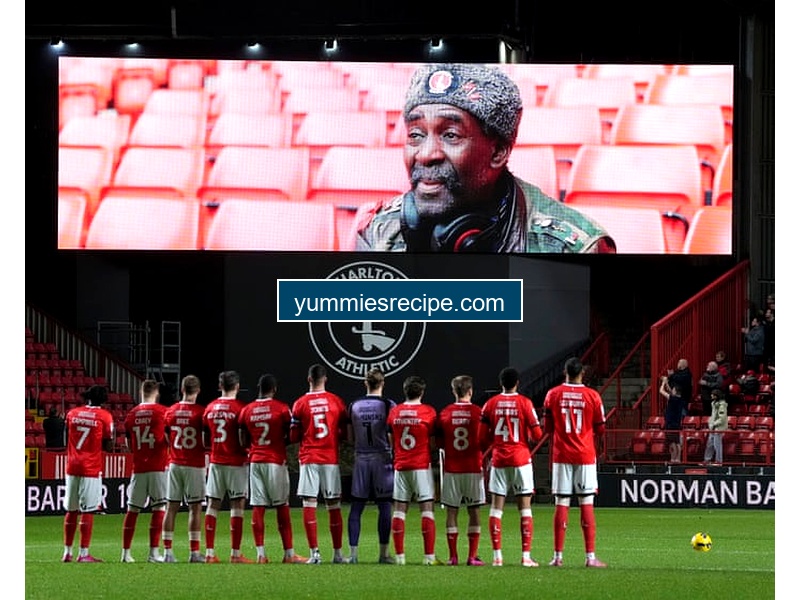
In 1968, the tactical landscape of English football was defined by heavy leather balls, mud-churned pitches, and a rigid adherence to orthodox formations that barely resemble the fluid positional play we see today. Fast forward fifty-six years to a hybrid-turf pitch in south-east London, and while the geometry of the game has been revolutionized, one constant variable in the North Stand remained entirely unchanged—until the clock stopped at the 12th minute last Saturday. The passing of Norman Barker, affectionately known as "Headphones Norm," forces us to pause our obsession with heat maps and pass completion rates to analyze the most critical, yet unquantifiable, metric in football: the legacy of the ever-present supporter.
The abandonment of the Charlton Athletic vs. Portsmouth fixture wasn’t merely a procedural halt; it was a systemic shock to the architecture of The Valley. When fans alerted officials to the medical emergency in the North Stand, the match ceased to be a contest of strategy and became a theater of human fragility. Barker, a fixture since that debut year of '68, was taken to the hospital where he sadly passed away, leaving a void that no transfer window or tactical tweak can fill.
The Infrastructure of Consistency
We often talk about the "spine" of a team—the goalkeeper, the center-back, the holding midfielder, the striker. We analyze their durability and their consistency ratings. Yet, we rarely apply this analytical lens to the stands. Norman Barker represented the ultimate statistical anomaly: absolute consistency in a league renowned for its volatility.
Known for his trademark headphones—a visual signature as recognizable in SE7 as a captain’s armband—Barker’s presence was a stabilizing metric for the club. In an era where managers last an average of 14 months and squad turnovers are drastic, figures like Barker provide the continuity that maintains a club's identity. He wasn't just a spectator; he was a piece of the club's load-bearing infrastructure.
"It is clear from an interview he did in 2020 that it was love at first sight. That led him to follow the club into his 60s and become ever-present at Addicks games and a very familiar figure."
From a psychological perspective, the "home advantage" is often dismissed as referee bias or travel fatigue. However, data suggests it is deeply rooted in familiarity and acoustic feedback loops. Barker, by being there for over five decades, was a generator of that feedback. His removal from the equation alters the sensory landscape of the North Stand.
The Physiological Impact of Abandonment
Moving to the pitch, we must analyze the implications of the match abandonment itself. A game stopped at 12 minutes creates a unique physiological and tactical problem for Nathan Jones and the Charlton squad.
Modern warm-up protocols are designed to peak a player's heart rate and metabolic activation precisely at kickoff. When that cycle is interrupted by a traumatic event and a subsequent suspension of play, the "cooling down" process is not just physical—it's mental. The adrenaline dump associated with a medical emergency involving a fan acts as a significant performance inhibitor.
- Disrupted Micro-cycles: The training week is geared towards peak output on Saturday at 3 PM. An abandonment voids that physical load, requiring fitness coaches to restructure the subsequent week to avoid detraining or overloading.
- Psychological Reset: Players are human. Witnessing the distress in the stands breaks the cognitive tunnel vision required for elite performance. The decision to abandon was the only logical tactical move for player welfare.
- Fixture Congestion: Strategically, this adds a rearranged fixture into an already dense Championship calendar, testing squad depth later in the season.
Galvanizing the Collective Unit
How does this impact the remainder of the season? Football history shows us that tragedy often acts as a potent catalyst for squad cohesion. The "siege mentality" usually manufactured by managers against the media or referees is organically replaced by a genuine cause: playing for the memory of one of their own.
When the fixture is eventually replayed, the tactical dynamic will be fundamentally different. It will no longer be just another gameweek; it will be an emotionally charged event. For Charlton, the challenge will be channeling that emotion into controlled aggression rather than chaotic energy.
The 12th Man Data Point
In tactical analysis, we look for overloads—situations where we have more players in a zone than the opponent (2v1, 3v2). The crowd at The Valley creates an auditory overload. Norman Barker was a key node in that network. His "Headphones" moniker might suggest isolation, but his presence was an act of communal integration.
The tributes pouring in reflect a realization often missed in modern sports analysis: the ecosystem of a football club relies as much on the loyalty of the North Stand as it does on the tactical prowess of the dugout. Losing a 56-year v