
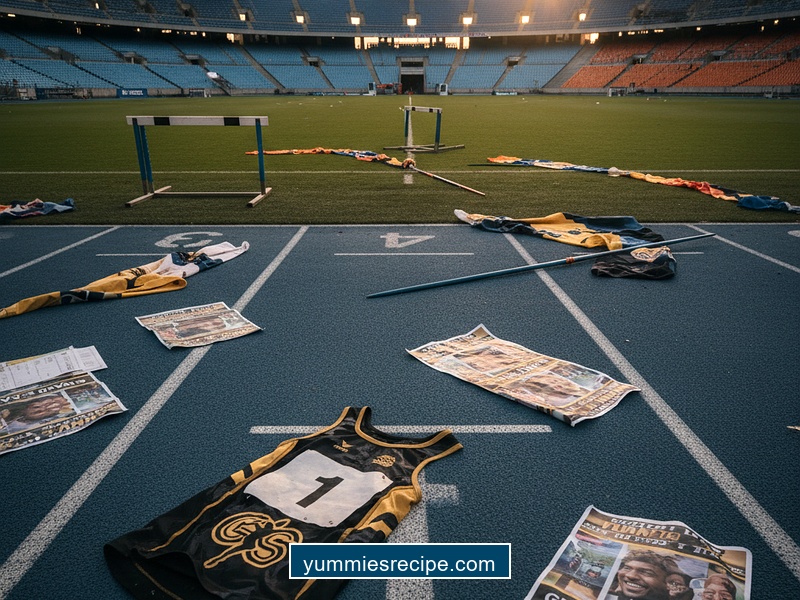
The Stat: $30 million in projected operational capital, evaporated in a financial sprint that lasted less than a single fiscal calendar, yielding an average attendance density that struggled to surpass a high-end NCAA regional meet. When you look at the raw numbers, the bankruptcy filing of Grand Slam Track isn't just a business failure; it is a catastrophic misalignment of supply, demand, and structural reality.
Michael Johnson, a man whose gold shoes once symbolized the absolute pinnacle of individual execution, has found himself boxed in on the back straight of the corporate world. The news that his ambitious athletics series has filed for bankruptcy in the United States is a seismic event, but for the analytical observer, the tremors have been detectable for months. This wasn't bad luck. This was a tactical failure to read the room, the market, and the very mechanics of modern consumption.
The Valuation Trap: Misreading the Revenue Model
The fundamental error here was not in the product—world-class athletes running fast is always compelling—but in the valuation of that product within a saturated ecosystem. Johnson attempted to apply a Formula 1 or Premier League "high-stakes" model to a sport that operates on a completely different rhythm. In football or motorsport, the league structure creates a cumulative narrative. Every match week builds equity.
Track and field, however, is structurally episodic. It relies on the "Major Championship" peak. By trying to artificially manufacture four "Grand Slam" peaks outside of the World Athletics ecosystem, GST created a supply glut. They assumed that high prize money would automatically convert to high gate receipts. That is a tactical fallacy.
"You cannot force vertical integration in a sport that is horizontally dispersed. The fans didn't buy the narrative because the stakes felt manufactured, not earned."
Cash flow problems in year one indicate that the "burn rate" (the speed at which a company spends its venture capital) was calibrated for a massive immediate return on broadcast rights and ticketing—a return that simply does not exist in track and field outside of the Olympics.
The Geometry of the Empty Stadium
Let’s analyze the "poor attendance" metric cited in the filing. This is where the strategy fell apart on a granular level. The choice of venues in the United States was a high-risk gamble. In Europe, the Diamond League thrives because meets like Zurich or Brussels are cultural institutions; the stadium is the destination.
In the US, outside of Eugene, Oregon, track is a niche curiosity. GST tried to scale up too quickly, booking venues that were too large to fill, destroying the atmosphere. A 20,000-seat stadium with 4,000 people feels like a funeral. A 5,000-seat stadium with 4,000 people feels like a riot. Johnson’s team failed to optimize for density. They went for optics and ended up with echoes.
The Broadcast Disconnect
Furthermore, the visual product suffered. Television networks pay for energy. When the cameras pan across swathes of empty aluminum bleachers, the "premium" nature of the product—essential for Johnson's pitch to advertisers—instantly degrades. It creates a negative feedback loop: lack of atmosphere leads to poor TV product, which leads to lower sponsorship revenue, which exacerbates the cash flow crisis.
The Athlete 'Load Management' Variable
From a performance analysis perspective, the Grand Slam Track concept ignored the physiology of the modern elite sprinter. We are in the era of load management. Athletes like Sydney McLaughlin-Levrone or Noah Lyles are meticulously periodized to peak once, maybe twice, a year.
- Peaking Cycles: Elite speed is a finite resource. Asking athletes to run world-leading times four times a year for a new league disrupts their Olympic/World Championship cycles.
- Risk vs. Reward: Even with high appearance fees, the risk of injury in a non-federation event often outweighs the financial gain for top-tier talent.
- Rivalry Dilution: If the top stars don't race each other often, the anticipation builds. If they race too often in a league format, the novelty wears off. GST hit the worst middle ground: high costs for athletes who weren't fully committed to the "war."
Johnson needed 100% buy-in from the top 1% of talent to make this work. He likely got 50% effort from 80% of the talent. You cannot build a billion-dollar property on "B-Game" performances.
What This Means for the Landscape
Is this the death knell for professional track innovation? Not necessarily, but it is a harsh correction. It validates the monopoly of World Athletics and the Diamond League, not because they are perfect, but because they understand the sustainability of the ecosystem. They rely on subsidized models (federation support, government grants for meets) rather than pure private equity profit motives.
The collapse of Grand Slam Track serves as a tactical case study in "Product-Market Fit." You can have the legend (Johnson), you can have the premise (head-to-head racing), but if the structural economics—the gate receipts, the burn rate, the athlete incentives—are misaligned, the result is inevitable.
Ultimately, Johnson tried to sprint a marathon. He expended all his kinetic energy in the first 100 meters of a business plan that required pacing, patience, and a much deeper understanding of why fans actually buy tickets. The ledger is now red, the stadiums are silent, and the lesson is brutal: in the business of sport, speed kills—but only if you run out of cash before you cross the finish line.
The Stat: $30 million in projected operational capital, evaporated in a financial sprint that lasted less than a single fiscal calendar, yielding an average attendance density that struggled to surpass a high-end NCAA regional meet. When you look at the raw numbers, the bankruptcy filing of Grand Slam Track isn't just a business failure; it is a catastrophic misalignment of supply, demand, and structural reality.
Michael Johnson, a man whose gold shoes once symbolized the absolute pinnacle of individual execution, has found himself boxed in on the back straight of the corporate world. The news that his ambitious athletics series has filed for bankruptcy in the United States is a seismic event, but for the analytical observer, the tremors have been detectable for months. This wasn't bad luck. This was a tactical failure to read the room, the market, and the very mechanics of modern consumption.
The Valuation Trap: Misreading the Revenue Model
The fundamental error here was not in the product—world-class athletes running fast is always compelling—but in the valuation of that product within a saturated ecosystem. Johnson attempted to apply a Formula 1 or Premier League "high-stakes" model to a sport that operates on a completely different rhythm. In football or motorsport, the league structure creates a cumulative narrative. Every match week builds equity.
Track and field, however, is structurally episodic. It relies on the "Major Championship" peak. By trying to artificially manufacture four "Grand Slam" peaks outside of the World Athletics ecosystem, GST created a supply glut. They assumed that high prize money would automatically convert to high gate receipts. That is a tactical fallacy.
"You cannot force vertical integration in a sport that is horizontally dispersed. The fans didn't buy the narrative because the stakes felt manufactured, not earned."
Cash flow problems in year one indicate that the "burn rate" (the speed at which a company spends its venture capital) was calibrated for a massive immediate return on broadcast rights and ticketing—a return that simply does not exist in track and field outside of the Olympics.
The Geometry of the Empty Stadium
Let’s analyze the "poor attendance" metric cited in the filing. This is where the strategy fell apart on a granular level. The choice of venues in the United States was a high-risk gamble. In Europe, the Diamond League thrives because meets like Zurich or Brussels are cultural institutions; the stadium is the destination.
In the US, outside of Eugene, Oregon, track is a niche curiosity. GST tried to scale up too quickly, booking venues that were too large to fill, destroying the atmosphere. A 20,000-seat stadium with 4,000 people feels like a funeral. A 5,000-seat stadium with 4,000 people feels like a riot. Johnson’s team failed to optimize for density. They went for optics and ended up with echoes.
The Broadcast Disconnect
Furthermore, the visual product suffered. Television networks pay for energy. When the cameras pan across swathes of empty aluminum bleachers, the "premium" nature of the product—essential for Johnson's pitch to advertisers—instantly degrades. It creates a negative feedback loop: lack of atmosphere leads to poor TV product, which leads to lower sponsorship revenue, which exacerbates the cash flow crisis.
The Athlete 'Load Management' Variable
From a performance analysis perspective, the Grand Slam Track concept ignored the physiology of the modern elite sprinter. We are in the era of load management. Athletes like Sydney McLaughlin-Levrone or Noah Lyles are meticulously periodized to peak once, maybe twice, a year.
- Peaking Cycles: Elite speed is a finite resource. Asking athletes to run world-leading times four times a year for a new league disrupts their Olympic/World Championship cycles.
- Risk vs. Reward: Even with high appearance fees, the risk of injury in a non-federation event often outweighs the financial gain for top-tier talent.
- Rivalry Dilution: If the top stars don't race each other often, the anticipation builds. If they race too often in a league format, the novelty wears off. GST hit the worst middle ground: high costs for athletes who weren't fully committed to the "war."
Johnson needed 100% buy-in from the top 1% of talent to make this work. He likely got 50% effort from 80% of the talent. You cannot build a billion-dollar property on "B-Game" performances.
What This Means for the Landscape
Is this the death knell for professional track innovation? Not necessarily, but it is a harsh correction. It validates the monopoly of World Athletics and the Diamond League, not because they are perfect, but because they understand the sustainability of the ecosystem. They rely on subsidized models (federation support, government grants for meets) rather than pure private equity profit motives.
The collapse of Grand Slam Track serves as a tactical case study in "Product-Market Fit." You can have the legend (Johnson), you can have the premise (head-to-head racing), but if the structural economics—the gate receipts, the burn rate, the athlete incentives—are misaligned, the result is inevitable.
Ultimately, Johnson tried to sprint a marathon. He expended all his kinetic energy in the first 100 meters of a business plan that required pacing, patience, and a much deeper understanding of why fans actually buy tickets. The ledger is now red, the stadiums are silent, and the lesson is brutal: in the business of sport, speed kills—but only if you run out of cash before you cross the finish line.