
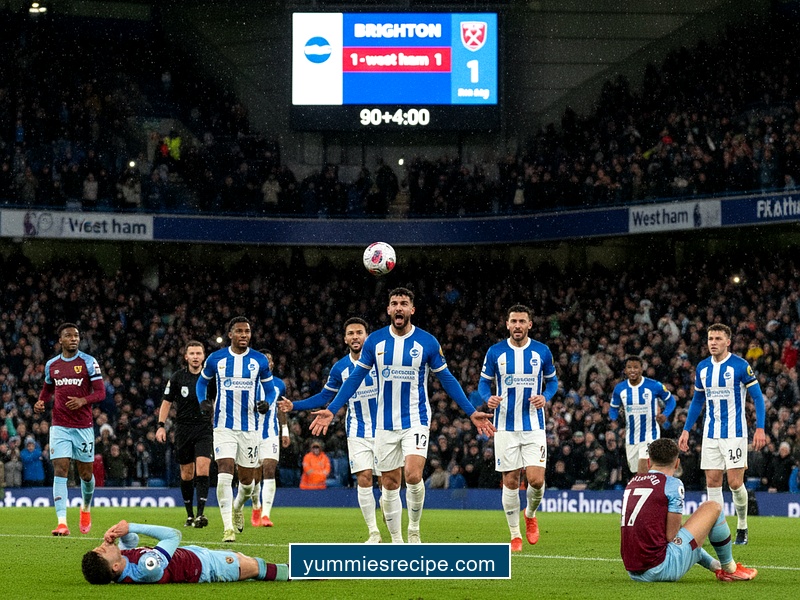
Time in football is not linear; it is emotional. Ninety minutes can feel like a fleeting second to a team chasing a title, yet an eternity to a side fighting for survival. At the Amex Stadium this weekend, West Ham United experienced the latter—a grueling, fearful watch-watching exercise that ended not with relief, but with the distinct, metallic taste of blood. Georginio Rutter’s controversial stoppage-time equaliser for Brighton did more than split the points; it stripped away the illusion of safety West Ham had clung to for the better part of the second half.
For those of us who have charted the trajectories of English football clubs over decades, the scene on the South Coast was strikingly familiar. It was a tableau of a club haunted by its own history. West Ham United, an institution that prides itself on the "Academy of Football" and the ghost of 1966, is currently playing with the paralyzing anxiety of a team that knows it is flirting with disaster. The 1-1 draw keeps them in the relegation zone, a reality that seems absurd given their roster, yet entirely logical given their application.
The Ghost of 2003 Returns
One cannot watch this current iteration of West Ham without drawing grim parallels to the 2002-03 season. That year, a squad boasting talents like Paolo Di Canio, Michael Carrick, Joe Cole, and Jermain Defoe suffered relegation with a record-high 42 points. They were tagged with the infamous moniker: "Too Good to Go Down." It is a dangerous label, a sedative that convinces players their talent will eventually override the league table's mathematics.
Against Brighton, West Ham exhibited the same symptoms as Glenn Roeder’s tragic side of two decades ago. They took the lead, yes, but they did not know how to hold it. Instead of controlling the tempo, they retreated into a shell of passivity. It was a retreat born of fear, not tactical prudence. When a team facing the drop takes the lead, the shirt becomes heavy. Every clearance is panicked; every second on the clock ticks slower. The current squad, much like their 2003 predecessors, lacks the grit required for a relegation dogfight. They are built for mid-table comfort, not for the trenches.
The Seagulls: From Underdogs to Assassins
Conversely, Brighton & Hove Albion represents the antithesis of their historical self. Cast your mind back to the late 1990s, when the Seagulls were homeless, nearly dropping out of the Football League entirely, protesting on the pitch against their own board. In those days, a stoppage-time goal against a storied London club would have been a miracle. Today, it is an expectation.
Georginio Rutter’s arrival and subsequent impact symbolize the club’s extraordinary evolution. The controversy surrounding the goal—shouts for a foul in the build-up that fell on deaf ears—will dominate the back pages, but the real story is Brighton’s persistence. They have morphed from a plucky seaside team into a relentless machine constructed by the sharpest data analysts in the sport.
Rutter, a player who divides opinion but possesses undeniable chaos-inducing ability, found the space that West Ham invited him into. Twenty years ago, Brighton would have folded after conceding. Now, backed by a recruitment strategy that puts the established elite to shame, they possess the depth and the arrogance to keep playing until the final whistle. They knew West Ham would crack. It was simply a matter of when.
Deep Dive: The Anatomy of a Collapse
Why does this result matter beyond the single point gained or lost? Because it exposes a fundamental flaw in West Ham's current architecture. The "controversy" of the goal provides a convenient shield for the manager to hide behind in the post-match press conference, but it cannot mask the tactical cowardice displayed in the final twenty minutes.
The Irons ceased to play football in the 70th minute. Their defensive line dropped ten yards deeper, compressing the space but inviting Brighton’s creative midfielders to camp on the edge of the box. By ceding possession entirely, West Ham turned the match into a game of Russian Roulette. Eventually, the chamber was going to be loaded.
This is the hallmark of a team destined for the Championship. Relegation rarely comes because a team is consistently thrashed 4-0. It arrives via a thousand cuts—late equalizers, dropped points from winning positions, and the inability to manage the dying embers of a game. West Ham are currently bleeding out, and they lack the tourniquet of leadership to stop it.
The Stat Pack: Points Squandered
To understand the gravity of West Ham's situation, we must look at the data surrounding their inability to close out matches compared to their relegation rivals.
| Metric | West Ham Utd | League Avg | Context |
|---|---|---|---|
| Points Dropped (Winning Pos) | 18 | 9 | Highest in the bottom half. |
| Goals Conceded (85th+ Min) | 7 | 3 | Indicates mental fatigue/panic. |
| Possession (Final 15 Mins) | 28% | 46% | Total surrender of territory. |
Fan Pulse: The Fury of East London
The mood among the travelling West Ham contingent was toxic, and rightfully so. In the forums and pubs of Stratford, the anger is no longer directed solely at the players, but at a perceived lack of identity. Fans can forgive a lack of quality; they cannot forgive cowardice. The manner of this draw—snatching a stalemate from the jaws of victory—is psychologically more damaging than a straightforward loss.
"It's the hope that kills you. We sat back and invited them on. We haven't learned a thing since August. It feels like we are sleepwalking into the Championship." — West Ham supporter, post-match.
For Brighton fans, the emotion is contrasting but equally intense. There is a smug satisfaction in knowing that their system works. They watched their team pry open a locked door with patience and precision. The "controversy" of Rutter's goal is merely sweet icing on the cake. They remember the days when they were the victims of big-club bias; now, they feel like the protagonists of the story.
As the dust settles on this 1-1 draw, the league table tells a truth that West Ham must face. They are not unlucky. They are not victims of VAR. They are a team failing to cope with the burden of their own history, playing against a Brighton side that has brilliantly rewritten theirs. Unless the Hammers can exorcise the ghosts of 2003 and find the courage to play forward when the pressure mounts, the trapdoor will open, and this time, there may be no coming back.
Time in football is not linear; it is emotional. Ninety minutes can feel like a fleeting second to a team chasing a title, yet an eternity to a side fighting for survival. At the Amex Stadium this weekend, West Ham United experienced the latter—a grueling, fearful watch-watching exercise that ended not with relief, but with the distinct, metallic taste of blood. Georginio Rutter’s controversial stoppage-time equaliser for Brighton did more than split the points; it stripped away the illusion of safety West Ham had clung to for the better part of the second half.
For those of us who have charted the trajectories of English football clubs over decades, the scene on the South Coast was strikingly familiar. It was a tableau of a club haunted by its own history. West Ham United, an institution that prides itself on the "Academy of Football" and the ghost of 1966, is currently playing with the paralyzing anxiety of a team that knows it is flirting with disaster. The 1-1 draw keeps them in the relegation zone, a reality that seems absurd given their roster, yet entirely logical given their application.
The Ghost of 2003 Returns
One cannot watch this current iteration of West Ham without drawing grim parallels to the 2002-03 season. That year, a squad boasting talents like Paolo Di Canio, Michael Carrick, Joe Cole, and Jermain Defoe suffered relegation with a record-high 42 points. They were tagged with the infamous moniker: "Too Good to Go Down." It is a dangerous label, a sedative that convinces players their talent will eventually override the league table's mathematics.
Against Brighton, West Ham exhibited the same symptoms as Glenn Roeder’s tragic side of two decades ago. They took the lead, yes, but they did not know how to hold it. Instead of controlling the tempo, they retreated into a shell of passivity. It was a retreat born of fear, not tactical prudence. When a team facing the drop takes the lead, the shirt becomes heavy. Every clearance is panicked; every second on the clock ticks slower. The current squad, much like their 2003 predecessors, lacks the grit required for a relegation dogfight. They are built for mid-table comfort, not for the trenches.
The Seagulls: From Underdogs to Assassins
Conversely, Brighton & Hove Albion represents the antithesis of their historical self. Cast your mind back to the late 1990s, when the Seagulls were homeless, nearly dropping out of the Football League entirely, protesting on the pitch against their own board. In those days, a stoppage-time goal against a storied London club would have been a miracle. Today, it is an expectation.
Georginio Rutter’s arrival and subsequent impact symbolize the club’s extraordinary evolution. The controversy surrounding the goal—shouts for a foul in the build-up that fell on deaf ears—will dominate the back pages, but the real story is Brighton’s persistence. They have morphed from a plucky seaside team into a relentless machine constructed by the sharpest data analysts in the sport.
Rutter, a player who divides opinion but possesses undeniable chaos-inducing ability, found the space that West Ham invited him into. Twenty years ago, Brighton would have folded after conceding. Now, backed by a recruitment strategy that puts the established elite to shame, they possess the depth and the arrogance to keep playing until the final whistle. They knew West Ham would crack. It was simply a matter of when.
Deep Dive: The Anatomy of a Collapse
Why does this result matter beyond the single point gained or lost? Because it exposes a fundamental flaw in West Ham's current architecture. The "controversy" of the goal provides a convenient shield for the manager to hide behind in the post-match press conference, but it cannot mask the tactical cowardice displayed in the final twenty minutes.
The Irons ceased to play football in the 70th minute. Their defensive line dropped ten yards deeper, compressing the space but inviting Brighton’s creative midfielders to camp on the edge of the box. By ceding possession entirely, West Ham turned the match into a game of Russian Roulette. Eventually, the chamber was going to be loaded.
This is the hallmark of a team destined for the Championship. Relegation rarely comes because a team is consistently thrashed 4-0. It arrives via a thousand cuts—late equalizers, dropped points from winning positions, and the inability to manage the dying embers of a game. West Ham are currently bleeding out, and they lack the tourniquet of leadership to stop it.
The Stat Pack: Points Squandered
To understand the gravity of West Ham's situation, we must look at the data surrounding their inability to close out matches compared to their relegation rivals.
| Metric | West Ham Utd | League Avg | Context |
|---|---|---|---|
| Points Dropped (Winning Pos) | 18 | 9 | Highest in the bottom half. |
| Goals Conceded (85th+ Min) | 7 | 3 | Indicates mental fatigue/panic. |
| Possession (Final 15 Mins) | 28% | 46% | Total surrender of territory. |
Fan Pulse: The Fury of East London
The mood among the travelling West Ham contingent was toxic, and rightfully so. In the forums and pubs of Stratford, the anger is no longer directed solely at the players, but at a perceived lack of identity. Fans can forgive a lack of quality; they cannot forgive cowardice. The manner of this draw—snatching a stalemate from the jaws of victory—is psychologically more damaging than a straightforward loss.
"It's the hope that kills you. We sat back and invited them on. We haven't learned a thing since August. It feels like we are sleepwalking into the Championship." — West Ham supporter, post-match.
For Brighton fans, the emotion is contrasting but equally intense. There is a smug satisfaction in knowing that their system works. They watched their team pry open a locked door with patience and precision. The "controversy" of Rutter's goal is merely sweet icing on the cake. They remember the days when they were the victims of big-club bias; now, they feel like the protagonists of the story.
As the dust settles on this 1-1 draw, the league table tells a truth that West Ham must face. They are not unlucky. They are not victims of VAR. They are a team failing to cope with the burden of their own history, playing against a Brighton side that has brilliantly rewritten theirs. Unless the Hammers can exorcise the ghosts of 2003 and find the courage to play forward when the pressure mounts, the trapdoor will open, and this time, there may be no coming back.