
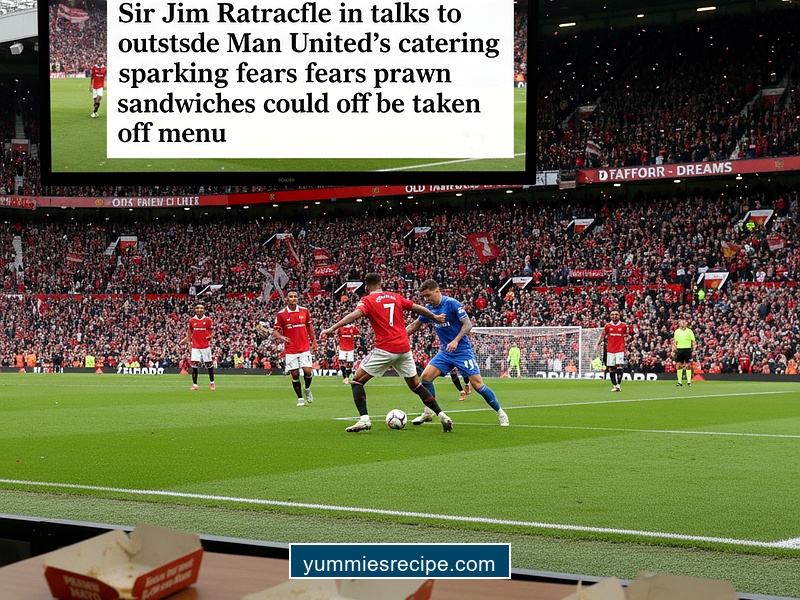
Institutions do not crumble overnight; they erode, grain by grain, until the structure that remains bears little resemblance to the foundation laid by its architects. We are witnessing such an erosion at Old Trafford. The latest reports emanating from the corridors of power suggest that Sir Jim Ratcliffe, the petrochemical billionaire tasked with steering this drifting vessel, is seeking to outsource the club’s catering operations. On the surface, this is a spreadsheet decision—a line item to be optimized. But for the historian looking back at the lineage of Manchester United, it represents a profound severance from the club’s communal roots.
The headline is almost satirical: the potential disappearance of the prawn sandwich. For a quarter of a century, that specific crustacean has defined the modern era of the club. It was the symbol of United’s transformation from a football team into a global brand. Now, in a twist of cruel irony, the very corporate efficiency that birthed the "Prawn Sandwich Brigade" seeks to dismantle the kitchen that feeds them.
The Shadow of the "Brigade"
To understand the gravity of this seemingly trivial catering change, one must revisit a drizzly November evening in 2000. Following a lackluster Champions League victory over Dynamo Kyiv, captain Roy Keane delivered a monologue that would echo through the decades. He wasn't talking about tactics or formations; he was talking about the soul of the stadium.
"Away from home our fans are fantastic, I'd call them the hardcore fans. But at home they have a few drinks and probably the prawn sandwiches, and they don't realise what's going on out on the pitch." — Roy Keane, 2000.
Keane was lamenting the gentrification of football. The transition from the terraced fervor of the Doc’s Army in the 1970s to the sanitised, corporate consumption of the new millennium. Yet, in the years that followed, the club embraced this identity. The hospitality suites became the financial engine that allowed United to compete with the state-backed clubs of Europe. The prawn sandwich ceased to be an insult and became a revenue stream.
By outsourcing catering to an external bidder, Ratcliffe is signaling the end of that specific epoch. It is the final admission that the unique "United Way"—even in something as mundane as hospitality—is subservient to market forces. The club is no longer a host welcoming guests into its home; it is a landlord renting out space to a vendor.
Deep Dive: The Erosion of "The Family Club"
This move is not merely about food; it is a strategic dismantling of the "family club" ethos that Sir Matt Busby built and Sir Alex Ferguson fiercely protected. For decades, United prided itself on the longevity of its staff. From the tea ladies (like the legendary Kath Phipps, who has served the club for over half a century) to the laundry room workers, everyone was part of the machinery of success.
Ferguson understood that a happy canteen led to a happy dressing room. He knew the names of the chefs. He understood that the staff were the continuity in a world of transient millionaire players. When you outsource, you sever that connection. You replace loyal employees who bleed red with agency staff on minimum wage who view Old Trafford merely as a shift location, indifferent to whether the team wins or loses.
INEOS is applying a petrochemical logic to a cultural institution. In heavy industry, efficiency is king. Unnecessary overheads are trimmed. But football clubs thrive on the intangible—the emotional investment of the people who work there. By aiming to save what is effectively a rounding error in the club’s accounts, Ratcliffe risks destroying the last remnants of the community spirit that once made Manchester United different from a mere franchise.
Stat Pack: The Cost of Soul vs. Success
To contextualize this shift, we must look at the dichotomy between the "Ferguson Era"—defined by internal control and stability—and the current "Corporate Era" defined by commercial expansion and operational flux.
| Metric | Ferguson Era (1990-2013) | Post-Fergie Era (2013-Present) |
|---|---|---|
| Operational Philosophy | Insular, Family-oriented, Stability | Commercial, Outsourced, High Turnover |
| Commercial Revenue | Organic Growth | Aggressive Global Monetization |
| Staff Connection | High (Manager knew all staff) | Low (Departmental silos) |
| League Titles | 13 | 0 |
| Transfer Strategy | Value & Youth Integration | "Hollywood" Signings & Panic Buys |
The data suggests a painful correlation: as the club has become more "professionalized" in a corporate sense, shedding its parochial habits, its on-pitch identity has evaporated. The obsession with the bottom line in ancillary areas like catering stands in stark contrast to the reckless profligacy in the transfer market, where hundreds of millions have been incinerated on players who failed to grasp the weight of the shirt.
Fan Pulse: Resignation in the Stretford End
How does this land with the faithful? A decade ago, such a move might have sparked protests. Today, the mood is one of weary resignation. The fanbase, battered by a decade of mediocrity, finds it difficult to muster outrage over pies and prawn sandwiches when the football itself is often indigestible.
However, there is a simmering resentment regarding the priorities of the new ownership. While INEOS is praised for clearing out the "dead wood" in the executive branches, targeting low-paid catering staff and kitchen traditions feels punch-down.
- The Hypocrisy Factor: Fans point to the £350,000-a-week wages paid to underperforming stars while the club looks to scrimp on matchday staff.
- Loss of Identity: Older supporters fear the stadium is becoming a generic venue, indistinguishable from the soulless bowls of the NFL or modern MLS.
- Quality Concerns: Outsourcing rarely leads to higher quality. The fear is that prices will rise while the standard of the famous matchday fare plummets.
The history of Manchester United is a story of resilience—from the railway workers of Newton Heath to the ashes of Munich. It was built on community. Sir Jim Ratcliffe, a local lad made good, surely understands this history better than the Glazers ever did. Yet, his actions suggest a disconnect. He is treating the symptoms of financial bloat with a scalpel, but he risks cutting into the arteries of the club's culture.
If the prawn sandwich is indeed taken off the menu, replaced by a generic corporate alternative, it will be the final curtain call for the Roy Keane era. We may not miss the sandwich itself, but we will surely mourn what its departure signifies: a club that has finally traded its soul for a slightly healthier balance sheet.
Institutions do not crumble overnight; they erode, grain by grain, until the structure that remains bears little resemblance to the foundation laid by its architects. We are witnessing such an erosion at Old Trafford. The latest reports emanating from the corridors of power suggest that Sir Jim Ratcliffe, the petrochemical billionaire tasked with steering this drifting vessel, is seeking to outsource the club’s catering operations. On the surface, this is a spreadsheet decision—a line item to be optimized. But for the historian looking back at the lineage of Manchester United, it represents a profound severance from the club’s communal roots.
The headline is almost satirical: the potential disappearance of the prawn sandwich. For a quarter of a century, that specific crustacean has defined the modern era of the club. It was the symbol of United’s transformation from a football team into a global brand. Now, in a twist of cruel irony, the very corporate efficiency that birthed the "Prawn Sandwich Brigade" seeks to dismantle the kitchen that feeds them.
The Shadow of the "Brigade"
To understand the gravity of this seemingly trivial catering change, one must revisit a drizzly November evening in 2000. Following a lackluster Champions League victory over Dynamo Kyiv, captain Roy Keane delivered a monologue that would echo through the decades. He wasn't talking about tactics or formations; he was talking about the soul of the stadium.
"Away from home our fans are fantastic, I'd call them the hardcore fans. But at home they have a few drinks and probably the prawn sandwiches, and they don't realise what's going on out on the pitch." — Roy Keane, 2000.
Keane was lamenting the gentrification of football. The transition from the terraced fervor of the Doc’s Army in the 1970s to the sanitised, corporate consumption of the new millennium. Yet, in the years that followed, the club embraced this identity. The hospitality suites became the financial engine that allowed United to compete with the state-backed clubs of Europe. The prawn sandwich ceased to be an insult and became a revenue stream.
By outsourcing catering to an external bidder, Ratcliffe is signaling the end of that specific epoch. It is the final admission that the unique "United Way"—even in something as mundane as hospitality—is subservient to market forces. The club is no longer a host welcoming guests into its home; it is a landlord renting out space to a vendor.
Deep Dive: The Erosion of "The Family Club"
This move is not merely about food; it is a strategic dismantling of the "family club" ethos that Sir Matt Busby built and Sir Alex Ferguson fiercely protected. For decades, United prided itself on the longevity of its staff. From the tea ladies (like the legendary Kath Phipps, who has served the club for over half a century) to the laundry room workers, everyone was part of the machinery of success.
Ferguson understood that a happy canteen led to a happy dressing room. He knew the names of the chefs. He understood that the staff were the continuity in a world of transient millionaire players. When you outsource, you sever that connection. You replace loyal employees who bleed red with agency staff on minimum wage who view Old Trafford merely as a shift location, indifferent to whether the team wins or loses.
INEOS is applying a petrochemical logic to a cultural institution. In heavy industry, efficiency is king. Unnecessary overheads are trimmed. But football clubs thrive on the intangible—the emotional investment of the people who work there. By aiming to save what is effectively a rounding error in the club’s accounts, Ratcliffe risks destroying the last remnants of the community spirit that once made Manchester United different from a mere franchise.
Stat Pack: The Cost of Soul vs. Success
To contextualize this shift, we must look at the dichotomy between the "Ferguson Era"—defined by internal control and stability—and the current "Corporate Era" defined by commercial expansion and operational flux.
| Metric | Ferguson Era (1990-2013) | Post-Fergie Era (2013-Present) |
|---|---|---|
| Operational Philosophy | Insular, Family-oriented, Stability | Commercial, Outsourced, High Turnover |
| Commercial Revenue | Organic Growth | Aggressive Global Monetization |
| Staff Connection | High (Manager knew all staff) | Low (Departmental silos) |
| League Titles | 13 | 0 |
| Transfer Strategy | Value & Youth Integration | "Hollywood" Signings & Panic Buys |
The data suggests a painful correlation: as the club has become more "professionalized" in a corporate sense, shedding its parochial habits, its on-pitch identity has evaporated. The obsession with the bottom line in ancillary areas like catering stands in stark contrast to the reckless profligacy in the transfer market, where hundreds of millions have been incinerated on players who failed to grasp the weight of the shirt.
Fan Pulse: Resignation in the Stretford End
How does this land with the faithful? A decade ago, such a move might have sparked protests. Today, the mood is one of weary resignation. The fanbase, battered by a decade of mediocrity, finds it difficult to muster outrage over pies and prawn sandwiches when the football itself is often indigestible.
However, there is a simmering resentment regarding the priorities of the new ownership. While INEOS is praised for clearing out the "dead wood" in the executive branches, targeting low-paid catering staff and kitchen traditions feels punch-down.
- The Hypocrisy Factor: Fans point to the £350,000-a-week wages paid to underperforming stars while the club looks to scrimp on matchday staff.
- Loss of Identity: Older supporters fear the stadium is becoming a generic venue, indistinguishable from the soulless bowls of the NFL or modern MLS.
- Quality Concerns: Outsourcing rarely leads to higher quality. The fear is that prices will rise while the standard of the famous matchday fare plummets.
The history of Manchester United is a story of resilience—from the railway workers of Newton Heath to the ashes of Munich. It was built on community. Sir Jim Ratcliffe, a local lad made good, surely understands this history better than the Glazers ever did. Yet, his actions suggest a disconnect. He is treating the symptoms of financial bloat with a scalpel, but he risks cutting into the arteries of the club's culture.
If the prawn sandwich is indeed taken off the menu, replaced by a generic corporate alternative, it will be the final curtain call for the Roy Keane era. We may not miss the sandwich itself, but we will surely mourn what its departure signifies: a club that has finally traded its soul for a slightly healthier balance sheet.