
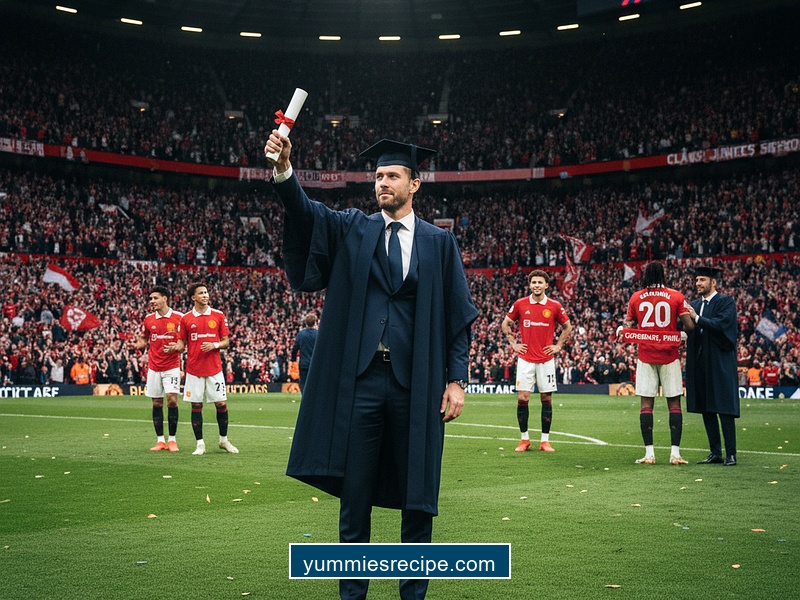
The transition from the chaotic geometry of the football pitch to the structured environment of the PFA Business School represents a shift in cognitive application rather than a change in fundamental ability. Phil Jones, Ilkay Gündogan, and their cohort illustrate that high-level tactical execution requires the same analytical processing power used in executive management. We analyze how the spatial intelligence defined their playing careers and now underpins their post-career evolution.
| Graduate | Tactical Archetype | Key Metric (Peak) | Cognitive Transfer |
|---|---|---|---|
| Phil Jones | Defensive Utility / Destroyer | 2.8 Interceptions/90 (2011/12) | Risk Mitigation & Crisis Management |
| Ilkay Gündogan | Raumdeuter / Deep Playmaker | 94% Pass Accuracy (Final Third) | Resource Allocation & Strategic Planning |
| Tim Krul | Sweeper Keeper / Specialist | Penalty Save % (Above Avg) | Data Analysis & High-Pressure Decision Making |
| Danny Simpson | Low-Block Fullback | 4.1 Clearances/90 (2015/16) | Structural Integrity & Defensive Organization |
Why The Numbers Matter
The raw data presented above serves as a blueprint for the modern footballer's cerebral capacity. When we strip away the narrative of "retirement" and view this through a tactical lens, we see players who operated as on-field processors. Phil Jones’ peak interception rate of 2.8 per 90 minutes during his early Manchester United tenure suggests a player with elite anticipatory skills. Interceptions differ from tackles; tackles are reactive physical events, whereas interceptions are proactive cognitive events. They require the defender to calculate the vector of the ball and the velocity of the opponent before the action occurs. This is purely analytical.
Similarly, Ilkay Gündogan’s presence in this graduating class reinforces the link between tactical mastery and business acumen. His ability to maintain high pass completion rates in the final third—the most congested area of the pitch—demonstrates an ability to find order in chaos. This "graduation" is merely the formalization of skills they honed in the crucible of the Premier League.
The Phil Jones Utility Function: A Tactical Breakdown
To understand Phil Jones' suitability for the strategic demands of the business world, we must re-examine his role under Sir Alex Ferguson, particularly the 2013 Champions League tie against Real Madrid. Tactically, this remains one of the most sophisticated defensive deployments of the last decade. Ferguson utilized Jones not as a center-back, but as a specific man-marker in the defensive midfield strata, tasked with nullifying Cristiano Ronaldo.
The heat maps from that era display Jones occupying a hybrid zone. He did not sit in a traditional pivot. Instead, his positioning data shows a reactive cluster that mirrored the opponent's playmaker. This required immense discipline. In a standard 4-4-2 or 4-2-3-1, the central defensive midfielder (CDM) protects the zone in front of the center-backs. Jones, however, often operated with a "seek and destroy" instruction set.
"The tactical versatility to switch between a right-sided center-back in a back three and a defensive midfielder in a double pivot indicates a player who understands the entire systematic architecture, not just his own individual role."
This versatility often worked against his public perception, yet it highlights his tactical IQ. Moving from the backline to the midfield requires an adjustment in "scanning frequency." A center-back scans 180 degrees; a midfielder must scan 360 degrees. Jones managed this transition repeatedly. His graduation signals a move to a role where that 360-degree view is mandatory: organizational management.
Gündogan and Spatial Engineering
While Jones represents the defensive, destructive side of tactics, Ilkay Gündogan represents the constructive. His inclusion in this PFA cohort brings a level of cerebral sophistication that defined Manchester City’s treble-winning campaign. Analyzing Gündogan’s role in Pep Guardiola’s 3-2-5 possession structure reveals a masterclass in "Half-Space" exploitation.
Gündogan rarely sprinted; he arrived. His late runs into the box utilized "blind-side movement," positioning himself just outside the peripheral vision of the opposing center-backs. This is a data-driven concept. Tracking data shows Gündogan often decelerated while others accelerated, creating separation through tempo manipulation rather than raw speed.
In a business context, this translates to market timing. The ability to read the flow of a game—knowing when to recycle possession (consolidation) and when to break the line (market entry)—is the exact skill set nurtured in business school curricula. Gündogan played the game like a grandmaster moving pieces; his transition to off-field strategy is a linear progression.
Systemic Rigidity: The Simpson Case Study
Danny Simpson, another graduate, offers a counterpoint to Gündogan’s fluidity. Simpson was a key component of Leicester City's 2015/16 title-winning 4-4-2. Claudio Ranieri’s system relied on extreme compactness. The distance between the forward line and the defensive line often compressed to less than 25 meters.
Simpson’s role as the right-back was distinct: he barely crossed the halfway line. His average position map from that season shows him tucking inside to form a temporary back three when Christian Fuchs, the left-back, advanced. This discipline allowed Riyad Mahrez complete freedom on the right wing. Simpson sacrificed personal offensive metrics for systemic stability.
This understanding of "Opportunity Cost"—sacrificing one asset to maximize another—is a fundamental economic principle. Simpson executed this weekly on the pitch. He understood that his restraint allowed the team's primary asset (Mahrez) to flourish without defensive liability.
If we view a corporate board as a formation, this graduating class fills the essential roles. Jones acts as the Compliance Officer (Risk Manager), identifying threats before they materialize. Gündogan is the Chief Strategy Officer, identifying gaps in the market (half-spaces) and timing the execution perfectly. Simpson operates as the COO, ensuring the operational structure remains rigid and efficient so the creatives can perform.
The Goalkeeper's Analytical Advantage
Tim Krul’s presence adds a final layer of tactical depth. Mo