
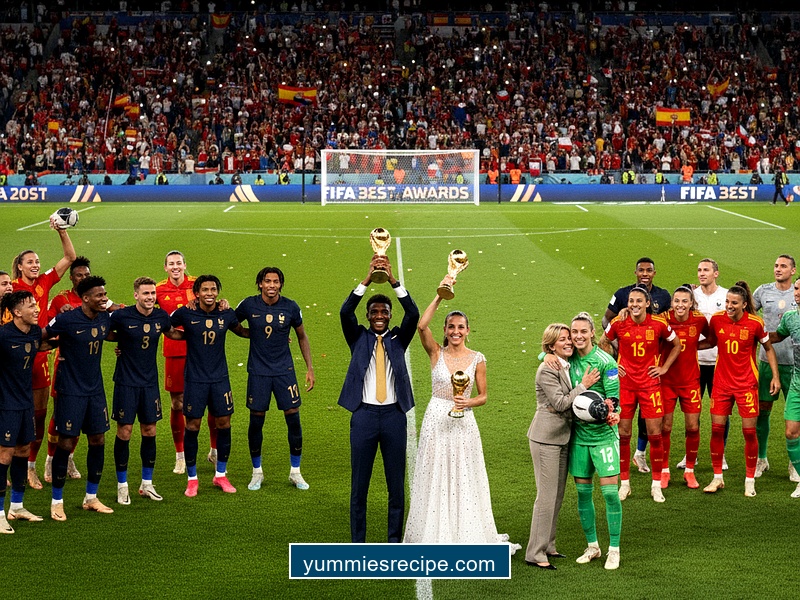
The glitter of Doha usually distracts from the cold mechanics of football’s power structures, but last night’s FIFA Best ceremony offered no such comfort to the established elite. When the lights dimmed and Ousmane Dembélé stood holding the trophy that Kylian Mbappé and Erling Haaland have spent their lives chasing, the tectonic plates of European football shifted. This was not merely a reward for Paris Saint-Germain’s maiden Champions League triumph; it was a warning shot. The era of the statistical guarantee is over, replaced by the age of the unpredictable.
For years, sporting directors built squads around reliability and output. Dembélé’s coronation scoffs at that logic. His victory signifies that the game has moved into a space where chaos reigns supreme. As we look toward the summer transfer window, the ripple effects of this night will be violent. Clubs will no longer hunt for the most efficient striker; they will desperately seek the disruptor who can break the rigid systems that have defined the last five years of tactical evolution.
The Death of the System Player
Consider the message sent to Manchester City or Arsenal this morning. Their meticulous, Pep Guardiola-inspired automatisms failed to stop PSG in Europe, and now the individual award confirms their obsolescence. Dembélé represents the triumph of instinct over instruction. For the managers of Europe’s elite, job security just became significantly more fragile. The boardrooms will ask difficult questions: "Why are we paying £100 million for system players when a maverick just won the world?"
"The market for 'difficult geniuses' just reopened. Dembélé’s success proves that tolerance for eccentricity pays out in silverware. Every scout in South America is now looking for the next dribbler, not the next poacher."
This shift impacts Gianluigi Donnarumma as well. Named Men’s Goalkeeper of the Year, the Italian’s recognition alongside Dembélé cements PSG as the new center of gravity. The Parisians have finally shed their reputation as a retirement home for fading stars. They are now the standard-bearers. Real Madrid, watching a former Barcelona player lift the top prize in a PSG shirt, faces an identity crisis. Their 'Galactico' strategy looks dated compared to PSG’s assembly of game-breakers. Expect Florentino Pérez to react aggressively in the market, likely inflating prices to obscene levels as he attempts to buy back relevance.
The Spanish Monopoly and England’s Last Line of Defense
If the men’s game faces a chaotic restructuring, the women’s game stares down the barrel of a monotony that could stifle competition for a generation. Aitana Bonmatí claiming her third consecutive FIFA Best award is not a celebration; it is a declaration of total dominance. With Barcelona reaching yet another Champions League final and Spain finishing as Euro 2025 runners-up, the infrastructure of Spanish football has created a monster.
| Metric | Spain (Liga F / National Team) | Rest of World |
|---|---|---|
| World XI Presence | 7 Players | 4 Players (England) |
| Top Individual Award | 3 Consecutive Wins | 0 Since 2022 |
| Tactical Trend | Technical Hegemony | Reactive / Counter-Attack |
Seven Spanish players in the World XI is a statistic that should terrify the FA and the NWSL. It signals that the pipeline in Iberia is producing world-class talent at a rate that other nations cannot match. The danger here is a closed loop where the best players stay in Spain, the best trophies stay in Spain, and the global interest wanes due to predictability.
However, Sarina Wiegman stands as the anomaly. Her award for Best Coach, alongside Hannah Hampton’s recognition and the inclusion of four Lionesses in the World XI, creates the only compelling narrative tension left in the sport. Wiegman is not just a coach anymore; she is the resistance. The implications for the FA are severe. They cannot afford to lose her. If Wiegman were to walk away—perhaps tempted by a federation with deeper pockets or the allure of the USWNT—European football would fall entirely under the Spanish shadow.
The Looming Market Correction
Looking forward, the awards in Doha will dictate the summer’s financial movements. The premium on Spanish midfielders will reach unsustainable levels. Clubs like Chelsea, Arsenal, and Lyon will be forced to overpay drastically to import even second-tier Spanish talent, simply to inject that specific DNA into their squads. We are approaching a bubble where nationality drives value more than form.
Conversely, Dembélé’s success creates a different market pressure. It devalues the 'project' signing. Clubs have spent five years investing in youth development and long-term integration. Dem