
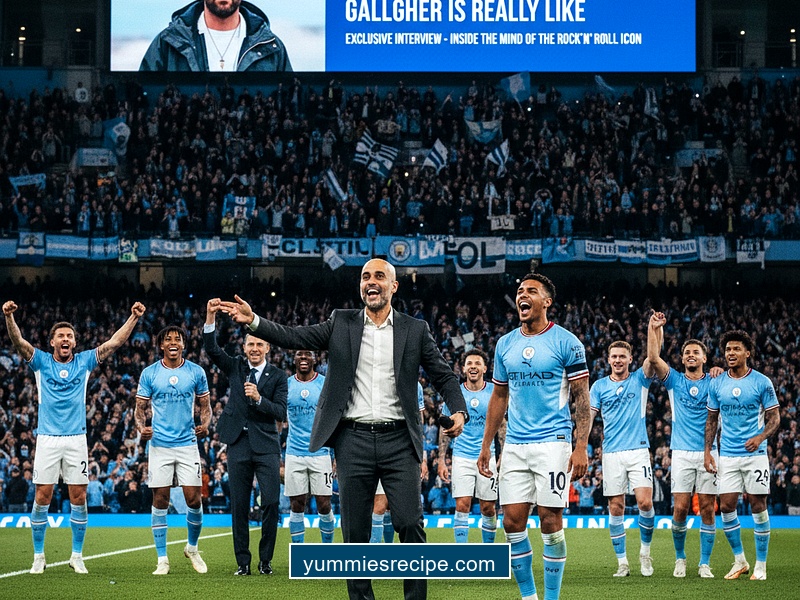
Pep Guardiola stands as the architect of modern football, a man defined by rigid control, tactical perfection, and an obsessive need for order. Yet, beneath the calm exterior of the Catalan tactician lies a tortured soul yearning for the unpolished grit of Manchester’s rock heritage to silence the noise in his own head. His recent, uncharacteristic embrace of Liam Gallagher reveals the desperate humanity hidden within the sport’s most demanding perfectionist.
| Attribute | Pep Guardiola (The Architect) | Liam Gallagher (The Voice) |
|---|---|---|
| Primary Weapon | Tactical Precision | Sonic Aggression |
| Leadership Style | Controlled Autocracy | Chaotic Charisma |
| Manchester Legacy | 6 Premier League Titles | Knebworth & Maine Road |
| Defining Trait | Obsessive Detail | Unfiltered Emotion |
Why The Contrast Matters
To understand the magnitude of Guardiola’s praise for Oasis, one must understand the psychological prison of his own making. The numbers above do not merely represent careers; they represent opposing forces of nature. Guardiola’s football is a symphony of geometry, where every pass is calculated, and every run is pre-determined. It is beautiful, but it is exhausting. The data highlights a man who lives in a world of high-stakes probability. By aligning himself with the chaotic energy of Gallagher, Guardiola isn't talking about music preferences; he is signaling a break in his own armor, a momentary lapse in discipline where the robot admits he needs to feel the rain.
The Burden of The Golden Cage
Pep Guardiola wanders the sidelines of the Etihad Stadium like a man possessed, a figure often trapped between genius and madness. For nearly a decade, he has transformed Manchester City into a winning machine, a juggernaut that devours records and crushes opposition dreams with clinical detachment. But this relentless pursuit of perfection exacts a heavy toll. To be Guardiola is to live in a state of perpetual dissatisfaction. Even in victory, he sees the misplaced pass; in triumph, he agonizes over the loss of control.
This is the tragedy of the visionary. He builds utopias on grass, yet he cannot inhabit them. He must always stand on the edge, watching, correcting, and worrying. The world sees the trophies, the trebles, and the accolades, but they rarely see the isolation of the innovator. He arrived in Manchester as an outsider, a man of Catalan sunshine and sophistication dropped into the industrial gray of Northern England. Critics whispered that his style was too fragile for the Premier League, too artistic for the mud and the tackles.
He proved them wrong, but in doing so, he risked becoming a caricature of himself—a cold, unfeeling algorithm in a cardigan. The narrative of his career threatened to become one of sterile dominance. He needed an anchor to the reality of the city he now calls home. He needed something that wasn't calculated, something that screamed rather than whispered.
Enter The Swagger: A Meeting of Minds
The news that Pep Guardiola recently spent time with Liam Gallagher shakes the foundations of his public persona. Here we have the ultimate disciplinarian breaking bread with the ultimate iconoclast. Gallagher, the swaggering frontman of Oasis, represents everything Guardiola suppresses on the pitch: disorder, arrogance, and glorious imperfection. Yet, Guardiola did not dismiss him. Instead, he revered him.
"He praises the band as 'the best rock band in the last 50 years.' It is not just a compliment; it is a confession of envy for the freedom they possess."
When Guardiola looks at Liam Gallagher, he sees a reflection of the raw passion that fuels football, stripping away the tactics and the boardrooms. It is a moment of redemption for Guardiola’s image. It humanizes him. It suggests that late at night, when the game tapes are off and the stadium lights are dim, Pep doesn't listen to classical concertos to soothe his mind. He listens to "Live Forever." He listens to the sound of Manchester screaming at the sky.
This connection bridges the gap between the foreign manager and the local soul. For years, there was a distance between the perfection of the Etihad and the grit of the local pubs. By acknowledging the cultural supremacy of Oasis, Guardiola effectively kneels before the altar of Manchester culture. He admits that while he can conquer the league, he cannot conquer the spirit of the city—he can only join it.
The Salvation of The Lonely King
Why does this matter in the grand arc of Guardiola’s career? Because every hero needs a flaw, and every god needs to bleed. Guardiola’s downfall, if it ever comes, will be his own intensity—the burnout that claimed him at Barcelona and the exhaustion that shadowed him at Bayern Munich. He consumes himself to light the way for others. This interaction with the Gallagher brother offers a glimpse of a potential escape route.
Pep's endorsement of Oasis is a tactical masterstroke in public relations, but an even greater victory for his mental longevity. It proves he is capable of stepping outside the 'football bubble.' Embracing the chaos of rock and roll might be the only thing keeping his tactical obsession from consuming him entirely.
There is a tragic beauty in imagining Guardiola, a man who screams at players for being t