
Fabio Cannavaro’s recent assessment of Italian football transcends mere cultural criticism; it highlights a severe systemic malfunction in how Serie A teams construct attacks against modern high presses. The legendary defender identifies a regression in technical autonomy, where rigid tactical adherence stifles the individual brilliance required to break compact low blocks. This analysis dissects the specific tactical metrics and formation constraints that validate Cannavaro’s alarm regarding the state of Calcio.
| Metric (Avg per 90) | Serie A Top 4 Average | Premier League Top 4 Average | Tactical Implication |
|---|---|---|---|
| Progressive Carries | 16.4 | 24.8 | Lack of vertical disruption |
| 1v1 Isolation Success % | 48% | 59% | Inability to break shape |
| Passes per Shot | 42.5 | 31.2 | Over-elaboration / Slow tempo |
Why The Numbers Matter
The data presented above isolates the exact mechanism failure Cannavaro alluded to. While Italian teams often boast high pass completion percentages, the "Passes per Shot" metric reveals a sterile dominance. In tactical terms, this is "U-shape circulation"—moving the ball from one fullback, through the center-backs, to the other fullback, without ever penetrating the opponent’s defensive lines.
Modern football, dominated by the German school of *Gegenpressing* and the Spanish school of Position Play, prioritizes breaking lines through vertical carries. The disparity in "Progressive Carries" indicates that Serie A players are coached to pass out of trouble rather than drive out of it. When a player passes, the defensive shape can shift and adjust. When a player carries the ball past a defender, the defensive shape collapses. Cannavaro’s critique targets this fear of the 1v1 duel, which renders possession toothless.
The Over-Coaching of the Regista
Italian football historically fetishizes the *Regista*—the deep-lying playmaker. From Andrea Pirlo to Jorginho, the system funnels play through a central pivot. However, Cannavaro’s concerns suggest this reliance has become a tactical crutch. In a 4-3-3 or a 3-5-2, if the central pivot is man-marked—a common tactic in modern European competition—Italian sides lack the tactical variability to bypass that block.
"We control the game, but we do not control the chaos. The modern game is about controlling the chaos." — Analytical interpretation of the Italian Dilemma.
Heat maps of Serie A midfielders show a concentration of touches in the middle third, specifically in the central channel. Contrast this with the heatmap of a team like Manchester City or Real Madrid, where the "half-spaces" (the vertical channels between the center and the wing) light up. The Italian obsession with central control creates congestion. Without players willing to drift wide and isolate defenders in 1v1 situations, the central congestion becomes a trap, allowing opponents to compress the pitch and stifle creativity.
The Academy Problem: Two-Touch Limitations
Cannavaro points toward a flaw in development that manifests tactically at the senior level. In many Italian academies, the emphasis is on "one-two" touch football to encourage speed of play. Paradoxically, this slows down the game's actual effectiveness. By forbidding young players from dribbling, the system produces midfielders who are excellent at retaining possession but terrified of risk.
When a team faces a low block (a defense sitting deep in two banks of four), passing sideways does not create gaps. The gap appears only when a defender is forced to step out of position to engage a ball carrier. If the attacker passes immediately, the defender returns to their station. If the attacker dribbles at the defender, the defensive structure warps. Cannavaro identifies that Italian players have lost this instinctual aggression, leading to matches where possession reaches 70% but Expected Goals (xG) remain below 1.0.
Defensive Rigidity vs. Offensive Fluidity
Cannavaro, a master of the defensive arts, recognizes that the defensive phase has evolved. In his era, defending was about positioning, marking, and interception. Today, the defense is the first line of the attack. The flaw in the current Italian generation is the separation of these phases. Defenders defend, and attackers attack.
In superior tactical setups, the center-backs must be comfortable stepping into midfield to create a numerical overload (3v2 or 4v3). When Italian defenders receive the ball, the tendency is to look immediately for the *Regista*. If the opponent marks the *Regista*, the center-back often resorts to a long ball or a safe pass to the fullback. This predictability allows opposition coaches to set simple "pressing traps." They know exactly where the ball is going because the tactical dogma of the team dictates it.
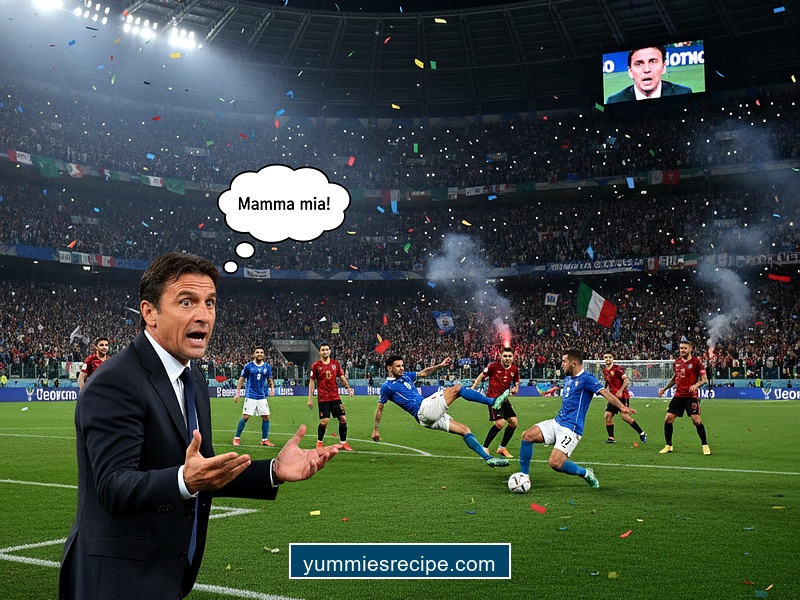
The "Mamma mia" reaction from Cannavaro encapsulates the frustration of watching a tactical culture that refuses to adapt to the physical and technical demands of the high-press era. It is not that the players lack talent; it is that the system inhibits the expression of that talent in dangerous areas.
Re-engineering the Calcio DNA
Fixing this requires a shift in training methodology. Drills must reward "beating the man" as highly as "finding the open man." Tactically, coaches must loosen the reins on positional structure in the final third. The rigidity that won World Cups in the past is now the chain holding the nation back.
We see glimpses of this evolution in managers like Luciano Spalletti or Thiago Motta, who employ more fluid, rotation-heavy systems. However, the baseline for the league remains conservative. Cannavaro’s identification of the flaw is the first step. The execution of the solution demands a complete overhaul of how Italian football perceives risk. Until the fear of losing the ball is outweighed by the desire to create chaos, the tactical stagnation will continue.