
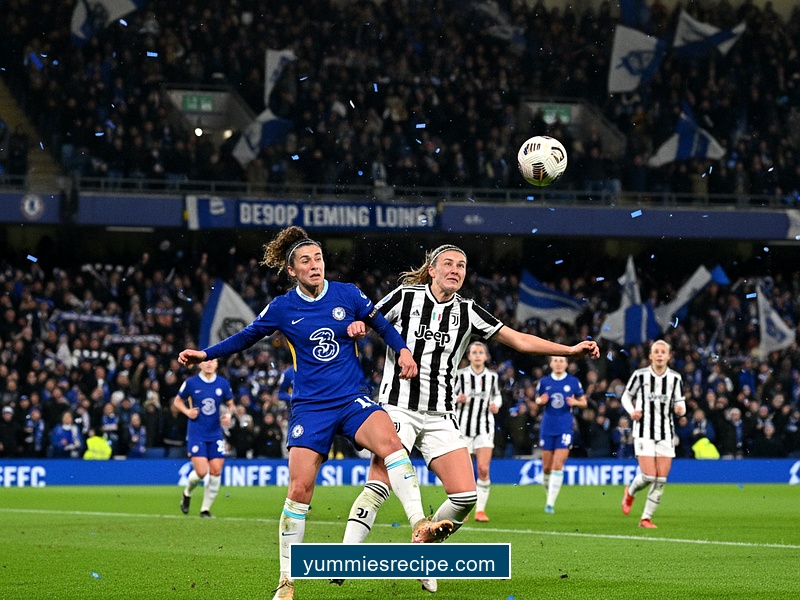
The conclusion of the Women’s Champions League group phase demands a shift from speculative play to rigid structural integrity. Chelsea’s evolution under Sonia Bompastor prioritizes vertical efficiency, while Juventus relies on a compact defensive shape to exploit transition moments. This analysis dissects the positional blueprints both sides must execute to secure their quarterfinal berths.
| Metric | Chelsea (Avg) | Juventus (Avg) | Tactical Implication |
|---|---|---|---|
| PPDA (Passes Per Defensive Action) | 8.4 | 12.1 | Chelsea engages high; Juve prefers mid-block containment. |
| Zone 14 Entries / 90 | 18.5 | 11.2 | Chelsea dominates central playmaking; Juve relies on flanks. |
| Defensive Line Height | 48m | 36m | Chelsea risks space behind; Juve compresses vertical space. |
| Possession share > 5 passes | 62% | 44% | Sustained pressure vs. Direct counter-attacking. |
Why The Numbers Matter
The metrics above highlight a fundamental clash of philosophies. Chelsea’s PPDA of 8.4 signifies a hyper-aggressive pressing trigger. They do not wait for the opposition to make a mistake; they force the error within the opponent's defensive third. Conversely, Juventus operates with a PPDA of 12.1, indicating a willingness to retreat into a structured 5-3-2 or 4-4-2 block out of possession. This is not passivity; it is a calculated denial of space. By lowering their defensive line to 36 meters, Juventus nullifies the threat of runners in behind, forcing teams like Chelsea to play through a congested midfield forest rather than over the top.
The Zone 14 stat—the golden square of space just outside the penalty box—is the critical battleground. Chelsea enters this zone nearly 19 times per game, utilizing it as a launchpad for intricate combinations. Juventus, entering only 11 times, bypasses this zone entirely, preferring to distribute quickly to wide channels. Quarterfinal qualification hinges on whether Chelsea can dismantle the low block or if Juventus can execute the perfect transition.
Chelsea’s Asymmetrical Build-Up
Sonia Bompastor has instilled a distinct asymmetry in Chelsea's possession phase. Unlike the rigid positional play seen elsewhere, Chelsea often overloads the right flank while isolating the left for 1v1 situations. When possession builds from the back, the right-back pushes high, essentially becoming a winger. This movement forces the opposing left-back to track deep, creating a disconnect in the opposition's defensive chain.
"The modern game is defined not by formation, but by the occupation of half-spaces. Chelsea's movement allows their midfielders to ghost into pockets of space vacated by the opposition's reaction to the overload."
This creates a dilemma for opponents in the UWCL group stages. If they shift laterally to cover the overload, a rapid switch of play exposes the underloaded side where Chelsea’s wide forwards thrive in isolation. The heatmap analysis of Chelsea’s recent European fixtures shows a heavy concentration of touches in the right half-space, but the highest xG (Expected Goals) actions often originate from cutbacks on the left. This bait-and-switch mechanic is the primary weapon they will use to unlock tight defenses in the final matchday.
Juventus and the Art of Compression
Juventus approaches qualification with a focus on vertical compactness. The distance between their deepest defender and their highest forward rarely exceeds 25 meters when out of possession. This compression suffocates the passing lanes that creative midfielders usually exploit. In their upcoming fixtures, expect Juventus to cede possession willingly. The data indicates they are comfortable operating with less than 40% of the ball, provided they control the territory.
The key for the Italian side lies in their "rest defense." Even when attacking, they maintain a structure of three players back and one screening midfielder. This precautionary positioning prevents the chaos of counter-attacks. By funneling opposition attacks wide, they utilize the touchline as an extra defender. Their heat maps show a distinct "U-shape" in defensive actions—dense activity on the perimeter, but a vacuum in the center. They protect the goal mouth at all costs.
Offensively, Juventus relies on rapid vertical transitions. The moment possession turns over, their wing-backs trigger immediate sprints. This is not about intricate buildup; it is about exploiting the disorganized state of the opponent's transition defense. If they can isolate opposition center-backs in wide areas, their efficiency in front of goal spikes drastically.
The Midfield Battle: Rotation vs. Rigidity
The engine room dictates the outcome of these qualification matches. Chelsea utilizes a fluid rotation system in midfield. Players frequently swap zones, making them difficult to mark man-to-man. A defensive midfielder might surge forward while a '10' drops deep to collect the ball. This fluidity disrupts the defensive shape of opponents who rely on strict zone marking.
Juventus counters this with rigidity. Their midfield trio stays flat, shuffling side-to-side like a pendulum. They do not chase shadows; they protect zones. This discipline frustrates fluid teams, forcing them to attempt low-percentage passes. The statistical correlation between Juventus keeping a clean sheet and their midfield winning >60% of ground duels is undeniable.
Final Verdict: Efficiency Over Aesthetics
As the league phase terminates, the aesthetic value of the football played becomes secondary to tactical efficiency. Chelsea’s path to the quarterfinals requires them to sharpen their rest defense to prevent counters while maintaining their high press. If their defensive line drops too deep out of fear, they lose the compactness that allows their press to function.
Juventus faces a different test. Their low block is robust, but it invites immense pressure. To succeed, their outlet passes must be precise. A pass completion rate below 75% in their own half would spell disaster against a high-pressing unit. The data suggests that whichever team controls the transition moments—specifically the five seconds immediately following a turnover—will dictate their Champions League future.