
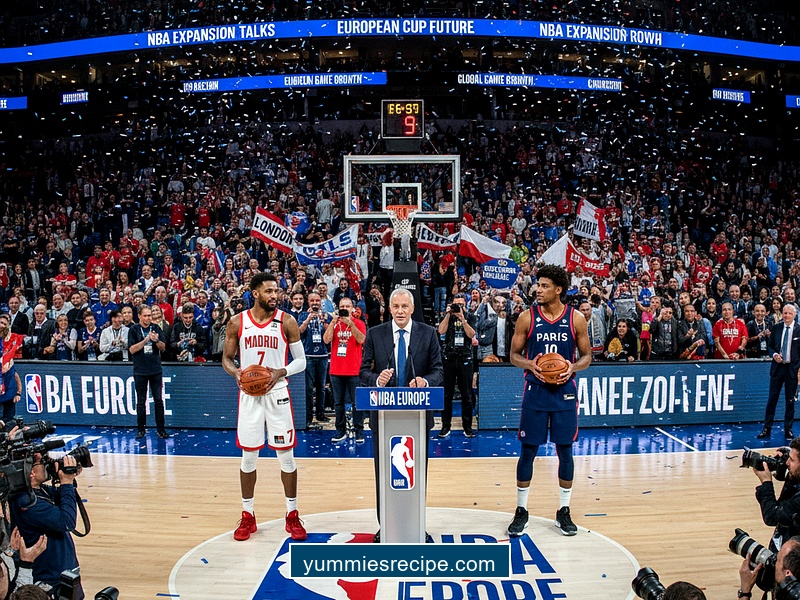
Commissioner Adam Silver is executing a complex offensive set designed to maximize leverage by delaying the expansion trigger until the 2026 season. This calculated clock management allows the league’s new media rights architecture to solidify before introducing high-variance assets like Las Vegas and Seattle into the rotation. We break down the structural geometry of this decision, analyzing how expanding to 32 teams alters the competitive balance and financial spacing of the league.
| Target Market | Tactical Role | Strategic Gravity | Projected Entry |
|---|---|---|---|
| Seattle | The Legacy Anchor | High (Historical IP + Tech Wealth) | 2027-28 Season |
| Las Vegas | The Entertainment Hub | Maximum (Gambling + Events) | 2027-28 Season |
| Europe | The Satellite Development | Medium (Talent Pipeline) | Indefinite / Exhibition |
Why The Numbers Matter
In tactical analysis, timing is the differentiator between a successful cut to the basket and a turnover. Adam Silver’s declaration that an expansion decision will not occur until 2026 is a masterclass in pace control. By waiting, the NBA Front Office ensures that the newly signed $76 billion media rights deal acts as the primary screen, clearing the lane for exorbitant expansion fees.
The arithmetic here dictates the formation. Bringing in two new partners divides the revenue pie by 32 rather than 30. However, if the expansion fees (likely exceeding $4-5 billion per franchise) are distributed efficiently, they offset the dilution of annual revenue. Silver is analyzing the heat maps of global capital; he knows that the valuation of sports franchises is currently spiking. Holding the ball until 2026 forces potential ownership groups in Seattle and Las Vegas to bid against the rising salary cap of entry, maximizing the return for the incumbent 30 owners.
The Spacing: Seattle and Las Vegas
Geographically and financially, the addition of Seattle and Las Vegas solves a "floor balance" issue for the Western Conference. Much like a modern offense requires shooters in the corners to open up the paint, the NBA requires market density in the Pacific Northwest and the Southwest to maximize broadcast efficiency.
Seattle represents the traditional "big man" in this formation. It brings historical weight, a high floor of fan engagement, and corporate corporate backing from the tech sector. The analytics on Seattle show a market that was inefficiently removed in 2008; reinstating it restores the structural integrity of the league’s northwest quadrant.
"It’s not just about adding teams; it’s about fixing the geometry of the conference map to reduce travel fatigue and optimize prime-time broadcast slots."
Las Vegas plays the role of the modern "unicorn" wing. It offers high variance but massive upside. The integration of gambling revenue and the NBA Cup (which has found a natural home in Vegas) creates a symbiotic relationship. Tactically, Vegas acts as a neutral site hub that can pivot between regular season host and tournament venue, offering the league a versatile asset that traditional markets cannot replicate. Silver’s focus on these two cities indicates a desire to lock down the Western flank before attempting any aggressive moves across the Atlantic.
Talent Dilution and Roster Construction
The most significant tactical concern with expansion is the dilution of quality. Adding two teams requires finding 30 to 34 NBA-caliber players who are currently outside the league or buried on benches. When we look at the "replacement level" player stats (VORP or PER), there is a legitimate concern that expanding to 32 teams lowers the overall efficiency of the product.
Silver’s delay to 2026 also allows the current collective bargaining agreement (CBA) to mature. The new "second apron" tax rules are designed to break up super-teams, redistributing star talent across more rosters. By the time Seattle and Vegas tip-off, the league’s talent distribution should be flatter, allowing these expansion franchises to compete earlier rather than languishing in the lottery for a decade. This is roster engineering at a macro level.
Defending the Perimeter: The European Strategy
Silver addressed the European market, but his tone suggests a zone defense rather than a man-to-man press. The logistics of a trans-Atlantic division remain a tactical nightmare regarding travel load management and recovery times. You cannot simply drop a franchise in London or Paris without destroying the circadian rhythms of the visiting Western Conference teams.
Instead, the data points toward a "Champions League" style model or increased exhibition density. The NBA realizes that while its player base is increasingly European (Jokic, Doncic, Giannis, Wembanyama), its infrastructure must remain North American to preserve the quality of the regular season product. The tactic here is brand extraction without logistical commitment. They will harvest the talent and the broadcast rights, but keep the physical franchises within the US borders to maintain the tempo of the 82-game schedule.
The Cup as a Pace-Pusher
Finally, Silver touched on the future of the NBA Cup. Tactically, this tournament solves the "mid-season slump" usage rate issue. November and December historically show dips in player intensity and viewer engagement. The Cup injects playoff-level possession efficiency into the first quarter of the season.
By validating the Cup’s future alongside expansion talk, Silver is signaling that the league format itself is fluid. The 2026 expansion isn't just about adding teams; it's about potentially restructuring the schedule, the divisions, and the playoff bracket. Seattle and Vegas provide the numbers needed to potentially move to four divisions of eight teams, simplifying the travel matrix and balancing the schedule.
The 2026 decision date is the pivot point. Adam Silver is currently holding the ball at the top of the key, letting the clock run down, waiting for the defense to shift before he makes the pass to Seattle and Las Vegas for the open shot.