
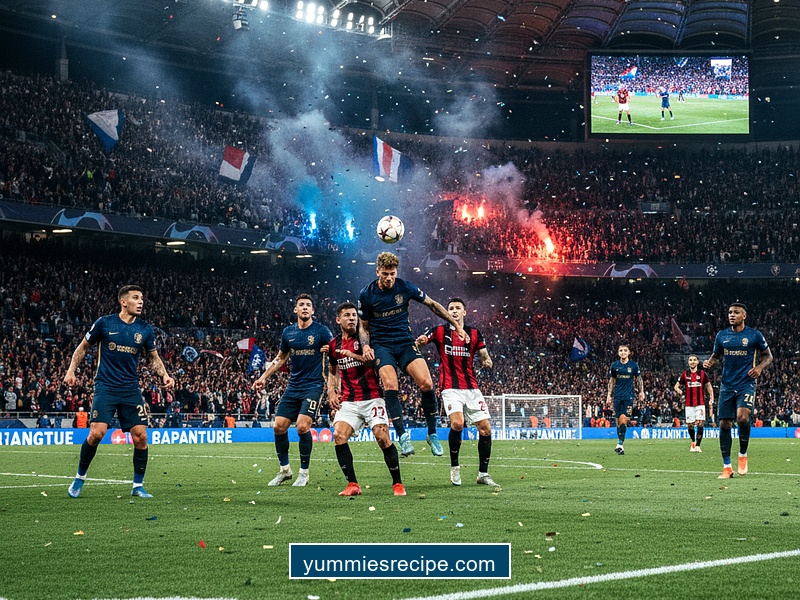
Matchday Six dismantled the notion of rigid positional play, rewarding fluid systems that maximized half-space exploitation over traditional width. The standout performers of the week did not merely accumulate statistics; they executed specific structural roles that destabilized opposition low blocks. We deconstruct the geometric precision, pressing triggers, and spatial dominance that earned these players their place among the tactical elite.
| Tactical Role | Key Metric | Structural Impact |
|---|---|---|
| Inverted Winger | 12 Progressive Carries | Collapses defensive shape to open Zone 14. |
| Ball-Playing CB | 94% Pass Completion (opp. half) | Bypasses first press line; acts as deep playmaker. |
| The 'Free' 8 | 4 Key Passes via Half-Spaces | Disrupts man-marking through vertical movement. |
Why The Numbers Matter
Traditional match reports often obsess over the final touch—the shot that hits the net or the fingertip save. However, the data emerging from the Champions League Team of the Week selection points to a deeper trend: the weaponization of space *before* the assist. The key metric defining this week's elite is not goals scored, but "packing"—the number of defenders bypassed with a single vertical action. The players selected for this Matchday didn't just win their duels; they rendered opponents obsolete by effectively removing them from the defensive equation through positioning and ball manipulation.
The correlation between high-pressing efficiency and chance creation was stark. Teams that dominated the Team of the Week selection often utilized a PPDA (Passes Allowed Per Defensive Action) of under 8.0, suffocating opponents in their own buildup phase. This suggests that the "best" players were not isolated geniuses, but rather the most efficient cogs in a high-functioning, high-pressing machine.
The Asymmetrical Overload
A distinct tactical pattern visible in the forward line selection involves asymmetry. Modern elite sides rarely attack with equal width on both flanks. This week, we observed a heavy reliance on overloading the left half-space to isolate the right winger 1v1 against the fullback. The selected forwards demonstrated an acute understanding of "gravity"—drawing multiple defenders toward the ball carrier to generate artificial space on the weak side.
"The modern winger is no longer defined by chalk on their boots, but by their ability to act as a second number 10 when possession is consolidated in the final third."
Heat maps from the standout wingers reveal a distinct lack of activity in the corner flag areas. Instead, activity concentrates just outside the penalty box, specifically in the channels between the opposition center-back and full-back. By occupying this corridor, the attacker forces the defensive line into a decision crisis: does the center-back step out and leave a gap behind, or do they hold position and allow a free shot? The Team of the Week forwards consistently exploited this hesitation.
The Pivot as a Deep Quarterback
Midfield dominance in Matchday 6 was not characterized by box-to-box athleticism, but by resistance to pressing traps. The elite midfielders selected displayed an uncanny ability to receive the ball facing their own goal, scan blindly, and execute a pivot that bypassed the opponent's first line of pressure. This technical security allows the entire team to advance 15 yards up the pitch, transitioning from a defensive rest shape to an attacking structure instantly.
Pure defensive midfielders who offer zero progression are vanishing from the Champions League elite. The data shows that the most effective '6s' this week completed more passes into the final third than successful tackles. Positioning and interception lanes have replaced the need for physical tackling, allowing for quicker transitions.
The distribution charts of these midfielders show a preference for diagonal switches. By rapidly shifting the angle of attack, they force the opposition block to shift laterally. It is during this lateral shift that gaps appear. The "quarterback" role at the base of midfield requires the vision to spot these momentary disconnects in the opponent's defensive chain and the technical execution to exploit them immediately.
Defensive Line: Compressing the Pitch
The defenders making the Team of the Week were not necessarily those who spent 90 minutes heading balls out of their own box. Instead, they were the architects of the "Rest Defense." This concept refers to the structure a team maintains while they are attacking, preparing for the moment possession is lost. The selected defenders maintained an aggressively high line, often stationed near the halfway line, compressing the playable area of the pitch.
By engaging attackers early—often before the opponent can turn—these defenders suffocate counter-attacks at the source. This requires elite anticipation and speed, rather than traditional strength. The metrics highlight a high number of "recovery runs" and interceptions in the middle third of the pitch. This proactive defending prevents the team from retreating into a low block, allowing sustained pressure and ball recycling.
Furthermore, the role of the goalkeeper as a pseudo-center-back cannot be ignored. The elite goalkeepers this week operated well outside their penalty area during build-up play, effectively creating an 11v10 overload against the opposition's press. This numerical superiority at the back ensures that there is always a free man available to receive the ball, breaking the opponent's pressing scheme and facilitating clean progression through the thirds.
Ultimately, the Matchday 6 Team of the Week serves as a blueprint for modern European success. It prioritizes cognitive speed over physical speed and structural discipline over individual flair. The tactical trends observed—inverted width, resistance to pressing, and aggressive rest defense—are not merely stylistic choices; they are the mathematical requirements for dominating the elite level of the sport.