
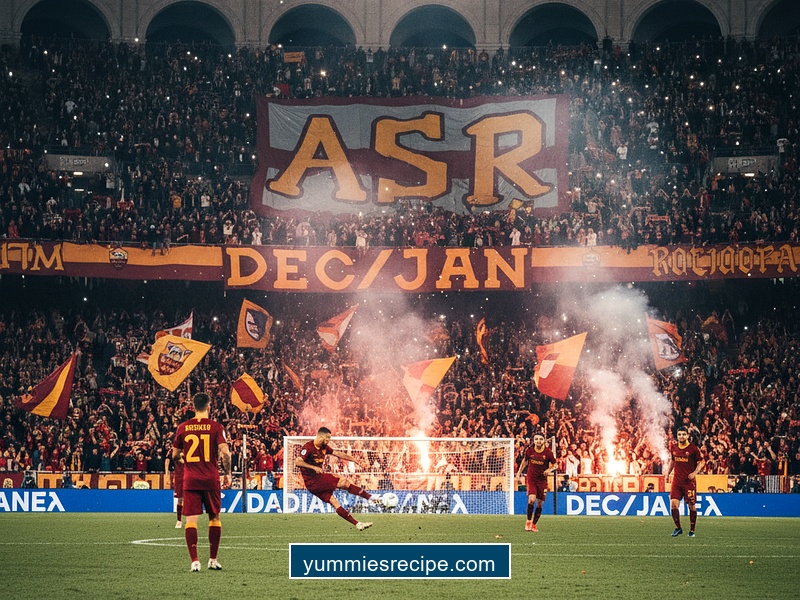
Fixture congestion in modern football is rarely just a test of fitness; it is a stern examination of tactical scalability. The upcoming December and January slate for AS Roma represents more than a logistical headache of short turnarounds. It serves as the definitive stress test for the tactical overhaul currently underway at Trigoria. When matches arrive every three days, the luxury of intricate training ground patterns evaporates. What remains is defensive geometry and instinct.
This analysis ignores the narrative of "tired legs" and instead scrutinizes the structural adaptations Claudio Ranieri and the coaching staff must deploy to survive this period. The data suggests a distinct shift is already happening: a move away from chaotic man-to-man marking toward a rigid, zonal compactness designed to maximize points while minimizing energy expenditure.
Abandoning the High Press: A Necessity, Not a Choice
The most glaring tactical adjustment for this winter block involves the PPDA (Passes Allowed Per Defensive Action) metric. Earlier in the season, under previous management, Roma frequently engaged opponents high up the pitch, often leaving significant gaps in transition. That approach is statistically unsustainable during a two-month period where recovery takes precedence over conditioning.
By analyzing the average player positions in recent outings, we observe the defensive line dropping five to seven meters deeper. This is not a retreat out of fear, but a calculated compression of space. By lowering the block, Roma reduces the surface area they must defend. Instead of covering 60 meters of vertical space, the team now operates within a tight 35-meter band. This compactness forces opponents to play laterally, circling the block rather than penetrating it.
"In congested schedules, the team that controls the space without the ball often outperforms the team that controls the ball without the space."
This shift impacts the wing-backs—Angelino and Celik—most profoundly. In a high-press system, they act as auxiliary wingers. In this winter preservation mode, heat maps show them tucking inside to form a narrow back four or five. This prevents the opposition from exploiting the half-spaces, a critical vulnerability Roma suffered from earlier in the campaign.
The Double Pivot: Screening vs. Progressing
The midfield engine room requires specific calibration during heavy fixture lists. The tandem of Manu Koné and either Bryan Cristante or Leandro Paredes has undergone a functional role change. Previously, the mandate was box-to-box coverage. The current instruction is strictly positional screening.
We can visualize this through a hypothetical passing network analysis. During standard weeks, pass maps show strong connections between the pivot and the final third. During this congested slate, the strongest connections inevitably shift laterally between the two midfielders and backward to the center-backs.
| Metric | Standard Schedule Role | Congested Winter Role |
|---|---|---|
| Avg. Distance Covered | 11.5 km (High intensity) | 10.2 km (Positional discipline) |
| Primary Zone | Zones 8, 11, 14 (Attacking) | Zones 5, 6, 8 (Defensive Screen) |
| Defensive Trigger | Press on bad touch | Block passing lanes |
This adjustment minimizes the risk of the midfield being bypassed by a single vertical pass. By keeping the pivot flat and close to the defensive line—often referred to as a "6+6" structure—Roma creates a cage around the edge of their own penalty area. This setup invites crosses, which plays to the strengths of aerial dominant defenders like Gianluca Mancini and Evan Ndicka, while neutralizing intricate through-balls.
The Dovbyk-Dybala Connection: Optimization over Volume
Offensively, the dense schedule forces an abandonment of sustained possession as a primary creative tool. Keeping the ball requires energy; countering requires precision. The tactical blueprint for December and January relies heavily on the interaction between Artem Dovbyk and Paulo Dybala, specifically in transition phases.
The mechanism is distinct: direct vertical play. Instead of building slowly through the thirds, the goalkeeper or center-backs look immediately for Dovbyk. The Ukrainian striker’s role transforms into that of a "wall player." His heat map barely registers in the box during build-up; he drops deep to contest the aerial ball or pin a defender.
Dybala, conversely, operates in the "shadow" of this contest. He does not press. Tactical instructions likely absolve him of defensive duties beyond occupying a passing lane. This preservation of energy allows him to explode into the space vacated by the defender engaging Dovbyk. This implies a lower quantity of chances created, but a significantly higher xG (Expected Goals) per shot due to the spatial advantage of attacking a disorganized defense in transition.
Strategic Utilization of Set Pieces
Finally, we must address the most efficient route to goal when open-play fluidity suffers due to fatigue: dead-ball situations. The busy slate essentially turns matches into battles of concentration. Roma’s height advantage is a tactical asset the coaching staff leverages aggressively.
The trend suggests an increase in creating "artificial transitions" via set pieces. Rather than aiming for direct headers, delivery targets the far post to head the ball back across the six-yard box—the "traffic area." This induces chaos. While aesthetically displeasing to purists, the statistical probability of a goal-mouth scramble leading to a shot is higher than attempting to pass through a settled low block on tired legs.
Navigating the December and January gauntlet requires pragmatism. Roma's shift to a compressed defensive block, a screening midfield pivot, and direct transition play signals a tactical maturity suited for the grind of Serie A. It is not about how beautiful the football looks; it is about how effectively the team controls the crucial spaces when physical reserves hit their limit.