
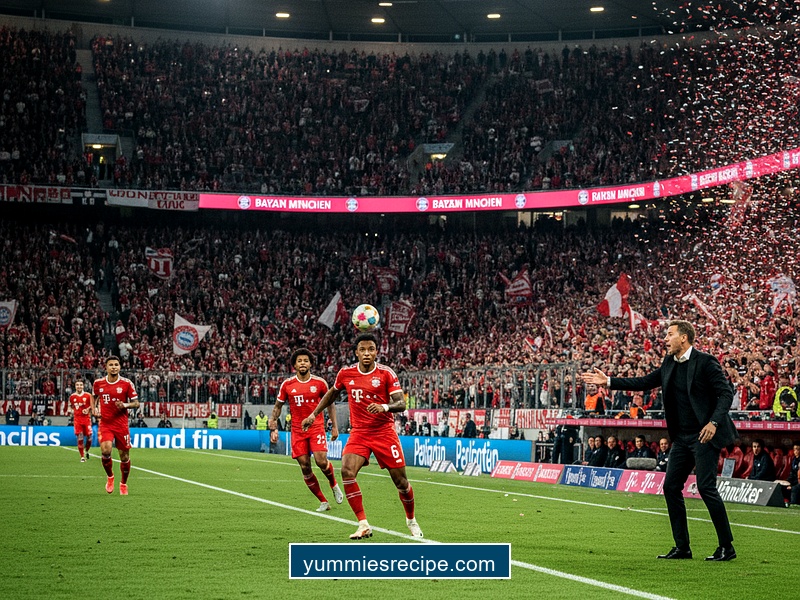
Vincent Kompany’s refusal to rotate heavily ahead of the winter break represents a fundamental philosophical wager on cognitive synchronization over physiological preservation. By prioritizing match rhythm, the Bayern manager acknowledges that his aggressive high-line system relies on split-second collective triggers that degrade faster through inactivity than through fatigue. This is not stubbornness; it is a calculation that tactical cohesion is the primary driver of defensive stability.
| Metric | Bayern (Current Form) | Bundesliga Avg | Tactical Implication |
|---|---|---|---|
| PPDA (Passes Per Defensive Action) | 8.4 | 12.1 | Extreme pressing intensity requiring constant rhythm. |
| Average Defensive Line Height | 48.2m | 39.5m | Risk of exposure necessitates neural sharpness. |
| Field Tilt (Possession in final 3rd) | 72% | 48% | Sustained pressure relies on aggressive rest defense. |
Why The Numbers Matter
The statistics above illustrate a team operating at the extremes of spatial compression. A PPDA of 8.4 indicates Bayern disrupts opponents almost immediately upon turnover. However, the most critical number is the defensive line height. Positioning a backline nearly 50 meters from goal creates a massive tract of space behind the defenders. Covering this space does not depend solely on the sprint speed of Dayot Upamecano or Kim Min-jae; it depends on the collective "offside trap" mechanics and the timing of the midfield press.
Kompany understands that this timing is neural, not muscular. If he rotates the squad significantly to prioritize "freshness," he risks disrupting the non-verbal communication required to hold that line. A difference of half a second in stepping up can result in a conceded goal. Therefore, the "work" he demands before the break is effectively calibration: keeping the defensive unit tightly wound to ensure the high-risk system functions without error.
The Architecture of Rest Defense
The concept of Restverteidigung (rest defense) sits at the core of Kompany’s reluctance to ease the workload. When Bayern attacks, they typically transition into a 2-3-5 or a 3-2-5 shape. The structure behind the ball—usually two center-backs and a pivot or inverted fullback—dictates whether an opponent can transition. This is the "control" element of the game.
Maintaining this shape requires relentless mental engagement. Players must constantly adjust their positioning relative to the ball, even when they are not involved in the active play. Analysis of Joshua Kimmich’s heat maps reveals a distinct clamping movement: he shifts laterally not to receive the ball, but to block passing lanes for the potential counter-attack.
"You cannot simulate the pressure of a transition moment in training. The geometric relationship between the number six and the center-backs is forged only in match scenarios."
If Kompany were to introduce rotation players into this delicate ecosystem, the distances between the "rest defense" unit would likely fluctuate. A gap of three meters between the pivot and the center-back creates a vertical passing lane for the opponent. By keeping the starting XI consistent, Kompany ensures that the spatial distances remain instinctive. The players know where their partners are without looking, allowing them to suffocate counter-attacks before they begin.
Verticality and the Pressing Trigger
Current form suggests Bayern is moving away from the slower, lateral possession of previous eras toward a vertical, direct style. This verticality increases the number of turnovers, which paradoxically increases the physical load. Every time Bayern attempts a risky through-ball to Kane or Musiala, there is a chance of losing possession, triggering an immediate sprint to counter-press.
This style demands anaerobic endurance—repeated high-intensity bursts. Physiological adaptation to this specific load takes months to build but weeks to lose. Kompany’s insistence on "work" implies he fears the de-conditioning effect of a break. The data supports this: teams that rotate heavily in December often see a drop in pressing intensity (PPDA rises) in January as players lose the "legs" for the specific stop-start nature of the high press.
Furthermore, the pressing triggers—the specific cues that tell the team to swarm the ball carrier—are highly specific to the personnel. Musiala presses differently than Müller; Olise presses differently than Sané. Mixing these profiles disrupts the wave of pressure. When the first line of the press fails due to a lack of cohesion, the midfield is exposed, and the high defensive line collapses. Kompany keeps the personnel static to keep the triggers consistent.
The Man-to-Man Risk in Wide Areas
A deeper look at Bayern’s defensive set-up reveals frequent man-to-man assignments in wide areas, particularly when the fullbacks push high. Alphonso Davies often operates as a winger in possession, leaving the left channel exposed. The defensive coverage relies on the near-side center-back stepping out aggressively into the wide channel.
This interaction—the center-back leaving the central corridor to cover the flank—is the most dangerous movement in football. It requires absolute trust that the defensive midfielder will drop into the vacated center-back slot. This rotation must happen in less than two seconds.
Kompany prioritizes form here because these defensive rotations are fragile. Introducing a player who is 5% slower to recognize the danger leaves the box undefended. The emphasis on work before the break serves to drill these rotations until they become subconscious reflexes. The manager is essentially hard-coding the defensive matrix into his players' minds so that the upcoming winter break does not erase the tactical programming.
Cognitive Load vs. Physical Load
Critics argue that ignoring freshness leads to muscle injuries. While true, Kompany weighs this against the "cognitive load" of the system. Bayern’s current setup is mentally exhausting. Players must constantly calculate space, angles, and pressing vectors.
By maintaining the starting XI, Kompany actually reduces the cognitive load on the individual. When players play together consistently, they stop thinking and start reacting. Anticipation replaces calculation. This reduction in mental fatigue allows the players to execute the physical demands more efficiently. A player who hesitates runs more; a player who anticipates runs less.
Ultimately, Kompany’s strategy highlights the evolution of modern management. It moves beyond simple rotation policies and engages with the neuro-tactical aspects of the game. He bets that a cohesive, rhythm-based unit will outperform a fresher, disjointed one. In the brutal geometry of the Bundesliga, where space is the ultimate currency, cohesion is the only way to solvency.