
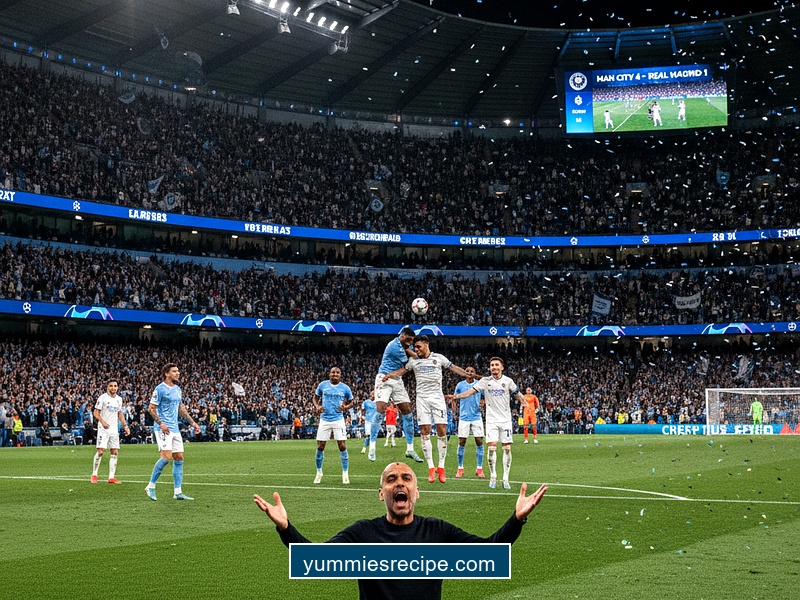
"We are close, yet we are far away. To beat Madrid is not enough. To hold the trophy requires a perfection we have not yet met."
The final whistle at the Santiago Bernabéu usually signals a release of pressure, a moment where the victors collapse in relief while the vanquished stare into the middle distance. Yet, when Manchester City overcame Real Madrid, the air did not smell of triumph. It smelled of unfinished business. Amidst the sweating bodies and the chaotic celebrations of the traveling support, one figure stood somewhat apart, his face flushed a deep, exertion-red, his chest heaving not just from physical toll, but from an emotional burden that seems to grow heavier with every season.
Kevin De Bruyne does not celebrate wins like other players. For him, a victory in the first leg, or a narrow escape against the aristocrats of Europe, is merely a stay of execution. Pep Guardiola’s post-match comments—stating that despite the win, the team remains "far away" from the title—might have dampened the mood for the fans, but for De Bruyne, it was simply a vocalization of his own internal monologue. He is the on-field avatar of Guardiola’s neurotic perfectionism, a genius trapped in a perpetual cycle of near-misses and almost-theres.
This is not a story about a football team. It is the story of a man who sees angles the rest of us cannot comprehend, yet finds the one trophy he covets most remaining stubbornly just out of frame. It is the tragedy of the modern playmaker: to be the best in the world, yet remain unfulfilled.
The Analysis: A Portrait of Brilliant Fragility
To understand the gravity of Guardiola's words—that they are "far away"—one must look at the career arc of his Belgian lieutenant. De Bruyne’s journey is Biblical in its oscillations between divinity and suffering. He possesses a right foot that functions like a surveyor’s laser, capable of bypassing three lines of defense with a single, nonchalant swipe. He sees the game in a top-down schematic while everyone else views it from ground level.
However, great art often requires a tragic flaw. For De Bruyne, it is the cruelty of timing. When City beat Madrid, the world applauded, but De Bruyne knows that beating the Kings of Europe is meaningless if you do not usurp their throne. He remembers the night in Porto against Chelsea all too well. That was meant to be the coronation. Instead, it became a noir film ending. A collision with Antonio Rüdiger left him with a fractured orbital bone, forcing him to watch through swollen, tear-filled eyes as his dream disintegrated from the touchline.
That moment defined the "far away" sentiment Guardiola speaks of. You can beat Madrid. You can dismantle Bayern. You can dominate the Premier League with a ruthlessness that borders on boredom. But the Champions League requires luck, durability, and the favor of the gods—three things that have historically abandoned Kevin De Bruyne at the critical hour.
The Boy Who Was Rejected
The hunger visible in De Bruyne’s play stems from his origin story. He was not always the untouchable maestro. At Chelsea, under José Mourinho, he was a discard. He was the boy deemed too soft, too quiet, unwilling to fight for his place. That rejection forged a steel spine beneath the pale exterior. He went to Wolfsburg, tearing up the Bundesliga with a ferocity that screamed "I told you so" with every assist.
When he returned to England, to the blue side of Manchester, he arrived as a man possessed. He has since spent years dragging this club toward European legitimacy. Yet, Guardiola’s comment stings because it rings true. Despite the money, despite the tactics, and despite De Bruyne’s individual brilliance, the club often looks like an imposter in the royal court of European football. De Bruyne feels this impostor syndrome more acutely than anyone. He is the best player of his generation never to have lifted the biggest prize.
Watch him when a teammate misses a pass. The arms go up. The face turns a shade of furious crimson. It is not petulance; it is desperation. He knows his window is closing. Midfielders, even ones as gifted as him, have an expiration date. The legs surely feel heavier now than they did in 2018. The hamstrings are tighter, more prone to snapping like an over-tuned violin string.
The Heavy Crown of Expectation
The win over Madrid highlighted the paradox of De Bruyne’s existence. He was magnificent, finding pockets of space where none existed, driving the team forward. But as Guardiola noted, winning a match is not winning the war. The "far away" comment serves as a psychological whip, and De Bruyne is the one bearing the lashes. He carries the creative burden of the entire squad.
| Attribute | The De Bruyne Reality |
|---|---|
| Vision | Unrivaled. He sees the pass three seconds before the recipient knows they are open. |
| Physicality | Deceptively robust, yet haunted by injuries in critical finals. |
| Legacy | A domestic King, but a European exile. |
When the manager speaks of the distance left to travel, he is speaking to the fragility of their mental state. Real Madrid can play poorly and win; their heritage pulls the ball into the net. Manchester City can play perfectly and lose; their history finds new ways to manifest disaster. De Bruyne is the man tasked with rewriting that history. It is a lonely job.
Every pass he hits has the weight of a manifesto. "We belong here." Every shot is a defiance of the status quo. But defiance is exhausting. You can see it in his body language as the games wear on. He doesn't just want to win; he wants to end the argument. He wants to silence the critics who say that without the Champions League, this City team is merely an expensive domestic ornament.
Redemption or Ruin?
We are witnessing the final act of De Bruyne’s prime. The narrative demands a resolution. Either he ascends the steps, ears ringing with the Champions League anthem, finally clutching the trophy that has mocked him for a decade, or he goes down in history as the greatest player never to conquer Europe.
Pep Guardiola’s assessment that they are "far away" is a challenge, but it is also a warning. It is a reminder that in football, as in life, you do not get what you deserve; you get what you take. De Bruyne has given everything—his sweat, his vision, literally his facial bones—for this cause.
As the team departs the stadium, leaving the conquered Real Madrid behind, De Bruyne does not smile for the cameras. He looks ahead, his blue eyes focused on a horizon that keeps receding. He knows better than anyone that beating the King is only the first step. You have to kill the King to wear the crown. And until that silver trophy is in his hands, Kevin De Bruyne remains the tragic hero of European football—magnificent, unrivaled, and agonizingly unfulfilled.