
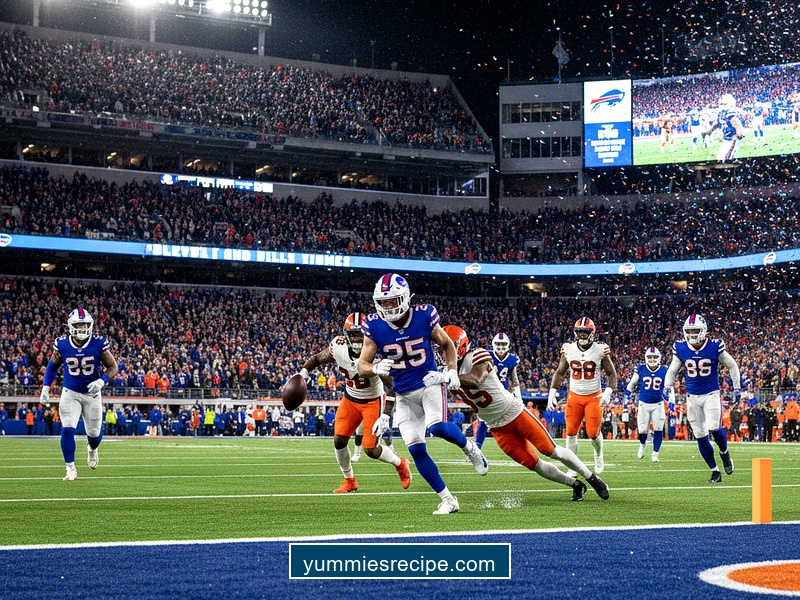
"In December football, the geometry of the field changes. The hash marks feel tighter, the passing windows compress, and the team that controls the 'B' gap usually controls the clock."
Forget the storylines about playoff pictures or emotional momentum. Week 16 battles in the AFC North’s territory are rarely decided by intangibles. They are decided by physics, leverage, and personnel grouping efficiency. When the Buffalo Bills line up against the Cleveland Browns, we are witnessing a collision of two distinct architectural philosophies.
The public narrative focuses on the quarterbacks, but the real game exists in the trenches and the secondary rotations. Computer models and efficiency metrics point toward specific outcomes not because of luck, but because of schematic probabilities. This breakdown ignores the noise to dissect the tactical realities: how Buffalo's spread concepts interact with Cleveland's pressure packages, and how the Browns' heavy personnel challenges the structural integrity of the Bills' defensive front.
The Analysis: Buffalo’s Protection vs. The Wide-9
The defining tactical variable in this matchup is the alignment of Myles Garrett and the Browns' defensive front against the Bills' offensive line protection slides. Cleveland often deploys a Wide-9 alignment, positioning the defensive end well outside the offensive tackle's shoulder. This creates isolation. The goal is to force the tackle into a one-on-one situation in space, removing the guard's ability to help.
Buffalo counters this through "chipping" and moving the pocket. Typically, teams facing elite edge rushers keep a tight end in to block. However, the Bills prefer to release five eligible receivers to stress the defensive structure vertically. Watch for Buffalo to utilize the running back in the flat to freeze the edge rusher or employ a "slide protection" where the center and guard slide toward Garrett, forcing the tackle to wash him down.
If Cleveland maintains gap discipline, they force Josh Allen to stay in the pocket. If the rush lanes break down—specifically if the interior defensive tackles get pushed past the quarterback's depth—Allen escapes through the B-gap. This is where the tactical battle shifts from structure to improvisation. The heat maps for Allen show a distinct preference for rolling right when pressured; Cleveland's defensive ends must maintain "contain" leverage to prevent the scramble drill, which is where Buffalo generates its most explosive plays (EPA/play > 0.6 on scrambles).
The Personnel mismatch: Nickel vs. Heavy
The most fascinating chess match occurs when Cleveland has the ball. The Browns historically rely on heavy personnel groupings (12 and 13 personnel) to establish the run and set up play-action. They want to put big bodies on the field to force the defense into a "Base" 4-3 or 3-4 look.
Buffalo, conversely, is a Nickel-base defense. They prioritize speed and coverage versatility, often keeping an extra defensive back on the field regardless of the offensive package. This creates a physics problem. Can a 200-pound nickel corner fill the run fit against a pulling guard or a lead-blocking tight end?
| Grouping | Browns Usage % | Bills Def Success Rate | Tactical Advantage |
|---|---|---|---|
| 11 (3 WR) | 42% | 54% | Bills (Speed matches Speed) |
| 12 (2 TE) | 35% | 41% | Browns (Size vs. Nickel) |
| 13 (3 TE) | 11% | 38% | Browns (Force Heavy Box) |
If Buffalo refuses to substitute and stays in Nickel, Cleveland will run "Duo" and "Inside Zone" concepts directly at the smaller defensive backs. The tactical pivot point here is the Buffalo linebackers' ability to "shoot the gap." They cannot wait to catch blocks; they must penetrate the line of scrimmage pre-snap or immediately at the snap to disrupt the blocking geometry before the momentum builds.
Coverage Shells and the Middle of the Field
Analyzing the secondary play, we see two differing philosophies on how to defend the middle of the field (MOF). Cleveland typically operates from a single-high safety look (Cover 1 or Cover 3) more frequently than the league average. This places a heavy burden on the corners to win on the perimeter and the linebackers to cover the intermediate crossers.
Buffalo's offense is specifically designed to exploit single-high coverages. By running "dagger" concepts—a deep vertical route to clear the safety, followed by a deep dig route underneath—they put the single-high safety in conflict. If the safety drops deep to respect the speed on the outside, the middle of the field opens up for the dig route at 12-15 yards depth.
Furthermore, watch the seam routes by the Bills' tight ends. Against Cover 3, the seams are the weak point between the cornerback's deep third and the safety's middle third. A perfectly placed ball in this corridor yields high efficiency. The data suggests that if Cleveland does not disguise their coverages—rolling from two-high to one-high post-snap—Allen will diagnose the static look and manipulate the single safety with his eyes.
The Variable of Variance: 4th Down Aggression
Modern tactical analysis must include decision-making logic. Both teams utilize analytics, but their application differs based on game state. Computer models projecting this game often favor Buffalo due to their higher "Aggression Index" in neutral game states.
When facing 4th-and-short situations in opposing territory, Buffalo treats the quarterback sneak or power run as a high-probability event (success rate > 80%). This forces Cleveland’s defense to play 3rd down differently. Knowing that Buffalo has four downs to convert changes the play-calling on 3rd-and-4. The Bills can run the ball or throw a short check-down, knowing they don't need the sticks immediately.
Cleveland’s defense must counter this by playing tighter to the line of scrimmage on 3rd down, pressing the receivers. This, however, exposes them to the double-move or the "go" route. It is a vicious cycle: respect the 4th down potential and get burned deep, or play soft and allow the conversion.
Final Tactical Outlook
The outcome of Week 16 rests on two pivotal axes: Buffalo's ability to maximize passing efficiency against a static Cover 3 shell, and Cleveland's capacity to bully Buffalo's Nickel personnel in the run game. If the Browns can consistently gain 5+ yards on first down using heavy sets, they neutralize the Bills' pass rush and keep Josh Allen on the sideline.
However, the spatial advantage belongs to Buffalo. Their spread formation forces the defense to cover every blade of grass horizontally, while Allen’s arm stretches it vertically. Unless Cleveland generates pressure without blitzing—relying entirely on their front four to win individual battles—the geometry of the Bills' offense creates too many open windows. The data favors the team that controls the air, provided they can survive the ground war.