
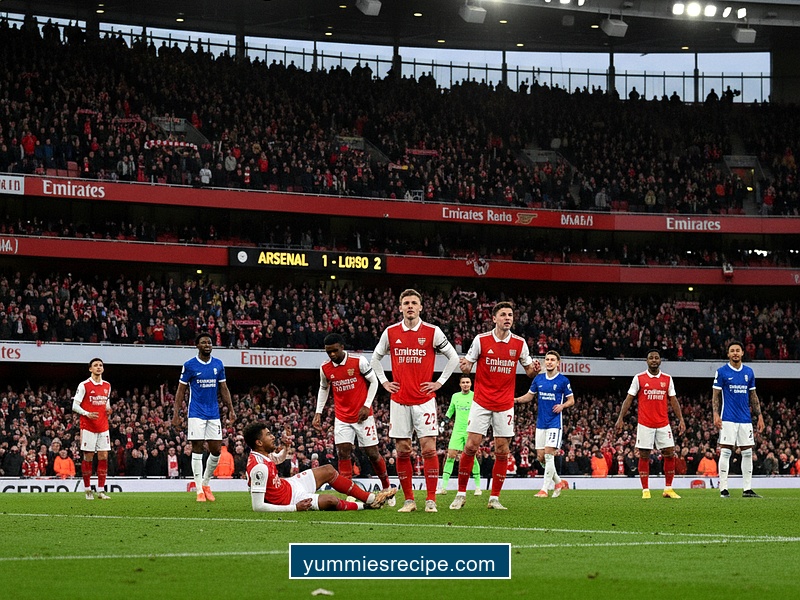
Mikel Arteta has engineered a machine designed for total territorial dominance, yet the underlying metrics suggest a fatal redundancy in the final third. The Gunners are currently suffocating under their own structured possession, often mistaking ball retention for effective chance creation against elite low blocks. We analyze how defensive over-compensation is blunting their attacking edge during this critical phase of the Premier League campaign.
| Metric | Arsenal (2023/24 Avg) | Arsenal (Current Phase) | Tactical Implication |
|---|---|---|---|
| Field Tilt (%) | 68.4% | 72.1% | Higher territory, less space. |
| xG per Shot | 0.12 | 0.09 | Lower quality chances. |
| Passes per Defensive Action (PPDA) | 9.6 | 11.2 | Less intensity in the high press. |
| Goals from Open Play | High Volume | Declining | Reliance on set-pieces increases. |
Why The Numbers Matter
The data reveals a concerning trend known in tactical circles as "sterile domination." While Arsenal’s Field Tilt—the share of possession in the final third—has actually increased, the quality of shots (xG per shot) has plummeted. This inverse relationship indicates that opposing defenses are comfortable allowing Arsenal to circulate the ball in a U-shape around the penalty area. The drop in PPDA suggests a physical drop-off or a conscious tactical shift to preserve energy, but it removes the transition chaos that previously generated Arsenal’s easiest goals. The "uncomfortable position" cited in reports is not emotional; it is a statistical reality of diminishing returns on possession.
The 3-2-5 Stagnation: Breaking Down the Block
Arteta’s primary offensive structure relies on a 3-2-5 or 2-3-5 in possession, designed to pin the opponent deep. However, recent fixtures expose a rigidity in this setup. Opponents have stopped engaging Arsenal’s center-backs, instead dropping into a compact 5-4-1 low block. This neutralizes the passing lanes into the "half-spaces" (the vertical channels between the wing and center).
When Arsenal faces this block, the ball speed slows. The center-backs, Saliba and Gabriel, often take three touches where one would suffice, allowing the defensive block to shuffle laterally. Without a dynamic ball-carrier in the midfield pivot to drive vertically—breaking the first line of pressure through dribbling rather than passing—the formation becomes static. The reliance on the right-sided triangle (White, Odegaard, Saka) has become predictable. Data shows nearly 44% of Arsenal’s attacks funnel down the right flank, allowing defenses to overload that sector without fear of punishment on the left.
The Declan Rice Paradox: Role Conflict
A significant factor in this structural discomfort is the utilization of Declan Rice. In the current system, Rice’s role fluctuates awkwardly between a sole #6 and a box-crashing #8. When deployed deeper, his ball progression numbers are elite, but his reluctance to turn on the half-turn limits Arsenal’s ability to play through the center of the pitch. He prefers facing the play, which slows vertical integration.
"Control does not equal creation. Arsenal's midfield provides security, but lacks the chaotic element required to dismantle a disciplined 5-4-1."
When Rice pushes forward as an #8 to accommodate a deeper playmaker (like Partey or Jorginho), the team suffers from spacing issues. Heat maps from recent matches show Rice often occupying the same vertical zones as the left-winger (Martinelli or Trossard). This congestion effectively removes the width on the left side. Unlike Granit Xhaka, who mastered the timing of entering the box late, Rice often arrives too early or occupies the crossing zones, clogging the very space the winger needs to operate. This forces the winger to recycle possession backward, resetting the attack and allowing the defense to breathe.
Rest Defense and the Fear of Transitions
The "uncomfortable position" highlights a psychological shift manifesting tactically: a fear of the counter-attack. Arteta has prioritized "Rest Defense" (the structure of players behind the ball while attacking) to an extreme degree. Typically, Arsenal maintains a 3-2 structure behind the ball.
However, against high-caliber transition teams, this has morphed into a more conservative 4-1 or flat back four staying deep. By keeping the fullbacks (Timber, Calafiori, or White) tethered to the halfway line, Arsenal loses the overlapping or inverting runs that usually destabilize the opponent's defensive shape.
This caution severs the link between the buildup phase and the finishing phase. The front five find themselves isolated against seven or eight defenders. Without the fullbacks committing to the final third, there are no 2v1 situations to exploit on the wings. The result is a sterile possession loop where the ball moves from center-back to winger and back again, waiting for a mistake that elite Premier League defenses rarely make.
The False 9 Limitations in Heavy Traffic
Kai Havertz’s role as the pivot point of the attack functions beautifully in open games where space exists between the lines. In the tight confines of a title run-in, however, the limitations of this system glare. When Arsenal pushes high, compressing the pitch, the "False 9" role becomes redundant if there is no space to drop into.
Defenders are happy to let Havertz drop deep because it leaves the penalty box empty. Arsenal lacks a "pinning" striker—someone who occupies the center-backs physically, forcing them deeper and creating space in front of the defensive line for Odegaard. Without this physical focal point, the opposing center-backs can step up aggressively to squeeze the midfield, condensing the play even further.