
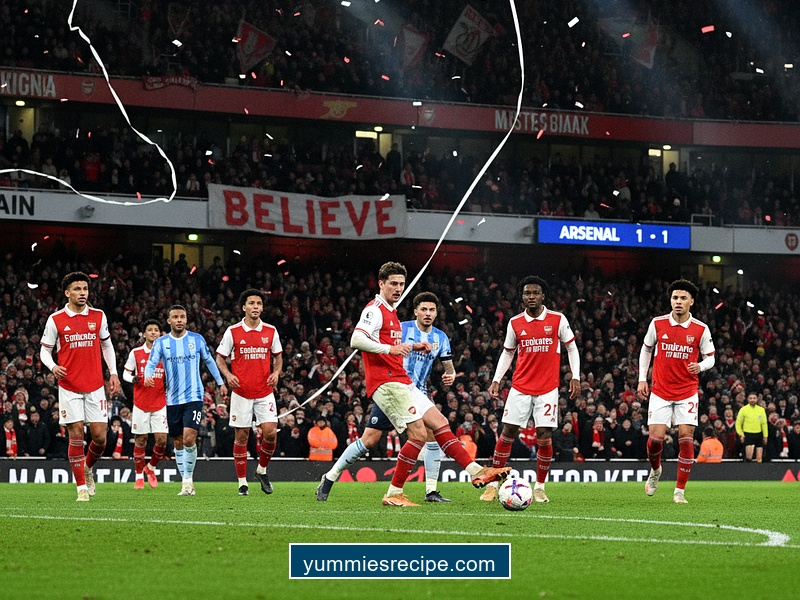
There is a distinct, jagged texture to a 1-0 win at Goodison Park that feels entirely different from a 4-0 romp at the Emirates. For decades, Arsenal traveled to the blue half of Merseyside not just to play football, but to undergo a psychological examination. Under Arsène Wenger’s twilight years and Unai Emery’s brief interregnum, they frequently failed. The recent victory over Everton, gritty and devoid of aesthetic sparkle, signals something far more potent than three points. It confirms the final metamorphosis of Mikel Arteta’s project from a tribute act to Pep Guardiola into a ruthless, autonomous entity.
The headlines suggest Arsenal are in an "uncomfortable" position. I disagree. This discomfort is merely the friction of a club shedding its reputation for softness. To understand the sustainability of this result, we must ignore the 90 minutes of scrappy play and dissect the managerial neurosis that engineered it. Arteta has realized that to usurp Manchester City, one cannot merely out-play them; one must out-suffer them.
The Rejection of Utopian Football
For years, the "Arsenal Way" was a millstone around the club’s neck. The post-Invincibles era was defined by a dogmatic adherence to offensive purity, often at the expense of structural integrity. We remember the chaotic 6-3 defeats and the implosions against physical sides like Bolton or Stoke. Arteta arrived in North London with a La Masia hard drive, but his operating system has been updated with a distinctly Basque pragmatism.
The 1-0 scoreline is the ultimate distinctive mark of champions in waiting. Consider the 1997-98 double-winning side. While Bergkamp provided the art, it was the 1-0 wins in the run-in—Wimbledon, Manchester United, Bolton—that secured the silverware. Arteta is channeling George Graham more than Wenger in these moments. The "Project" is no longer about teaching young players how to pass; it is about teaching them how to stand still, how to absorb pressure, and how to kill a game without the ball.
"It is not about the aesthetics of the possession. It is about the control of the space. Arsenal have stopped trying to walk the ball into the net and started trying to lock the door behind them."
Nicolas Jover and the Moneyball of Set Pieces
To analyze this victory without mentioning Nicolas Jover is malpractice. The set-piece coach, poached from Manchester City, is arguably Arteta’s most critical tactical signing. In games where open play is stifled by a low block—like Sean Dyche’s Everton—corners and free kicks are not restart mechanisms; they are high-probability scoring opportunities.
This is where the sustainability argument finds its legs. Relying on 30-yard screamers is unsustainable variance. Relying on meticulously choreographed set-pieces is a repeatable skill. Arsenal’s reliance on set-piece goals is not a weakness; it is an inefficiency in the market that they are exploiting better than anyone else in Europe. While pundits clamor for a 20-goal-a-season striker, Arteta has distributed those goals across his center-backs and defensive midfielders via Jover’s playbook. It is a democratization of goal-scoring that makes the team harder to nullify.
The Architecture of the 'Horseshoe'
Critics often deride Arteta’s possession maps as a "horseshoe of doom"—circulating the ball from winger to full-back to center-back without penetration. This analysis is lazy. Against a team like Everton, the horseshoe is a constrictor snake. It is designed to minimize transition threats.
By keeping the ball in wide areas and recycling it through Declan Rice or William Saliba, Arsenal denies the opponent the chaos of the counter-attack. In previous seasons, Arsenal would force a pass through the middle, lose it, and concede to a transitional goal. Now, they wait. This patience is often mistaken for a lack of creativity. It is actually risk management. Arteta has calculated that a 0-0 draw in the 70th minute is preferable to an open, basketball-style game where the result becomes a coin flip.
Defensive Rigidity: The Saliba-Gabriel Axis
The sustainability of Arsenal’s title charge rests entirely on the partnership of William Saliba and Gabriel Magalhães. We are witnessing the best defensive pairing the Premier League has seen since Rio Ferdinand and Nemanja Vidić. The data supports the eye test: Arsenal restricts opponents to historically low Expected Goals (xG) numbers, particularly away from home.
This is the bedrock of the Arteta philosophy. While Guardiola’s City defends through possession (keeping the ball so you can't score), Arteta’s Arsenal defends through physical dominance and territory. They are comfortable without the ball. They enjoy the duel. The signing of Declan Rice was the final piece of this puzzle, providing a physical screen that allows the center-backs to be aggressive. This is not a team that lucks into 1-0 wins; it is a team built to manufacture them.
The Psychology of the 'Uncomfortable'
Why do headlines describe Arsenal’s position as "uncomfortable"? Because the media narrative demands a plucky underdog story or a collapse. Arsenal is refusing to give them either. They are simply winning with a boring, robotic efficiency that unnerves observers used to their historic fragility.
Arteta has instilled a "siege mentality" that borders on paranoia, but it works. By treating every away ground as a hostile combat zone rather than a football pitch, he has stripped the emotion out of the performance. The players didn't celebrate the Everton win with wild abandon; they celebrated it with relief and professional satisfaction. That emotional regulation is the biggest difference between the Arsenal of last season—who ran on adrenaline until they crashed—and the Arsenal of today.
The Verdict: Sustainable Suffering
Is this sustainable? Absolutely. In fact, winning 1-0 is more sustainable than winning 4-3. High-scoring shootouts rely on strikers being in red-hot form. Defensive shutouts rely on structure, organization, and discipline—qualities that do not fluctuate as wildly as finishing form.
The "Project" has entered its mature phase. The youthful exuberance is gone, replaced by a cynical, hardened desire to win at all costs. If Arsenal lifts the Premier League trophy in May, it won't be because of liquid football played on sunny afternoons at the Emirates. It will be because on grim, grey days at Goodison, Luton, and Sheffield, they embraced the ugly side of the game. Arteta has built a machine capable of suffering, and in the Premier League, he who suffers best, wins.