
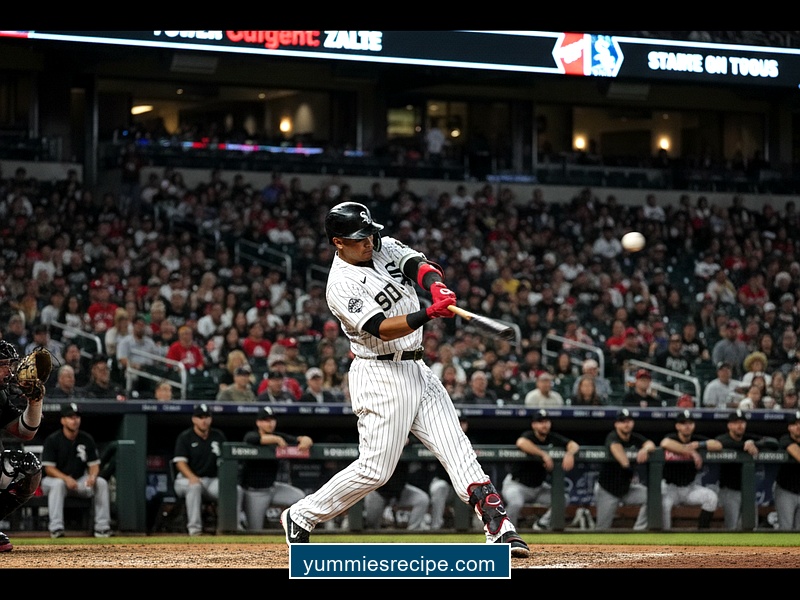
The Chicago White Sox, a franchise recently indistinguishable from a controlled demolition, have suddenly decided to construct a skyscraper in the middle of the rubble. The signing of Munetaka Murakami to a two-year, $34 million contract is not merely a transaction; it is a philosophical whiplash that defies the logic of a front office that spent 2024 meticulously engineering the worst baseball team in modern history.
For a fan base traumatized by 121 losses, the arrival of the "Village God" feels less like a roster move and more like divine intervention. But let’s strip away the hype of the international signing window and look at the baseball reality. This move echoes the ghosts of 35th and Shields, recalling a specific era when the South Side relied on thunderous, imported power to mask structural deficiencies. We have seen this movie before, and while the protagonist speaks a different language, the swing holds the same violent promise as the legends of the mid-2000s.
The Ghost of Jim Thome and the Power Vacuum
To understand the gravity of Murakami wearing black and white, one must look back to 2006. The White Sox were defending World Series champions, yet they made a bold, mercenary move to acquire Jim Thome. Thome was a known quantity, a left-handed sledgehammer brought in to exploit the short porch in right field. In 2006, Thome launched 42 home runs with a 129 OPS+, providing the lineup with an anchor that forced pitchers to engage.
Murakami is the spiritual successor to that specific version of Thome. Not the Frank Thomas homegrown dominance of the 1990s—Thomas was an artist of the strike zone, a right-handed monolith who hit for average as effortlessly as power. Murakami is different. He is raw torque. His 56 home runs in 2022 for the Tokyo Yakult Swallows shattered Sadaharu Oh’s record for a Japanese-born player, a milestone that had stood as the holy grail of NPB power hitting for nearly six decades.
Like Thome, Murakami pulls the ball with disdain. The geometry of Guaranteed Rate Field (formerly U.S. Cellular) is tailor-made for his bat path. The right-field foul pole sits 335 feet away, but the power alley is where Murakami lives. If he adjusts to Major League velocity, we aren't just looking at 25 home runs; we are looking at balls landing on the concourse where the smell of grilled onions usually overpowers the stench of defeat.
The Mechanics of Translation: Velocity vs. Variance
The lazy analysis is to compare Murakami to Shohei Ohtani or Hideki Matsui. That does a disservice to the specific scouting report on Murakami. His mechanical profile is fascinatingly risky. In Japan, he thrived on a diet of splitters and breaking balls, showcasing an ability to stay back and explode through the zone. However, his struggle in the 2023 World Baseball Classic against high-velocity fastballs up in the zone offers a cautionary tale.
The MLB environment he enters is radically different from the NPB of 2022. The average four-seam fastball in MLB sits at 94.2 mph. In the NPB, it hovers closer to 90-91 mph. Murakami’s swing has a distinct loop—beautiful when it connects, fatal when timing is disrupted. He posted a strikeout rate in Japan that occasionally drifted north of 25%. In the Majors, against the likes of Tarik Skubal or Emmanuel Clase, that hole in his swing will be hunted mercilessly.
"The transition for a power hitter is steeper than for a contact hitter. Ichiro could slap 95 mph into left field. Murakami has to turn on 97 mph inside. That requires bat speed, yes, but more importantly, it requires the elimination of doubt."
If he cannot catch up to the high heat, he becomes Adam Dunn without the walks. If he can, he becomes a left-handed version of Paul Konerko—a middle-of-the-order threat who changes the temperature of the game with one swing. The White Sox are betting $34 million that the adjustment period will be brief.
The Reinsdorf Arithmetic
We cannot analyze a White Sox move without acknowledging the shadow of Jerry Reinsdorf. Why this player? Why now? The two-year, $34 million structure is classic Reinsdorfian economics. It is a "prove-it" deal masked as a blockbuster. It lacks the ten-year commitment the Dodgers gave Ohtani or the long-term security the Cubs gave Seiya Suzuki. It is a low-risk, high-reward rental designed to put bodies in seats while the rest of the roster undergoes a painful, slow-motion rebuild.
This smells like the Albert Belle signing of the late 90s—a massive infusion of cash for a singular talent intended to distract from the surrounding mediocrity. Belle gave the Sox two monstrous seasons (including a miraculous .328/.426/.655 slash line in 1998) before an obscure clause allowed him to walk. Murakami’s two-year window suggests the White Sox view him as a bridge. Either he explodes into a superstar they can trade for a king’s ransom at the 2026 deadline, or he leads the next great Sox team. Given the farm system's timeline, the cynical money is on the former.
Roster Construction: The Protection Problem
The tragedy of the 2024 White Sox wasn't just the lack of talent; it was the lack of protection. Andrew Vaughn and Luis Robert Jr. (when healthy) were stranded on an island. Pitchers had no incentive to throw strikes. Bringing Murakami into this lineup creates a fascinating tactical dilemma for opposing managers.
If Luis Robert Jr. rebounds to his 2023 All-Star form, suddenly the South Side has a 3-4 punch reminiscent of the Dye-Konerko duo of 2005. Jermaine Dye offered Paul Konerko the luxury of seeing fastballs. Without a credible threat behind him, Murakami will see nothing but sliders in the dirt. The success of this signing is inextricably linked to the health of Robert Jr. Without him, Murakami will simply be walked, much like Barry Bonds in the mid-2000s, albeit with fewer intentional passes.
Defensively, the hot corner is a question mark. Murakami won Gold Gloves in Japan, but scouts are split on his lateral mobility for the MLB game. The speed of play on American turf is faster. Expect him to log significant innings at Designated Hitter, pushing Gavin Sheets or Andrew Vaughn into uncomfortable defensive alignments. But frankly, if he hits 35 home runs, he can play third base wearing oven mitts and nobody in Chicago will care.
The Verdict: A flicker of Life
The White Sox have spent the last two years actively alienating their fanbase. They broke the trust of a loyal, grit-obsessed demographic that spans generations. Signing Munetaka Murakami does not fix the rotation. It does not cure the defensive lapses. It does not erase the humiliation of 121 losses.
However, it provides something the South Side has been starved of since the days of peak José Abreu: relevance. It gives the fans a reason to endure the April chill. When Murakami steps into the box, digs his cleats into the dirt, and waggles that bat, the ghosts of Thome, Thomas, and Konerko will be watching.
The White Sox may not win the AL Central in 2025. They might not even finish above .500. But for the first time in years, the "pinwheels" on the scoreboard have a reason to spin. The Village God is here, and even in the ruins of a rebuild, royalty commands attention.