
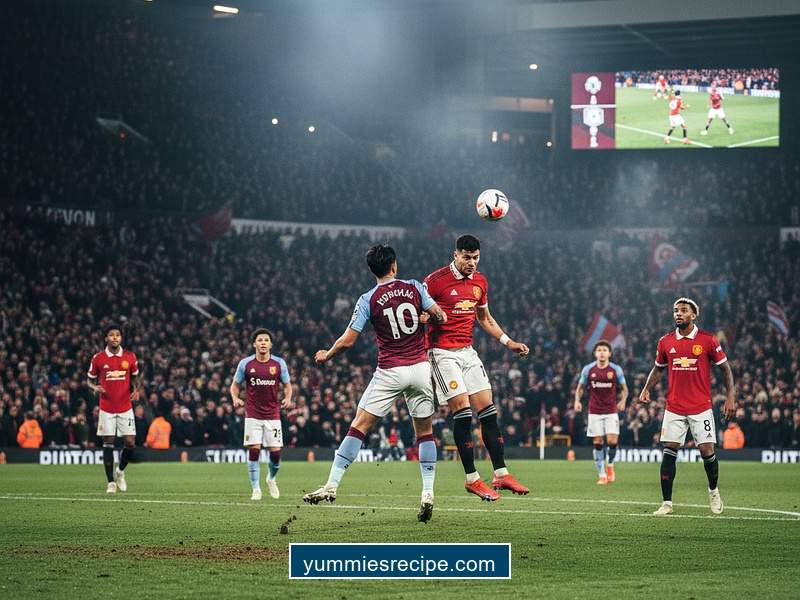
There is a specific, terrifying hum that emanates from the Holte End when Aston Villa smells blood. It is no longer the nervous energy of a club fighting to regain relevance, nor the fatalistic sigh of a fanbase accustomed to false dawns. What we witnessed at Villa Park, as Unai Emery’s side dismantled Manchester United 2-1, was the sound of certainty.
Morgan Rogers, with a brace that felt less like a personal triumph and more like a systemic inevitability, provided the goals. But the story here is not about the 90 minutes. It is about two divergent corporate projects: one that has mastered the alchemy of recruitment and coaching, and another that is still, painfully, trying to translate a Portuguese distinct dialect into Mancunian English.
The Cult of the Basque Professor
To understand why Aston Villa are genuinely nipping at the heels of the league leaders, you must look past the scoreboard and look at the geometry. Unai Emery does not simply coach football; he installs an operating system. Since his arrival, he has transformed Villa from a relegation-threatened outfit into a Champions League staple, not through magic, but through a rigid, non-negotiable tactical architecture.
Against United, the "Emery Trap" was visible from the stratosphere. Historically, English football favors the brave, but Emery favors the precise. His deployment of a hybridized 4-4-2, which morphs into a 4-2-2-2 in possession, creates a box midfield that suffocates opponents. When Rogers surged forward to net his double, he wasn’t running into open space by accident. He was triggering a rehearsed vertical transition that Villa has drilled until their feet bleed.
"Emery has replaced the chaotic emotion of Villa Park with the cold calculation of a chess grandmaster. Every pass is a lure; every defensive line step is a trap."
This is where the "Project" distinction lies. Villa’s recruitment, spearheaded by Monchi, is inextricably linked to Emery’s tactical demands. They do not buy superstars; they buy puzzle pieces. Morgan Rogers is a physical anomaly—capable of carrying the ball through lines like a number 8 but finishing like a number 9. He was purchased because his data profile fits the exact "second striker" role Emery perfected at Villarreal with Gerard Moreno. This is sustainable. This is institutional knowledge at work.
Amorim’s Identity Crisis
Across the technical area, Ruben Amorim stood with the stoic expression of a man realizing the magnitude of the renovation job at Old Trafford. The headlines will scream about the result, but the nuance lies in the friction between Amorim’s preferred 3-4-3 system and the personnel at his disposal.
The Manchester United "Project" is currently in a phase of violent transition. The inclusion of Matheus Cunha—a player of undeniable talent who rated well despite the loss—highlights United's lingering addiction to individual brilliance over systemic fit. Cunha offered sparks, drifting wide and driving at the Villa defense, but he often looked like a soloist in an orchestra that hadn't received the sheet music.
The injury to Bruno Fernandes during the match serves as a grim metaphor for United's tactical fragility. For five years, Fernandes has been the tactical band-aid, the "Heroball" solution to structural deficits. Amorim’s philosophy, honed at Sporting CP, relies on automated patterns and wing-back dominance, not the frantic creativity of a single number 10. Without Fernandes, United looked devoid of a soul; with him, they look unable to evolve beyond chaos.
The Sustainability Index
We must ask the uncomfortable question: Is Villa’s title charge a Leicester City-style miracle or a permanent shifting of the tectonic plates? The evidence points to the latter.
When Leicester won the league in 2016, they did so with 44% possession and a reliance on variance. Villa controls games. They manipulate the ball. Emery’s side consistently lures the press to bypass it, a hallmark of modern elite sides like Manchester City and Arsenal. This is not a hot streak; it is a high-performance machine.
| Metric | Aston Villa (The Emery Model) | Manchester United (The Amorim Rebuild) |
|---|---|---|
| Recruitment Strategy | Data-driven, profile-specific (e.g., Rogers, Onana) | Star-driven, market-opportunity based (e.g., Cunha) |
| Tactical Identity | Rigid structure, high-line offside trap | Fluid transition, reliant on individual moments |
| Managerial Authority | Absolute. The Manager is the star. | Conditional. Players still hold immense sway. |
The 4/10 Reality Check
The player ratings from the Manchester Evening News were scathing, handing out two 4/10s to United starters. This is not merely poor form; it is a rejection of responsibility. In Amorim’s 3-4-3, the wing-backs and the double pivot must run unimaginable distances. If the commitment drops by 5%, the system collapses into expansive gaps which Morgan Rogers happily exploited.
United’s squad was assembled by four different managers with four different philosophies. You have Ten Hag’s transition players, Solskjaer’s counter-attackers, and now Amorim trying to force them into a structured positional game. It is a Frankenstein’s monster of a roster. Until INEOS clears the decks—a process that will take at least three more transfer windows—United will remain a cup team masquerading as a title contender.
The New Hierarchy
There is a tendency in English media to treat the "Big Six" as a fixed caste system. Unai Emery has taken a sledgehammer to that concept. By keeping Villa on the leaders’ heels deep into the season, he has validated the Monchi-Emery axis as the smartest front office in the league.
This result was not an upset. Let us be clear about that. The betting markets might have offered value, but the footballing logic dictated a Villa win. They possess a clarity of purpose that Manchester United lost somewhere between the retirement of Sir Alex Ferguson and the hiring of their first interim manager.
Ruben Amorim is a talented coach with a high ceiling, but he walked into Villa Park and saw what a finished project looks like. Emery has had time, yes, but he also had a plan that didn't waver. Rogers’ double was the punctuation mark on a statement that has been being written for eighteen months: The old aristocracy is dead.
Villa are not dreaming of the title. Dreamers wake up. Villa are planning for it, drilling for it, and, based on the dissection of Manchester United, they are ready to seize it.