
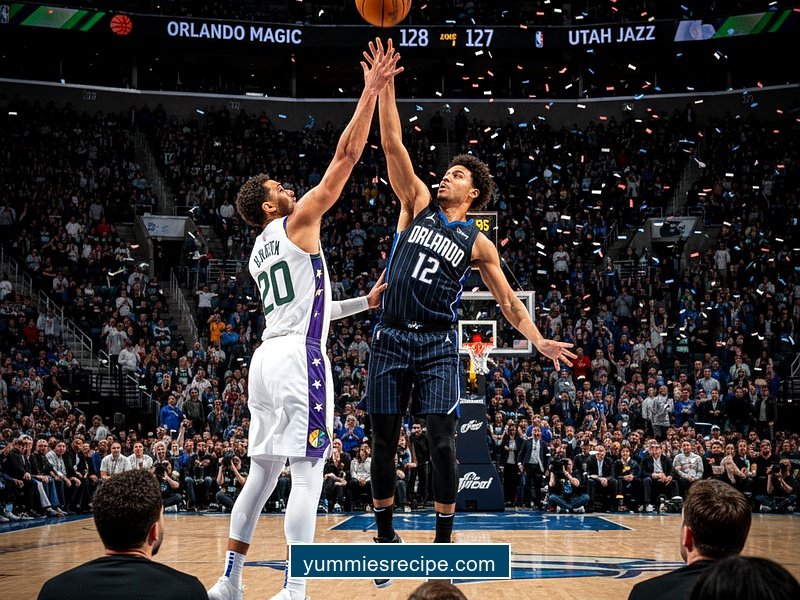
The scoreboard at the Delta Center read 128-127 in favor of the Orlando Magic, a result that will be logged in the standings as a victory. But for anyone who has tracked the trajectory of this franchise since the Jeff Weltman and Jamahl Mosley partnership began, Friday night’s shootout in Utah wasn't a triumph. It was a tactical capitulation.
We are now deep into the 2025-26 campaign. The "rebuild" label has long since peeled off the locker room walls. This is supposed to be the era of contention. Yet, watching the Magic trade buckets with a Utah Jazz squad that is seemingly perpetually stuck in the play-in purgatory feels less like progress and more like an identity crisis. The box score suggests an offensive explosion; the tape reveals a team that has forgotten the very defensive principles that dragged them out of the lottery.
The Erosion of the "Defensive First" Mandate
When Jamahl Mosley was hired in 2021, he arrived with a reputation forged in the fires of the Dallas Mavericks' defensive schemes. The mandate was clear: use the freakish length of this roster to suffocate opponents. For two seasons, that worked. In 2023-24, the Magic boasted a top-five defensive rating, hanging their hat on the ability of Jalen Suggs and Jonathan Isaac to wreck pick-and-roll actions. They won ugly, and they loved it.
Fast forward to December 2025. Giving up 127 points to the Jazz is not an anomaly; it is becoming a disturbing feature of the "modernized" Magic. The narrative coming out of the locker room, cited in reports regarding the team's "fight for energy," masks the structural issue. Energy is a commodity; scheme is a foundation. You can lose energy on a back-to-back. You shouldn't lose your defensive geometry against a team lacking a top-tier superstar.
The Magic were built to be the '89 Pistons with better spacing. Lately, they look like the '91 Nuggets with worse shooting.
The philosophical shift is palpable. The front office constructed a roster of giants—Franz Wagner (6'10"), Paolo Banchero (6'10"), and Wendell Carter Jr. (6'10")—under the assumption that "positionless basketball" meant switching everything. Against Utah, that switch-heavy scheme was exposed. The Jazz guards didn't beat Orlando with complexity; they beat them with speed, turning Orlando’s greatest asset (size) into a liability (lateral quickness). If the plan is still to win with defense, the blueprint is fading.
The Trap of the "Offensive Evolution"
There is a seductive lie in the modern NBA that to win a championship, you must simply outscore the opposition. Yes, the offensive efficiency across the league has skyrocketed since the rule changes of the early 2020s favoring the aggressor. However, history is rigid on this point: Championship teams do not hemorrhage points.
Let's look at the historical data. Since the NBA merger, only two teams have won a title with a defensive rating outside the top 11. The Magic scoring 128 points feels good for the highlight reels, but it relies heavily on high-difficulty shot-making from Banchero and Wagner. That is not a system; that is individual brilliance bailing out a stagnant philosophy.
Historical Defensive Ratings of Champions (Last 5 Years Context)
| Season | Champion | Defensive Rtg Rank | Avg Pts Allowed |
|---|---|---|---|
| 2023-24 | Boston Celtics | 2nd | 109.2 |
| 2022-23 | Denver Nuggets | 15th (Playoff adjust: 4th) | 112.5 |
| 2021-22 | Golden State Warriors | 2nd | 105.5 |
| 2020-21 | Milwaukee Bucks | 9th | 110.1 |
The Magic currently sit well outside these metrics. By engaging in a shootout with Utah, Mosley is essentially betting that his talent can out-gun the league. It is a hubristic pivot from a coach who made his name preaching grit.
The Banchero Heliocentrism Problem
The root of this 128-127 chaotic style lies in the offensive load carried by Paolo Banchero. By year four, Banchero has become a legitimate MVP candidate. But there is a hidden cost to his dominance, one that was visible throughout the fourth quarter in Salt Lake City.
When an offense becomes heliocentric—revolving entirely around one gravity-well player—the defensive transition suffers. Teammates spend possessions standing in the corners or cutting, rather than maintaining floor balance. When Banchero drives and misses, or turns it over, the Magic are often caught flat-footed, leading to the easy buckets that fueled Utah's 127-point night.
This is the "Luka Dončić Dilemma" that Mosley saw firsthand in Dallas. You get elite offensive production, but your defense creates a glass ceiling. The Magic were supposed to be different. They were supposed to be a collective unit, not a "Helio" system. The reliance on Paolo to score 30+ to scrape by the Jazz indicates that the supporting cast's "energy" issues are actually symptoms of disengagement.
Sustainability: The Verdict on the Project
Is this result sustainable? Absolutely not. Winning 128-127 is akin to driving a Formula 1 car with a leaking fuel line; you might cross the finish line, but you're risking an explosion at every turn.
The "Project" in Orlando was sold on the premise of versatility and suffocation. Jeff Weltman has hoarded long, athletic wings for half a decade. If that collection of talent cannot hold a rebuilding Jazz team under 110 points, we must question the instruction, not just the personnel.
Will Hardy’s Jazz are a scrappy, well-coached bunch, but they are the control group in this experiment. A title contender suppresses a team like Utah. They don't play with their food. The Magic playing down (or up, in terms of pace) to their opponent's level displays a lack of championship maturity.
Mosley must make a choice before the 2026 playoffs arrive. He can embrace this new identity as an offensive juggernaut, risking it all on shot variance, or he can tighten the leash, simplify the offense, and demand the defensive intensity that defined his early tenure. Right now, Orlando is stuck in the middle—a team with elite talent playing a confused brand of basketball. A one-point win in December feels like relief. In April, this brand of basketball will look like a first-round exit.