
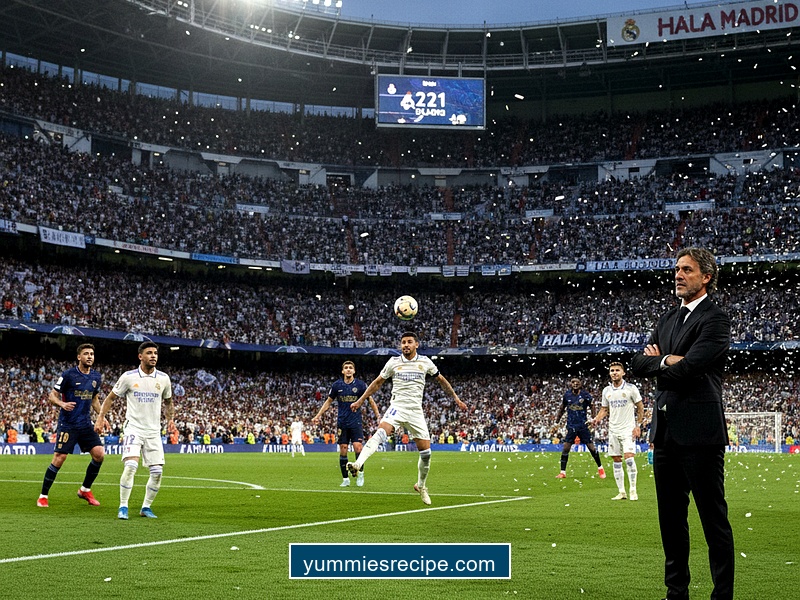
The rumor mill in the Spanish capital does not whisper; it screams. Recent reports suggesting specific upcoming fixtures could decide Xabi Alonso’s future at Real Madrid are, frankly, reductive. To suggest that a managerial appointment of this magnitude hinges on ninety minutes of football ignores the tectonic shifts occurring in European football management. Florentino Pérez does not make decisions based on a singular scorecard; he hires based on dynasties.
While the headlines focus on Carlo Ancelotti’s current struggles or Bayer Leverkusen’s fixture list, the real story is the philosophical chasm between Real Madrid’s current "laissez-faire" reliance on individual brilliance and the structural obsessiveness Xabi Alonso has cultivated in Germany. This is not merely a coaching change; it is a potential ideological revolution for the 15-time European champions.
The Evolution of the 'Hybrid' Manager
To understand why Alonso is the coveted piece of the Madrid puzzle, one must strip away the emotion of his "Invincible" season and analyze his pedigree. We are looking at a manager who is a genetic splice of the three most dominant coaching influences of the 21st century. He possesses the defensive organization of Rafa Benitez, the vertical ruthlessness of Jose Mourinho, and the positional obsession of Pep Guardiola.
Most young managers lean too heavily into one school of thought. Vincent Kompany is rigid in his Guardiola-esque idealism; Diego Simeone is entrenched in defensive pragmatism. Alonso is fluid. At Leverkusen, his team averaged 62% possession not for vanity, but for control. Yet, when the transition moments arrived, they attacked with the ferocity of Jurgen Klopp’s Liverpool.
"Alonso has solved the modern managerial paradox: how to control a game without boring the audience, and how to defend without parking the bus."
Real Madrid has historically rejected "system managers." The Bernabéu crowd demands flair, not geometry. However, modern football has evolved to a point where individual talent—even talent as immense as Kylian Mbappé and Vinícius Júnior—cannot consistently dismantle elite low blocks without a sophisticated structure. Ancelotti’s "vibes and friendship" approach is hitting a tactical ceiling against hyper-organized opponents. Alonso represents the necessary modernization of the Madrid ethos.
Deconstructing the 3-4-2-1: A Blueprint for Bellingham
The lazy analysis suggests Alonso’s preferred 3-4-2-1 formation cannot work at Madrid because the club "doesn't play three at the back." This ignores the fluidity of his system. In possession, Alonso’s Leverkusen morphs into a 3-2-5 or even a 2-3-5, overloading the central channels and isolating wingers against full-backs.
This system is tailor-made for Jude Bellingham. At Leverkusen, Florian Wirtz operates in the half-spaces, drifting between lines, shielded by a double pivot (Granit Xhaka and Exequiel Palacios). Imagine Bellingham in the Wirtz role, relieved of deep defensive duties, operating purely as an enganche or a shadow striker. The current Madrid setup often leaves Bellingham isolated or forced to cover vast swathes of grass to link play. Alonso’s compact structure brings the game to the creator, rather than forcing the creator to chase the game.
Furthermore, the reliance on aggressive wing-backs—Jeremie Frimpong and Alejandro Grimaldo—offers a terrifying glimpse into a potential Madrid future. With Alphonso Davies heavily linked to Madrid and Trent Alexander-Arnold’s contract situation at Liverpool monitoring, Alonso’s arrival would likely accelerate the transition to highly technical, inverted full-backs who act as playmakers. This is a fundamental shift from the traditional overlapping full-back role Madrid has utilized since the days of Roberto Carlos.
Sustainability vs. The One-Season Wonder
Skeptics point to the "Second Season Syndrome" affecting Leverkusen this year as proof that Alonso might be a flash in the pan. This analysis is flawed. Underlying metrics—specifically Expected Goals (xG) differential and Field Tilt (territorial dominance)—show that Leverkusen remains elite. The regression is largely due to defensive individual errors and a normalization of their freakish late-game efficiency from the previous campaign.
The "Project" at Leverkusen was built on smart recruitment of undervalued assets. The "Project" at Madrid is different; it is about ego management and resource allocation. Can Alonso’s rigid positional play coexist with Mbappé’s desire to roam? This is the friction point.
However, history suggests Alonso carries the requisite authority. He is not an outsider like Rafa Benitez was in 2015. Alonso is Madrid royalty. He controlled the midfield during La Décima. When he speaks, the dressing room listens not just because of his tactics, but because he has walked the path they are on. This "credibility capital" allows him to enforce tactical discipline that a lesser name could not.
The Death of the 'Free Role'
The most controversial aspect of a potential Alonso tenure would be the death of total freedom. Under Ancelotti, Vinícius and Rodrygo often switch flanks at will. Alonso’s system relies on strict spacing rules—if one player comes short, another must go long. If the wing-back tucks in, the 10 must drift wide.
| Tactical Element | Ancelotti's Madrid | Alonso's Leverkusen |
|---|---|---|
| Build-up Play | Individual carries, heavy reliance on Kroos (retired) | Automated patterns, central progression via pivot |
| Pressing Structure | Situational, player-led triggers | Coordinated, trap-based pressing |
| Width | Provided by Wingers (Vini/Rodrygo) | Provided exclusively by Wing-backs |
| Midfield Role | Physicality and transition defense | Control, recycling, and tempo setting |
This structural discipline is what Madrid lacks in the post-Toni Kroos era. The team has lost its metronome. Fede Valverde and Eduardo Camavinga are engines, not conductors. Alonso’s system essentially outsources the "conductor" role to the structure itself. The players don't need to improvise the rhythm because the passing lanes are pre-determined by the geometry of the formation.
The Verdict: An Inevitable Marriage
Reports tying Alonso’s future to specific match results act as a smokescreen for the inevitable. Real Madrid is currently a team of Ferraris stuck in traffic. They have the horsepower but lack the lane discipline to maximize it. The "Galactico" model of simply buying the best players and hoping they gel is yielding diminishing returns against systems like Manchester City’s or Barcelona’s renewed high-line under Hansi Flick.
Florentino Pérez is acutely aware that the next dominance cycle in European football requires a tactician, not just a man-manager. The profile of player Madrid has hoarded—physical, technical, young—is perfectly suited to Alonso’s high-intensity, possession-dominant philosophy.
Whether it happens in June or sooner, the appointment feels preordained. It is not about saving a season; it is about future-proofing the institution. Alonso doesn't just bring a playbook; he brings a methodology that bridges the gap between Madrid’s historic arrogance and the tactical sophistication required to win in the modern era.