
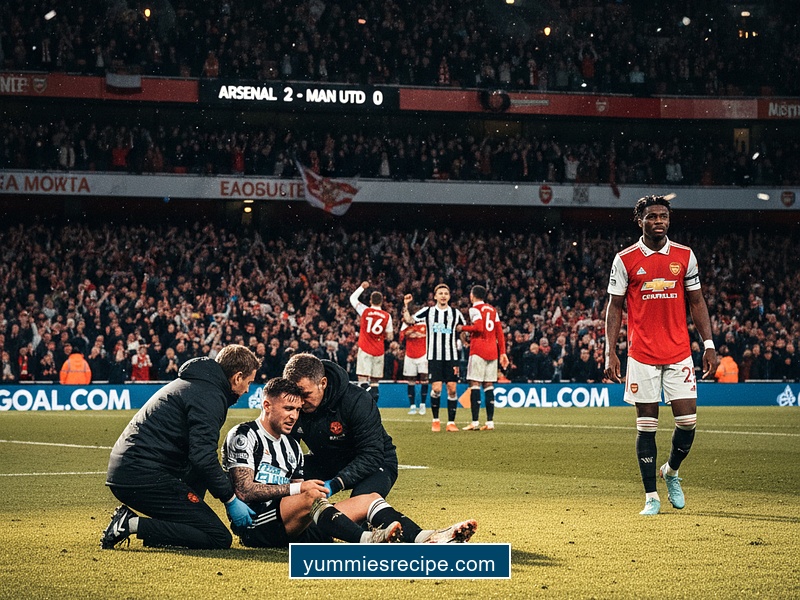
The Premier League table is a liar. It presents a sanitized, linear hierarchy of success, stripping away the blood, sweat, and torn muscle fibers that underpin the rankings. When we look at the headlines—Arsenal sitting at the summit, Alexander Isak sidelined with a significant leg injury, and Kobbie Mainoo omitted from the Manchester United squad—we are not looking at isolated incidents. We are witnessing the forensic evidence of three distinct managerial philosophies colliding with the brutal reality of physiology and squad planning.
To view these events merely as team news is to miss the point entirely. This is about the "Project"—that nebulous buzzword used by boardrooms to buy time—and the exact moment where ideology meets the bone-crunching friction of the English game. Arsenal is the proof of concept; Newcastle is the warning label; Manchester United is the existential crisis.
Arteta's Totalitarian Efficiency
Arsenal resting at the top of the table is not a fluke of fixture scheduling; it is the dividends of a cultural purge that began three years ago. Mikel Arteta didn't just install a tactical system; he installed an operating system that demanded total compliance. The current dominance is built on the concept of Juego de Posición—positional play—where every player knows exactly where their teammates are without looking.
Historically, this level of automation takes four transfer windows to perfect. We saw the growing pains: the relentless passing in a horseshoe shape, the sterile possession of 2021. But look at the data now. Arsenal’s defensive stability isn't based on last-ditch tackles; it is based on structure. They suffocate opponents because their shape in possession acts as their primary defensive mechanism. When they lose the ball, they are already positioned to win it back.
"Sustainability in football is not about buying the best players; it is about reducing the cognitive load on the players you have. Arsenal players no longer think; they execute."
This is why Arsenal’s position is sustainable while others falter. They rely on the collective structure rather than individual brilliance. When a cog is replaced, the machine still turns, albeit perhaps slightly slower. Arteta has successfully transitioned from the "chaos phase" of a rebuild to the "maintenance phase." The floor has been raised so high that their bad days are still better than most teams' good days. That is the hallmark of a mature Project.
Howe, Isak, and the Redline of Intensity
Contrast the serenity of the Emirates with the medical emergency brewing on Tyneside. Alexander Isak’s significant leg injury is a disaster, but it was also a statistical inevitability. Eddie Howe has done a remarkable job, but his methodology comes with a heavy tax: physical attrition.
Howe’s Newcastle is built on the philosophy of intensity. It mirrors the high-pressing, transition-heavy style of Jurgen Klopp’s early Liverpool or Marcelo Bielsa’s Leeds United. The data shows Newcastle consistently ranks in the top percentile for sprints and high-intensity runs. However, history teaches us a cruel lesson about this approach: without a squad capable of deep rotation, the human body breaks.
The "Project" at St James' Park accelerated faster than the recruitment department could keep up. They qualified for the Champions League ahead of schedule, placing a European workload on a domestic squad skeleton. Isak is not just a striker; he is the tactical release valve. His ability to carry the ball relieves pressure on a midfield that runs itself into the ground. Without him, the system loses its vertical threat, forcing the midfield to work even harder to generate chances.
This is the glass ceiling of the Howe philosophy. You cannot redline the engine every three days. We saw this with Pochettino at Spurs in 2018—the team ran out of gas because the philosophy demanded more than the physiology could provide. Unless the Saudi-backed ownership accelerates squad depth to match the intensity of the manager's demands, Newcastle risks becoming a team that burns bright and burns out.
The Manchester United Identity Vacuum
Then we arrive at Old Trafford, where the omission of Kobbie Mainoo signifies a much deeper rot than a simple selection decision. Erik ten Hag is currently presiding over a Project that is entering its third year with less defined identity than Ange Postecoglou managed at Tottenham in three months.
The reliance on Mainoo—a teenager—to fix a dysfunctional midfield structure earlier in the season was an indictment of the club's recruitment. His absence now highlights the volatility of Ten Hag's management. Is this protection? Or is it confusion? The manager speaks of wanting to be the "best transition team in the world," yet the recruitment suggests a desire for possession.
| Metric | Arsenal (Structured) | Man Utd (Chaotic) |
|---|---|---|
| Passes Allowed Per Defensive Action (PPDA) | Low (Intense, Organized) | High (Passive, Disjointed) |
| Midfield Turnovers | Rare | Frequent |
| Space Between Lines | Compressed (10-15m) | Vast (25-30m) |
The table above illustrates the chasm. United’s "Project" is currently a series of expensive individual moments masquerading as a tactic. When Mainoo is out, the team loses fluidity because there is no systemic floor to catch them—unlike at Arsenal. Ten Hag is caught between the Ajax school of control and the Premier League reality of chaos, resulting in a side that is porous defensively and reliant on individual brilliance offensively.
Historically, Manchester United flourished under Ferguson not just because of spirit, but because of adaptability. The 1994 team was physically dominant; the 2008 team was tactically fluid. Ten Hag has yet to imprint either. Leaving Mainoo out might be physically prudent, but it exposes the lack of a coherent Plan B. If the system fails because an 18-year-old is missing, there is no system.
The Verdict: Structure vs. Attrition
The league table tells us Arsenal is top, but the context tells us why they will likely stay there. Arteta has built a self-sustaining ecosystem. The players serve the system.
Newcastle is currently fighting the laws of physics. Howe’s philosophy is sound, but his timeline is out of sync with his squad depth. The injury to Isak is a siren, warning that grit and running power have a shelf life.
Manchester United remains a graveyard of intentions. The Mainoo situation is a microcosm of a club that doesn't know what it wants to be. Until Ten Hag establishes a philosophy that survives personnel changes, they will remain trapped in a cycle of false dawns.
Football management is no longer just about the locker room speech. It is about managing the cognitive load, the physiological redline, and the tactical identity. Right now, only one of these three managers has balanced the equation.