
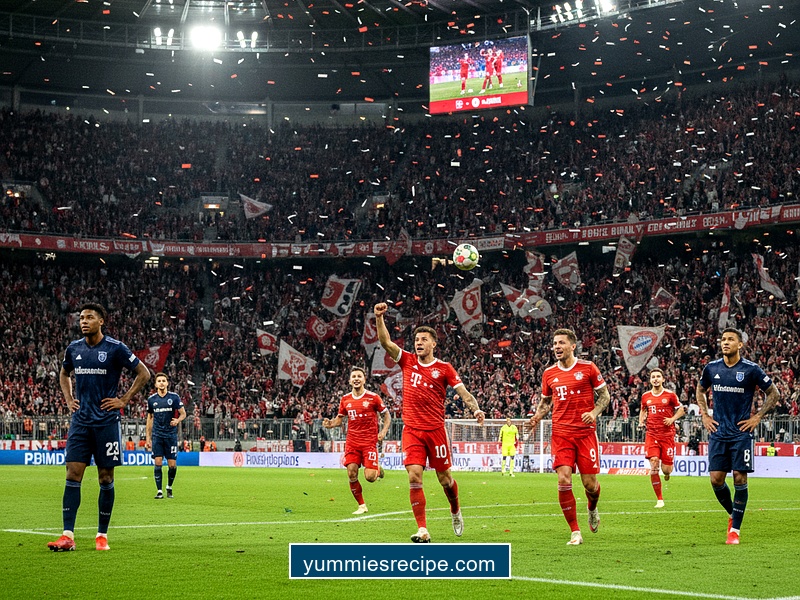
The scoreboard at the Allianz Arena read 4-0, but the scoreline was the least interesting statistic of the afternoon. When Bayern Munich dismantled Heidenheim this weekend, securing a nine-point cushion atop the Bundesliga entering the winter break, they didn't just win a football match. They signaled the end of the "transitional" chaos that has plagued the club since the abrupt dismissal of Julian Nagelsmann.
For the casual observer, a drubbing of Heidenheim—a club that punches miraculously above its weight under Frank Schmidt but lacks the budget of Bayern’s kit laundry service—is expected. But to dismiss this as routine is to ignore the granular details of how Vincent Kompany has re-engineered this machine. This wasn't the fragile, neurotic Bayern of Thomas Tuchel that would lead 2-0 and collapse.
This performance, and the dominance of this Hinrunde (first half of the season), vibrates with a frequency we haven't felt in Bavaria for over a decade. It echoes the ruthless, suffocating efficiency of Jupp Heynckes’ 2012-13 treble winners.
The Anatomy of a Nine-Point Chasm
A nine-point lead at Christmas is effectively a coronation in German football. History tells us this. But the texture of the lead matters more than the math. Last season, Bayer Leverkusen embarrassed the Munich hierarchy not just by winning, but by playing with a joy and invincibility that Bayern had lost. The response this season has been cold, hard, and terrifyingly serious.
Against Heidenheim, Bayern faced the quintessential Bundesliga "spoiler" tactic: a deep 5-4-1 low block, physical disruption in midfield, and reliance on set-piece chaos. In previous years—specifically the erratic 2022-23 campaign—Bayern would have resorted to hopeful crosses (the "Cross and Inshallah" era) or been caught on a counter-attack by a pacy winger.
Instead, we saw surgical dismantling. The interchanging movement between Jamal Musiala, Leroy Sané, and Harry Kane rendered the Heidenheim defense dizzy. This is where the historical parallel becomes undeniable. We are witnessing a tactical reversion to the principles of 2013, filtered through modern positional play.
The Ghost of 2013: Heynckes vs. Kompany
To understand the magnitude of this current side, one must look back to the 2012-13 season. That year, Bayern was fueled by the trauma of the "Finale Dahoam" (the lost Champions League final to Chelsea). They played with a vengeance. Dante and Jerome Boateng formed a wall; upfront, Mario Mandžukić pressed like a maniac, and the wingers, Robben and Ribéry (Robbery), cut inside with lethal intent.
Vincent Kompany, often unfairly scrutinized for his lack of top-level managerial experience before arriving, has managed to synthesize the defensive high-line bravery of Pep Guardiola with the directness of Heynckes. The comparison is startling when you break down the personnel.
"This isn't about possession for possession's sake anymore. The verticality against Heidenheim was striking. When Bayern won the ball, they didn't reset; they attacked the jugular. That is the Jupp Heynckes DNA returning to the Allianz."
The Engine Room: Schweinsteiger then, Kimmich now
In 2013, Bastian Schweinsteiger was the spiritual and tactical heartbeat, operating as a box-to-box general alongside the destroyer Javi Martinez. Joshua Kimmich has spent the last three years in an identity crisis, debating whether he is a six, an eight, or a right-back. Under Kompany, Kimmich has found his Schweinsteiger-esque rhythm. Against Heidenheim, his distribution wasn't just safe lateral passing; it was line-breaking progression that bypassed Schmidt’s midfield press entirely.
| Metric | 2012-13 (Heynckes) | 2024-25 (Kompany) |
|---|---|---|
| Defensive Shape | Physical, deep stability (Dante/Boateng) | Aggressive High Line (Kim/Upamecano) |
| Primary Attack | Wing Isolation (Robben/Ribéry) | Central Overloads (Musiala/Kane) |
| Pressing Style | Positional Traps | Man-to-Man High Press |
| Vibe | Vengeful | Suffocating |
The Kane Supremacy vs. The Mandžukić Grunt
While the 4-0 scoreline is impressive, the role of Harry Kane distinguishes this team from the 2013 legends. Mario Mandžukić was a defensive forward’s dream—he battered center-backs to create space for Robben and Ribéry. Kane is different. He is both the Mandžukić and the Thomas Müller of 2013 combined.
In the Heidenheim match, Kane’s movement dropping deep drew the center-backs out of position, creating the vacuum that Musiala exploited. This is a level of sophistication the Bundesliga hasn't seen from a traditional number nine since Robert Lewandowski’s prime, but even Lewandowski was more of a pure finisher. Kane is the quarterback of the offense.
However, the true revelation is the supporting cast’s adherence to defensive duty. The 2013 team is legendary because Ribéry and Robben tracked back. Against Heidenheim, seeing Michael Olise and Leroy Sané sprinting 40 yards to recover possession in their own defensive third is the clearest indicator that Kompany has won the locker room. Talent has never been the issue in Munich; ego application has.
The Fallacy of the Weak League
Critics will inevitably look at the 9-point gap and decry the "Farmers League." This is lazy analysis. The Bundesliga currently boasts a Bayer Leverkusen side that went unbeaten last year and a tactically astute RB Leipzig. For Bayern to open such a wide gap by the winter break suggests that the opposition isn't weak—Bayern has simply elevated their floor.
Frank Schmidt’s Heidenheim is a metric for league health. They are disciplined, physical, and organized. Most teams struggle to break them down. Bayern’s ability to dismantle them 4-0 without shifting out of second gear is frightening. It suggests that the erraticism that allowed Leverkusen to sneak in last year has been cauterized.
The Defensive Gamble: Upamecano and Kim
If there is a divergence from the 2013 perfection, it lies at the back. The Boateng-Dante partnership was risk-averse. They were protected by Javi Martinez. The current pairing of Dayot Upamecano and Kim Min-jae is playing a high-wire act. Kompany demands they defend at the halfway line.
Against Heidenheim, this worked flawlessly because the press upfront was cohesive. But looking ahead to the Champions League knockout stages, this remains the single point of failure. A 4-0 win against a team with limited pace up top flatters a high line. The true test isn't Heidenheim; it’s when they face the transition speed of a Real Madrid or Liverpool in the spring.
The Winter Reality
A nine-point lead essentially ends the domestic conversation. In the history of the Bundesliga, no team has surrendered such a lead from this position in the three-point era. The Meisterschale is effectively being polished for a May return to Marienplatz.
But this editorial isn't a celebration of a title race effectively ending in December. It is an acknowledgment of a cultural reset. Bayern Munich has stopped trying to be the "modern, hip" club of Nagelsmann or the "conflict-ridden" soap opera of Tuchel. They have returned to being the boring, inevitable, crushing industrial complex of German football.
The 4-0 against Heidenheim wasn't a thriller. It was a statement of administrative competence on the pitch. And for the rest of Europe, that should be terrifying. The Bavarian giant isn't sleeping, nor is it stumbling. It is awake, it is angry, and it looks a hell of a lot like the treble-winning monster of 2013.