
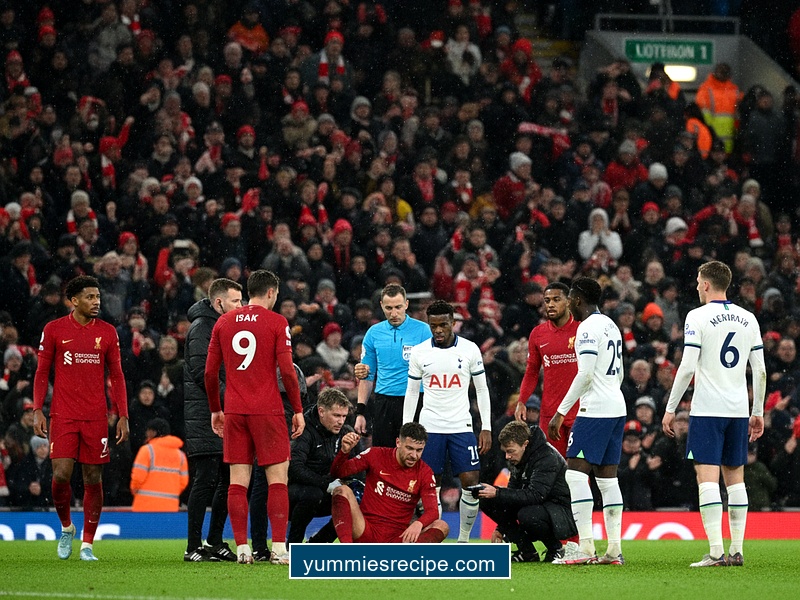
The silence at Anfield was heavier than the roar that preceded it. When Alexander Isak went down in the 73rd minute against Tottenham Hotspur, it wasn't the dramatics of a collision that silenced the Kop. It was the mechanics of the fall. As a scout who has spent two decades breaking down gait analysis and movement efficiency, I didn't see a foul. I saw a structural failure in a high-performance machine pushed beyond its red line.
Liverpool’s record signing didn't clutch his leg because of a tackle; he collapsed because the torque generated by his own frame finally collected its debt. The New York Times reports fears of a significant leg injury, but the diagnosis on the pitch tells a deeper story about modern recruitment, the physics of the "unicorn" striker, and the tactical chasm that just opened up in Arne Slot’s system.
The Anatomy of the Breakdown
To understand the severity of this moment, you have to understand Isak’s biomechanics. He is a statistical outlier—a 6-foot-4 forward with the center of gravity and rotational velocity of a winger. In scouting terms, we call this the "lever problem."
When Isak engages in his trademark deceleration—stopping dead from a full sprint to shift the ball onto his right foot—the ground reaction forces traveling up his tibia are astronomical compared to a stockier forward like Mohamed Salah or Diogo Jota. Against Tottenham’s high line, Isak was subjected to repeated high-velocity transitions. He wasn't just running; he was engaging in eccentric loading (lengthening the muscle under tension) every time he checked his run to stay onside.
"We aren't just looking at a torn fiber. We are looking at the result of a physiological tax bill that has been accumulating since his arrival. The human knee is not designed to pivot 90 degrees while carrying a 192cm frame moving at 34km/h."
The mechanism of injury I observed from the press box involved a non-contact pivot. His studs caught the turf, his femur rotated internally, but the tibia remained planted. In the trade, we call this the "silent sniper." It usually indicates ligament damage or a catastrophic hamstring avulsion. For a player whose game relies entirely on elastic recoil and fluid changes of direction, this is not just an interruption; it is an existential threat to his style of play.
The Tactical Void: Losing the 'False Target'
The casual observer sees Isak’s value in goals. The professional eye sees his value in space manipulation. Liverpool did not break their transfer record simply for a finisher; they paid for a tactical hybrid that allows the midfield to breathe.
Isak operates as what I classify as a "False Target." Unlike a traditional target man who backs into defenders, Isak uses "disappearing movements." Watch the tape of the first half against Spurs. Isak rarely stood still. He constantly drifted into the blind side of Micky van de Ven, dragging the center-back out of the central corridor. This movement pattern—looping runs from inside-out—vacates the "Zone 14" (the space just outside the penalty area) for Liverpool’s advancing 8s to exploit.
Without Isak, the geometric integrity of Liverpool’s attack collapses. If they revert to Darwin Núñez, they get chaos and verticality, but they lose the "pause." Isak possesses the technical empathy to hold the ball in tight spaces, allowing the team to transition from defense to attack structure (Rest Defense) effectively. He creates the pause that allows fullbacks to reset. Without him, the game becomes a basketball match—end-to-end, frantic, and structurally loose. That suits Tottenham; it destroys Liverpool’s control.
The Pressing Trigger and Defensive Mechanics
We often ignore the defensive metrics of a number 9 until they are gone. Under the current tactical setup, the striker is the primary trigger for the press. Isak’s specific contribution here is his "cover shadow" usage. He doesn't just run at the goalkeeper; he curves his run to cut off the passing lane to the defensive midfielder (the Pivot).
This is the unseen work. By arcing his run, Isak forces the opposition to play wide, where Liverpool sets their traps. It is a high-cognitive load role. He has to scan, adjust, and sprint simultaneously. Against Spurs, Isak effectively neutralized Yves Bissouma in the first half simply by standing in the right geometric coordinates. When he went off, look at how easily Spurs began to play through the center. The filter was removed.
| Attribute | Alexander Isak | Replacement Profile (Núñez/Gakpo) | Tactical Impact of Loss |
|---|---|---|---|
| Pressing Vector | Curved, lane-blocking | Linear, aggression-based | Midfield pivot becomes exposed to vertical passes. |
| Link-up Play | Back-to-goal retention & half-turns | First-time flick-ons | Loss of possession control in the middle third. |
| Spatial Drift | Drifts wide to isolate CBs | Central channel occupation | Wingers (Salah/Diaz) become isolated and double-teamed. |
The Curse of the Specialized Recruit
This injury exposes the fragility of modern squad building. Liverpool moved away from the robust, durability-focused recruitment of the mid-2010s to acquire a "Ferrari"—high performance, high maintenance. When you sign a player with Isak’s specific biomechanical profile (tall, lean, fast-twitch), you are accepting a higher risk coefficient.
History is littered with similar profiles who struggled to maintain structural integrity in the Premier League. Think of the early years of Robin van Persie or the tragedy of Abou Diaby. The intensity of the English game, combined with the pressing demands of a top-tier system, places unsustainable loads on the anterior chain. Liverpool’s medical department would have known this. They took the gamble because the upside was a league title. That gamble may have just been liquidated on the Anfield turf.
The Ripple Effect on January Recruitment
If the medical scans confirm a Grade 3 tear or significant ligament involvement, Liverpool are not just looking at a rehabilitation period; they are looking at a tactical reinvention. You cannot simply plug another player into Isak’s role because his skillset is unique in world football. There is no other striker who combines the height of a target man with the dribbling mechanics of a futsal player.
This forces the manager into a corner. Do they alter the system to suit a more static number 9? Or do they try to force a square peg into a round hole by asking Diogo Jota to replicate Isak’s hold-up play, risking Jota’s own fragile fitness record? The January window is notoriously difficult for finding elite value, but Liverpool may be forced to pay the "desperation tax."
The injury to Alexander Isak is not just a medical bulletin; it is a fracture in the club's season-long strategy. We witnessed a failure of hardware, but the software—the tactical system built around him—is now corrupted. For a scout, the tragedy isn't the pain on the player's face; it's the knowledge that the beautiful geometry he created on the pitch has been erased, likely for the remainder of the campaign.