
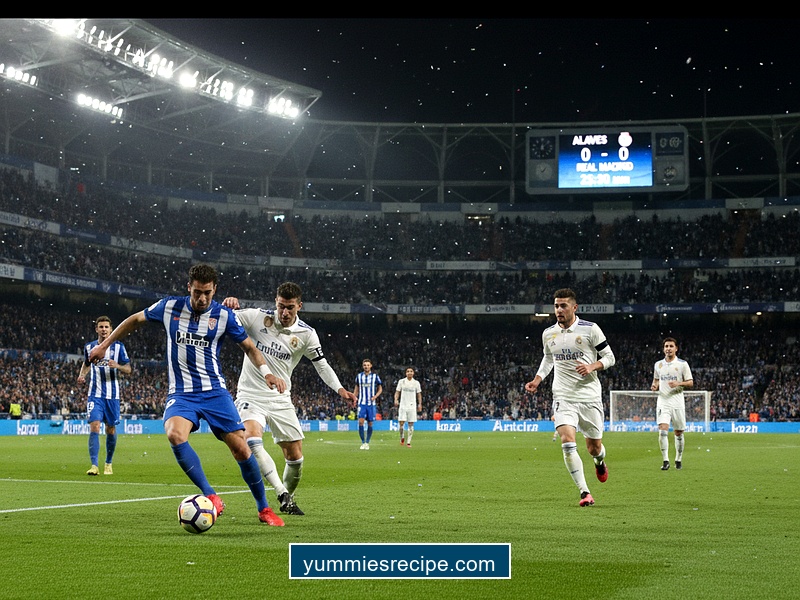
The teamsheet at Mendizorrotza tells you who is playing, but it never tells you who is ready to suffer. When Alaves hosts Real Madrid, we are not merely watching a football match; we are witnessing a collision of psychological architectures. As a scout, I stop looking at the ball after the first five minutes. The truth of this fixture lies in the micro-adjustments, the biomechanics of exhaustion, and the silent, violent communication that happens when the referee looks away.
While the mainstream press obsesses over Carlo Ancelotti’s rotation policy or the glitz of Kylian Mbappé and Vinícius Júnior, the real story is found in the dirt. It is found in the negative space. Real Madrid does not win league titles because they are faster; they win because their "rest defense" is a masterclass in arrogance, and today, Alaves must dismantle that arrogance to survive.
The Biomechanics of Deceleration
Let’s talk about what makes Vinícius Júnior and his attacking cohorts nightmares for a low-block defense like Alaves. Pundits talk about their speed. That is lazy analysis. In the scouting world, top-tier speed is common; top-tier deceleration is the unicorn.
Watch the Alaves right-back today. Don't watch the ball. Watch his hips. When Vinícius drives at him, the Brazilian has the kinetic ability to drop from 34 km/h to zero in two steps. This is the "ankle breaker." The defender’s momentum carries him backward, opening a half-meter of separation. That gap is where the game is decided.
For Alaves to cope, their defensive line cannot rely on reaction. They must rely on pre-orientation. If the fullback is square-on (shoulders parallel to the sideline) when Madrid’s winger receives the ball, he is already beaten. He must adopt a staggered stance, showing the touchline, inviting the drive outside. If Alaves’ defenders square their hips, Madrid will cut inside and operate in the half-spaces, leading to a tactical slaughter.
Scanning Frequency: The Midfield Battleground
The modern game is decided by "scanning"—the number of times a player checks his shoulder before receiving possession. Jude Bellingham and Fede Valverde operate at a scanning frequency that borders on neurotic. We are talking about 0.6 to 0.8 scans per second in high-traffic areas.
"The elite player plays the game in the future. The average player plays in the present. The poor player plays in the past."
This is where Alaves often loses the game before a tackle is made. Madrid’s midfielders manipulate the "blind side" of the Alaves double pivot. By drifting just two yards behind the vision of the defensive midfielder, they force the Alaves player to constantly turn his head. This causes cognitive fatigue.
By the 60th minute, that split-second delay in processing information—because the neck muscles and the brain are tired—creates the pockets of space Madrid exploits. A scout looks for the moment the Alaves midfielder stops checking his shoulder. That is the moment the game is lost.
The Psychology of the Low Block
Alaves will likely deploy a compact 4-4-2 or 5-4-1 out of possession. The "distance of relation" between their center-backs and central midfielders is critical. Ideally, this vertical distance should never exceed 12 meters. It suffocates the space "between the lines."
However, watching this structure requires an understanding of body language. Look for the "shrug." When Madrid circulates the ball harmlessly across the backline—Tchouaméni to Rüdiger and back—watch the Alaves forwards. If they drop their shoulders or throw their hands up in frustration at their lack of possession, Madrid has them. That body language signals a breakage in the team’s collective focus.
Real Madrid thrives on this boredom. They weaponize patience. They are the best team in the world at doing absolutely nothing for 10 minutes, lulling the opposition into a false sense of security, and then executing a vertical transition in three seconds. If Alaves loses discipline in their shuttle runs—sliding left to right as a unit—Madrid’s diagonal switch (the cambio de juego) will catch the fullback isolated.
The Unseen Work: Rest Defense
The most underrated aspect of this Madrid side is their "Rest Defense" (Restverteidigung). This is the positioning of the players not involved in the attack while their team has possession.
When Madrid attacks the Alaves box, watch their center-backs and the holding midfielder. They do not just stand and watch. They actively close the space behind the attack to suffocate any potential counter-attack before it begins. They perform "preventative marking" on the Alaves outlets.
For Alaves to get a result, their striker must be physically violent in his hold-up play. He cannot just win the header; he must secure the ball against a defender who is already physically leaning on him. If the Alaves outlet man cannot hold the ball for three seconds to allow his team to breathe and move up the pitch, the wave of Madrid pressure returns instantly. This creates a cycle of suffocation that leads to inevitable defensive errors.
Historical Context and The 'Mendizorrotza Factor'
We must acknowledge the venue. The Estadio de Mendizorrotza is a claustrophobic ground. The stands are steep, the pitch often feels tighter than the Bernabéu (though standard dimensions apply, the visual perception affects player spacing). Historically, Madrid struggles here when the tempo is chaotic. The "Vitoria-Gasteiz" climate—often colder and windier—can turn the ball into a slippery projectile, favoring direct play over intricate passing.
In the 2020/21 season, Alaves shocked Madrid at the Di Stefano, and they have historically been a "bogey team" capable of disrupting rhythm. But the current iteration of Madrid is less reliant on rhythm and more reliant on moments of individual brilliance that defy tactical structure. Alaves manager Luis García Plaza knows he cannot out-tactic Ancelotti; he must out-work them. But work rate without structural integrity is just suicide by cardio.
The Verdict
Do not be fooled by the possession stats. Alaves may end this game with 30% possession yet feel like they are in control if they force Madrid wide. The danger zone is the "Zone 14" (the central area just outside the penalty box). If Alaves collapses too deep, inviting shots from Valverde or Bellingham, they will concede.
I will be watching the hands. The hands of the Alaves defenders grabbing shirts, checking runs, and the hands of Madrid players gesturing for calm. The team that controls their emotional baseline in the cauldron of Mendizorrotza takes the points. Madrid’s technical superiority is a given, but it is their emotional indifference to pressure that makes them lethal. They don't panic. They just wait.