
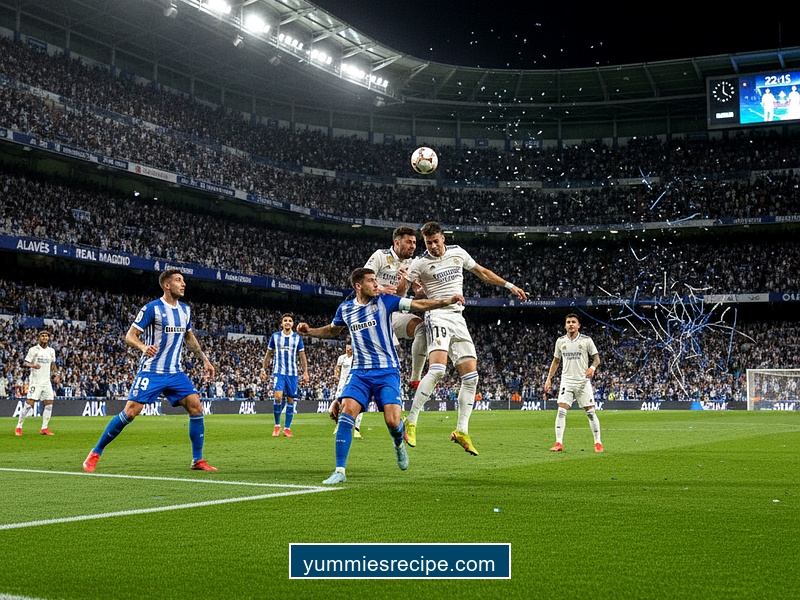
The casual observer watches the ball; the scout watches the space. When Real Madrid travels to the Mendizorrotza to face Deportivo Alavés, the narrative usually fixates on the Galactico glitter—the market value of the forward line versus the budget of the Basque hosts. But having spent two decades analyzing the minutiae of La Liga, I can tell you that Tuesday’s clash isn’t about who steps over the ball with more flair. It is about the brutal, silent geometry of the pitch.
Carlo Ancelotti’s Madrid is often accused of relying on individual brilliance, labeled as a team of "moments" rather than systems. This is a lazy critique. The reality, visible only when you strip away the hysteria of the scoreboard, is a masterclass in functional relationism. Against a Luis García Plaza side that thrives on suffocating vertical channels, the true battle will be fought in the half-spaces and the unseen communication between Madrid’s pivot and their erratic, brilliant forwards.
The Deception of the "Rest Defense"
Most post-match analyses will show you heat maps. I prefer to look at the "Rest Defense" (Restverteidigung). This is the structure a team maintains while attacking, purely to prevent counter-attacks. At the Mendizorrotza, a stadium that traps noise and encourages chaotic transitions, Madrid’s Rest Defense is their lifeline.
Watch Aurelien Tchouaméni or Eduardo Camavinga—not when they have the ball, but when Vinícius Júnior loses it. There is a specific trigger movement: the immediate shortening of the pitch. The pivot doesn’t drop back; he steps lateral. This cuts off the diagonal outlet pass to the Alavés winger (likely Carlos Vicente or Rioja, historically). It is a game of angles, not tackling.
"An elite pivot doesn't win the ball back; he forces the opponent to play a pass they don't want to make. He dictates the mistake before it happens."
If you watch the body language of the Alavés midfield, look for the "head drop" immediately after winning possession. That split second of hesitation caused by Madrid’s suffocating central positioning allows Fede Valverde to engage his recovery sprint. Valverde’s biomechanics are distinct; his deceleration is as violent as his acceleration. This allows him to "brake" in the passing lane rather than overrun it, a flaw seen in lesser box-to-box midfielders.
Alavés and the Art of the Low Block Accordion
Luis García Plaza is a pragmatist, but he is also a specialist in vertical compactness. Alavés does not just "park the bus"; they operate an accordion. When Madrid’s center-backs have the ball, Alavés will likely sit in a 4-4-2 or a 5-4-1 mid-block, keeping the distance between their striker and their center-backs to under 30 meters.
This compactness forces Madrid’s creative players to receive the ball with their back to goal. This is where the scout’s eye moves to the hips. Watch Jude Bellingham. His elite trait isn't his finishing; it’s his ability to receive the ball on the "half-turn" within a telephone booth of space. He scans his blind side an average of 0.6 times per second before receiving. This high-frequency scanning allows him to know exactly which Alavés defender has committed his weight to the wrong foot.
The "Gravity" of Kylian Mbappé
Integrating a superstar like Mbappé into a functioning ecosystem requires sacrificing structural rigidity. In this match, pay attention to Mbappé’s movement when the ball is on the opposite flank. If Vinícius has the ball on the left, does Mbappé crash the box, or does he loiter on the edge of the area?
This "loitering" is tactical gravity. By refusing to enter the box immediately, he forces the Alavés center-backs to make a decision: hold the line and leave him free for a cutback, or step up and leave space behind for a Rodrygo or Bellingham run. It is a psychological war. You can see the anxiety in defenders like Abdel Abqar; they are constantly pointing, shouting, trying to hand off marking responsibilities. That confusion is where Madrid lives.
The Invisible War: Set Pieces and "Dark Arts"
Alavés knows they cannot outplay Madrid in possession, so they will weaponize stoppages. La Liga has seen a resurgence in set-piece specificity, and Alavés is excellent at creating "picks" (basketball screens) in the box. Watch the Alavés attackers target Madrid’s goalkeeper, Thibaut Courtois or Andriy Lunin, not to win the ball, but to prevent him from claiming the cross.
Antonio Rüdiger’s role here is paramount. We often praise Rüdiger for his tackles, but his true value lies in his "shithousery"—the dark arts. Watch how he engages the striker before the ball is even kicked. A tug on the jersey, a step on the toe, invading personal space. He disrupts the opponent's rhythm and focus. It’s ugly, it’s cynical, and it’s absolutely necessary to win league titles on cold Tuesday nights in Vitoria.
Historical Context: The Ghost of the "Quinta del Buitre"
To understand why this specific fixture matters, we must look backward. In the 1980s, the "Quinta del Buitre" Madrid side dominated through cohesion and rhythm. Today’s Madrid is different; they dominate through physical superiority and technical improvisation. This shift mirrors the evolution of modern football—from orchestrated symphonies to heavy metal jazz.
Alavés represents the old guard of Spanish football: grit, organization, and the belief that a system can defeat talent. However, the data suggests that the "system" is breaking under the weight of modern athleticism. Teams that press Madrid high usually suffer in the last 15 minutes as their anaerobic capacity drains. Madrid, conversely, seems to get stronger.
Key Matchups: The Scout's Card
If you are watching the game, ignore the ball for ten minutes and focus on these individual duels. They will dictate the tempo.
| Zone | The Duel | Tactical Indicator to Watch |
|---|---|---|
| Left Flank | Vinícius Jr vs. Alavés RB | The Stop-Start: Does the defender commit to the first feint? If Vini gets the defender's hips turned toward the touchline, the duel is over. |
| Central Channel | Valverde vs. Guevara/Blanco | The Second Ball: Who reacts faster to the loose ball? This measures mental fatigue and anticipation. |
| Defensive Third | Rüdiger vs. Kike García (or target man) | The Pin: Can the striker back into Rüdiger to bring teammates into play? If Rüdiger steps in front, Madrid dominates transition. |
The Verdict: Intensity over Esthetics
Do not expect a beautiful game. Expect a fractured one. Luis García Plaza will instruct his team to break the rhythm—tactical fouls in the middle third will be high. The "effective playing time" might drop below 55 minutes.
For Real Madrid, the challenge is mental. Can they maintain the discipline of their "Rest Defense" when frustrated by a low block? Can Vinícius keep his cool when the inevitable double-team arrives with physical aggression? The points in La Liga aren't won in the El Clásico blowouts; they are scraped together in matches like this, where the grass is heavy and the opponent refuses to dance.
Watch the shoulders. Watch the scanning. Watch the space. That is where the truth of this match lies.