
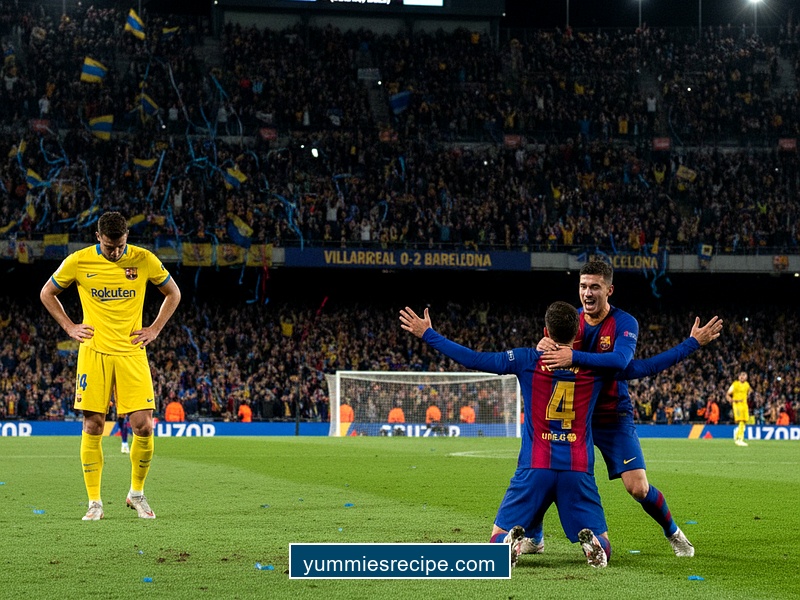
The Estadio de la Cerámica has never been a place for the faint of heart. It is tight, hostile, and historically, a graveyard for Catalan ambitions. Yet, on this biting December evening in 2025, Barcelona didn't just escape with a 2-0 victory; they engaged in a masterful act of historical reenactment. To the casual observer checking the scoreline on an app, this was a routine victory sending the Blaugrana four points clear at the summit of La Liga. To those of us who have tracked the pulse of this club for two decades, it was something far more potent.
We are no longer watching the sterile, hypnotic geometry of the 2011 Guardiola era, where opponents were suffocated by possession until they simply ceased to exist. This Barcelona, gritty and occasionally cynical, echoes the raucous, mercurial spirit of Frank Rijkaard’s 2005-06 side. It is a team that knows how to brawl as well as it knows how to dance.
The Myth of the "Clean" Victory
Villarreal’s manager spent the post-match press conference incandescent with rage regarding the red card that reduced his side to ten men. His frustration is understandable, but his surprise is naive. The dismissal changed the topography of the match, certainly, turning a contest of equals into a siege. However, focusing solely on the officiating ignores the tactical attrition that preceded it.
Great teams possess a gravitational pull that forces errors. In the mid-2000s, it was Samuel Eto’o’s incessant pressing that panicked defenders into rash challenges. Today, that anxiety is generated by the sheer verticality of Barcelona’s transition play. When you force a defender to make a decision at full sprint while facing his own goal, you are not relying on luck; you are engineering probability. The red card at Villarreal wasn't a gift; it was the inevitable structural failure of a defense stressed to its breaking point.
Historically, this mirrors the 2009 Champions League semi-final against Chelsea—often cited for the chaos of Ovrebo’s officiating, but rarely analyzed for the sheer panicked exhaustion Iniesta and Xavi forced upon the Chelsea low block. Tonight, Villarreal cracked. That is what title contenders make you do.
Lamine Yamal: The Heir to the 2006 Throne
Lamine Yamal’s goal was not merely a statistic; it was a statement of intent that bridges a twenty-year gap. In December 2025, Yamal operates with a terrifying maturity that belies his years. But the comparison here isn’t the fully formed Lionel Messi of 2012, scoring 91 goals in a calendar year. That is a lazy parallel.
Instead, Yamal tonight channeled the 19-year-old Messi of the 2006-07 season—specifically the version that announced himself with a hat-trick against Real Madrid in March 2007. There is that same audacity to drive into traffic, not to pass, but to disrupt. When Yamal cut inside from the right flank to bury the opener, the mechanics were eerily familiar. The low center of gravity, the deceptive pause before the strike, the refusal to go down under contact.
However, there is a divergence in evolution. While the young Messi was a pure soloist, a force of nature operating within a system, Yamal in late 2025 has become the system’s conductor. His ability to switch play to the opposite flank—a trademark of Ronaldinho’s playmaking from the left in 2005—adds a layer of unpredictability that the "Messidependencia" years eventually lacked. Yamal is not just finishing moves; he is dictating the tempo of the attrition.
"To compare anyone to the legends of 2009 is dangerous. But to ignore the grit of the 2005 champions is to forget how this club actually learned to win. We are seeing the return of the fighters."
The Four-Point Cushion: A Dangerous Comfort
Being four points clear entering the Christmas break is the classic "Winter Champion" narrative, but let us dissect the numbers. In the 2008-09 treble-winning season, Guardiola’s Barça had already amassed 50 points by the midway stage, effectively ending the league in January. This current iteration is not that juggernaut. They are closer to the 2004-05 team that won the league with 84 points—a triumph built on grinding out results away from home rather than obliterating opponents.
The reliance on a 2-0 scoreline against a ten-man Villarreal suggests a pragmatism that many Culés find uncomfortable. The Catalan exigency demands style over substance, but the reality of modern European football requires the ability to suffer. The defensive solidity shown tonight, marshaled by a backline that celebrated blocks like goals, recalls the partnership of Carles Puyol and Rafael Márquez. It wasn't elegant. It was often desperate. But it was the foundation upon which the artistry was allowed to flourish.
Tactical Evolution: The Death of Tiki-Taka, The Birth of Verticality
We must address the elephant in the room: possession stats are becoming irrelevant for this Barcelona side. In the golden era (2008-2012), possession was a defensive tactic—if we have the ball, they can't score. Tonight, Barcelona seemed content to let Villarreal have the ball in harmless areas, springing traps in the middle third.
This is a tactical regression to a more direct style, reminiscent of the chaotic brilliance under Luis Enrique in 2015, but with less star power and more collective lung capacity. The midfield trio, rather than weaving intricate triangles, acted as pistons. They bypassed the slow buildup to feed the wings immediately. It is high-risk, high-reward football. When it fails, it looks disjointed. When it works, as it did for the second goal to seal the match, it is devastatingly fast.
The Verdict
Villarreal will feel aggrieved. The headlines will scream about refereeing decisions and the "big club bias" that has fueled bar debates in Spain for a century. But underneath the noise, something substantial is hardening in Catalonia.
For the first time in a decade, Barcelona looks like a team comfortable with being the villain. They are no longer trying to convince the world of their moral superiority through "pure" football. They are happy to go to the Cerámica, infuriate the crowd, weather the storm, and leave with three points and a smirk.
If the 2011 team was a symphony, this 2025 team is a rock band—loud, occasionally messy, but undeniably electric. Lamine Yamal is playing the lead guitar, but the rhythm section is doing the dirty work that wins titles. Four points clear is not a dynasty, but for a club that has spent years chasing its own shadow, it looks remarkably like a future.