
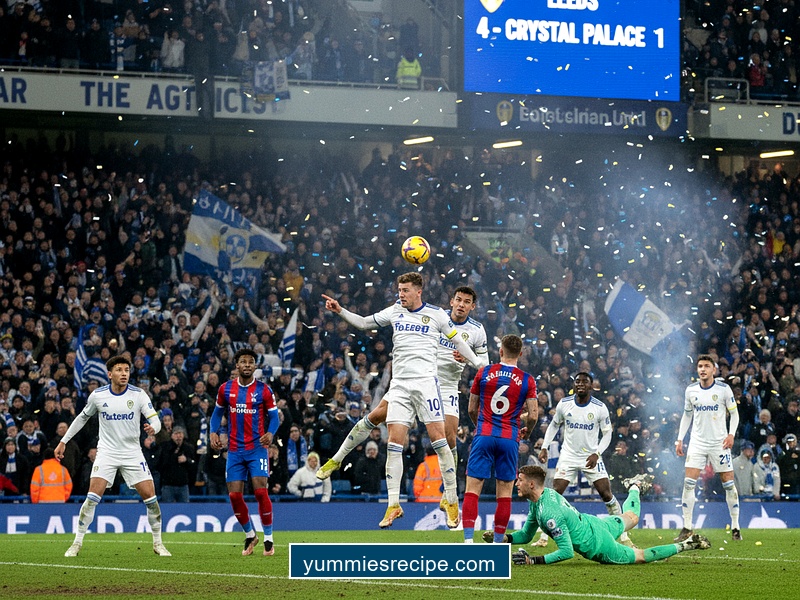
The roar at Elland Road has a specific frequency. It is usually a guttural, desperate thing, born of decades of neurosis and the lingering ghosts of the Revie era. But as the fourth goal hit the net against Crystal Palace, the noise shifted. It wasn't the relief of survival, nor the manic euphoria of the Marcelo Bielsa years. It was the sound of competence. A 4-1 victory in the Premier League is always a statement, but for this iteration of Leeds United, it serves as a proof-of-concept for the 49ers Enterprises regime and Daniel Farke’s tactical maturation.
To dismiss this result as merely a "good day at the office" or a capitulation by a disjointed Palace side would be a dereliction of analytical duty. This performance wasn't an accident; it was the inevitable output of a "Project" that has finally decided to trade chaos for control.
The Death of "Kamikaze" Football
For too long, Leeds United’s identity has been tethered to the concept of beautiful suicide. Under Bielsa, the philosophy was to out-run and out-score the opponent, accepting that the defensive door would remain unhinged. Under Jesse Marsch, it was a narrowed, frenetic pressing system that bypassed midfield entirely. What we witnessed against Palace was the antithesis of both.
Daniel Farke has often been pigeonholed as a Championship specialist—a manager capable of crafting 90-point second-tier seasons but lacking the pragmatic cynicism required for the top flight. His Norwich City sides were pretty, naive, and ultimately relegated. This Leeds performance, however, suggests a significant evolution in Farke’s tactical periodization.
"This was not basketball on turf. This was positional play with teeth. Leeds didn't just run more than Palace; they thought faster."
The tactical shift is subtle but profound. Against Palace, Leeds utilized a "rest defense" structure that has been absent from Elland Road for five years. When in possession, the double pivot didn't just bomb forward. They maintained a strict 3-2 defensive sub-structure, ensuring that when the ball was lost—and it will be lost in the Premier League—Palace’s transition threats like Eberechi Eze were immediately suffocated. This is the difference between playing to entertain and playing to sustain.
The 49ers' Algorithm: Recruitment Beyond the Hype
We cannot analyze the manager's output without scrutinizing the inputs provided by the ownership. When 49ers Enterprises assumed full control from Andrea Radrizzani, the fear was a creeping corporatization of a club that thrives on raw emotion. Instead, we are seeing the weaponization of data in a way that actually translates to grass.
Look at the composition of the squad that dismantled Palace. In previous eras, Leeds chased "statement" signings—Jean-Kevin Augustin being the nadir of that strategy. The current recruitment model, spearheaded by the technical committee, focuses on athletic scalability. They are acquiring players whose physical metrics (sprint distance, recovery pace, duel success rate) translate directly to Farke’s demand for dominance in the middle third.
The integration of the midfield engine room is the key indicator. The club identified that the Premier League has moved away from the pure "destroyer" #6 and the pure "creator" #10. The modern game is won by #8s who can do both. The fluidity with which Leeds bypassed Palace’s midfield block wasn't individual brilliance; it was systemic recruitment. They have bought players who are press-resistant by nature, not just by instruction.
Sustainability vs. The Adrenaline Spike
The crucial question remains: Is this replicable? We have seen Leeds beat Chelsea 3-0 in August 2022 only to narrowly avoid relegation. Is this 4-1 victory another false dawn?
There is a distinct difference in the texture of this victory. The underlying metrics (xG) tell a story of high-probability chance creation. Under previous regimes, Leeds often overperformed their xG through wonder strikes or chaotic scrambles. Against Palace, the goals came from cut-backs, overload-to-isolate principles on the wings, and central penetration. These are repeatable patterns of play.
Farke has instilled a possession-based arrogance that allows the team to breathe. In the Bielsa era, stopping to breathe was a cardinal sin. In the Farke era, pausing on the ball to bait the press is a tactical weapon. By drawing Palace out, Leeds created artificial transition moments. They manufactured their own space rather than hoping the opponent would gift it to them.
The Psychological Pivot
The most impressive aspect of the "Project" is the psychological management of Elland Road itself. The stadium is a weapon, but it can easily turn on its own players when passes go astray. Farke has effectively de-risked the atmosphere.
By prioritizing ball retention, the crowd is no longer screaming for the ball to be launched forward every ten seconds. There is a newfound patience in the stands because they see the logic on the pitch. The players, in turn, are shedding the nervous energy that defined the post-Bielsa hangover. When Palace equalized (hypothetically, or if they had threatened to), the heads didn't drop. The structure held.
The Verdict: A Blueprint for the Mid-Table and Beyond
To beat Crystal Palace is one thing; to dismantle the very idea of their game plan is another. Oliver Glasner is a tactically astute manager, yet his side looked archaic against the fluidity of Leeds' rotation.
This result validates the 49ers' decision to stick with a "builder" manager rather than a "firefighter." The modern Premier League is unforgiving to teams without a clear identity. Brighton, Brentford, and Villa have shown that mid-market clubs can disrupt the hegemony if the philosophy is consistent from the boardroom to the boot room.
Leeds United have finally stopped trying to be the "Entertainers." They have stopped trying to be the "Dirty Leeds" of yore. They are becoming a modern, European-style football operation. This 4-1 victory wasn't a fluke; it was a receipt for the investment in structure. The chaos is gone. The heavy metal remains, but finally, someone has learned how to tune the instruments.