
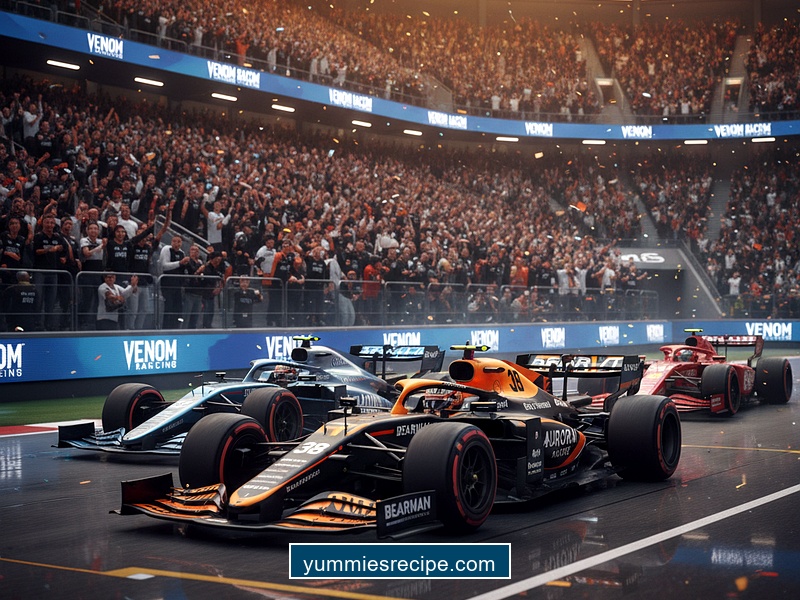
The paddock has a short memory. In March 2024, Oliver Bearman was the savior of Jeddah, a teenage substitute parachuted into a Ferrari SF-24 who managed to keep it out of the wall and inside the points. It was a feel-good story, the kind Netflix producers salivate over. But seasoned observers know that one race does not make a career. Nyck de Vries had a brilliant Monza cameo and was chewed up by the Red Bull machinery within months.
What we are witnessing in 2025, however, is not a hangover from that Saudi Arabian dream. It is something far more substantial, something that sends a shiver of recognition down the spines of those who were standing in the torrential rain at Monza in 2008. Oliver Bearman’s rookie campaign with Haas is no longer about survival; it is the most convincing midfield elevation we have seen since Sebastian Vettel dragged a Toro Rosso to the top step of the podium.
The Toro Rosso Parallel
To understand the magnitude of what Bearman is achieving this season, we must look back seventeen years. The 2008 Toro Rosso STR3 was a solid car, designed by Adrian Newey’s Red Bull Technology, but it was operated by a team that was formerly Minardi—perennial backmarkers. Yet, a young Sebastian Vettel didn't just drive it; he transcended it.
Vettel’s genius in 2008 wasn't just raw speed; it was an innate understanding of how to extract lap time from a chassis that lacked the downforce of the McLarens and Ferraris. He drove with a fluidity that masked the car's instability.
Bearman is replicating this specific alchemy in 2025. The VF-25 is, by all accounts, a midfield contender. It struggles with tire warmup in qualifying and suffers from drag on high-speed straights. Yet, look at the telemetry traces from Silverstone or Suzuka. Where his teammate—a race winner in Esteban Ocon—is fighting the steering wheel, making micro-corrections to keep the rear planted, Bearman is smooth. He is inducing rotation with pedal inputs rather than steering angle, a hallmark of the elite.
Beyond the "Super-Sub" Narrative
The danger of the "super-sub" label is that it implies luck. It suggests that the driver walked into a perfect situation. Jeddah 2024 was easy in one regard: zero expectations. Driving for Haas in 2025 brings the crushing weight of the cost cap era, where every point is worth millions in prize money.
The brilliance of Bearman’s transition lies in his technical feedback. Reports from the Haas garage suggest a level of maturity reminiscent of a young Niki Lauda. While rookies often chase peak downforce, obsessing over one-lap pace, Bearman has prioritized raceability. He has spent Friday practice sessions focusing on the degradation curve of the Pirelli C3 and C4 compounds, sacrificing headline times for long-run data.
This is where the Vettel comparison solidifies. In 2008, Vettel understood that the Toro Rosso could be fast if he managed the rear tires to allow for aggressive traction out of slow corners. Bearman has identified that the current ground-effect Haas requires a similar approach: compromise the entry to maximize the exit. It is a tactical sophistication that usually takes half a decade to learn. He has mastered it in six months.
The Ocon Benchmark
We cannot ignore the yardstick in the other garage. Esteban Ocon is no pushover. He stood toe-to-toe with Fernando Alonso at Alpine and didn't blink. For a rookie to arrive and immediately challenge, and frequently outperform, a driver of Ocon's caliber is statistically deviant behavior.
In 2001, Kimi Räikkönen arrived at Sauber with almost no car racing experience and immediately put pressure on Nick Heidfeld. That season convinced Ron Dennis to sign the Finn to McLaren. Bearman is doing to Ocon what Räikkönen did to the established order at Sauber. He isn't just beating him; he is forcing the team to develop the car around his preferences.
The internal politics at Haas have shifted. Usually, the veteran dictates the development path. But when the rookie is finding three-tenths in the high-speed transitioning sectors, the engineers stop listening to experience and start listening to the stopwatch. Bearman has effectively hijacked the technical direction of the team through sheer performance.
The Ferrari Endgame
Let’s not be naïve about the endgame here. This is an audition. Just as Vettel’s 2008 season was a warm-up for his promotion to Red Bull Racing, Bearman’s 2025 is being scrutinized by Maranello. With Lewis Hamilton in the scarlet car, Ferrari has a defined window. They need the successor ready not in five years, but in two.
The pressure of being the "Ferrari Prince" has broken many drivers—ask Antonio Giovinazzi or Mick Schumacher. The difference is the mental steel. Mick Schumacher crumbled under the weight of the Haas environment, struggling to find the limit without crossing it, resulting in costly chassis bills. Bearman finds the limit, lives on it, and brings the car home clean.
The Verdict
Formula 1 loves a "next big thing," often prematurely crowning drivers who eventually fade into the midfield obscurity. But the data does not lie. The gap between Bearman and the expected performance of the Haas chassis is the largest delta we have seen from a rookie since 2007-2008.
He has moved past the novelty of his debut. The narrative is no longer "Look at the kid go." It is now "How do we stop him?" In a sport defined by engineering margins, Oliver Bearman has become the variable that the spreadsheets couldn't predict. He isn't the future of F1; on current form, he is the only thing making the midfield worth watching right now.