
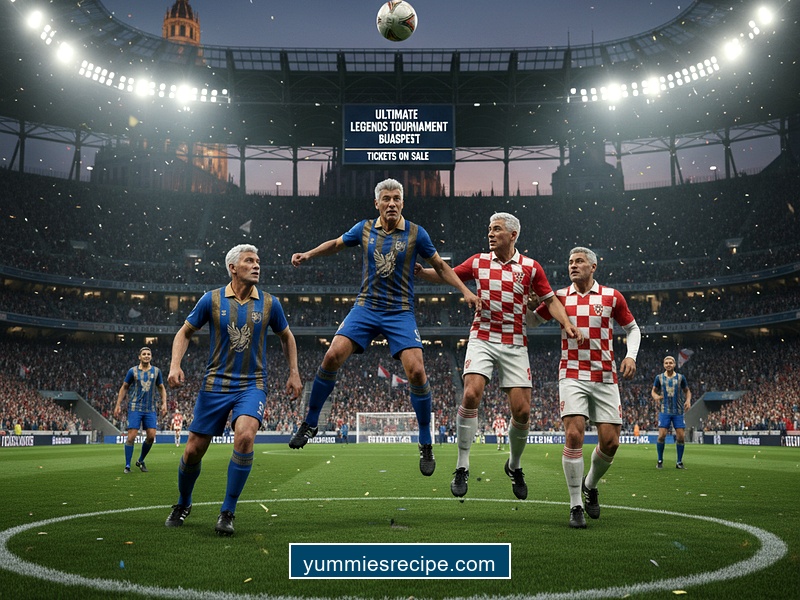
To the casual observer, the announcement from UEFA regarding the Ultimate Champions Legends Tournament in Budapest is an invitation to a carnival. It sells tickets based on sentimental value, promising a glimpse of graying temples and slightly tighter jerseys. But for those of us who have spent decades shivering in the gantries of Europe, scribbling notes on passing lanes and hip rotation, this isn't entertainment. It is a masterclass in biomechanical efficiency.
When the whistle blows in Hungary, do not look for speed. Speed is a depreciating asset; it abandons an athlete in their mid-30s. Look instead for the cognitive mapping that remains pristine long after the VO2 max has dropped. This tournament is an opportunity to study the "unseen" work—the dark arts of positioning and spatial manipulation—that defined the greatest era of European football.
The Economy of Movement: A Lesson in Conservation
Modern football is obsessed with pressing triggers and high-intensity interval running. We measure distance covered as a proxy for effort. However, watching a legends match offers a counter-narrative: the supremacy of the standing playmaker. When you watch a player like Clarence Seedorf or Andrea Pirlo operating in these environments, you witness what coaching manuals refer to as "La Pausa"—the ability to freeze the opponent by simply doing nothing.
Scouts call this "scanning frequency." In their prime, elite midfielders scan the field 0.6 to 0.8 times per second. Even at 45 or 50 years old, these legends retain that tick. Watch the head movement before the ball arrives. They aren't looking for the ball; they know where the ball is. They are mapping the exit route. By the time possession is secured, they have already played the pass in their mind three seconds prior. This creates an illusion of time. They aren't faster than the opposition; they are simply operating in a future timeline.
"Speed is often confused with insight. When I watch these veterans, I don't see slow players. I see players who have eliminated every unnecessary step from their gait. It is efficiency in its purest, most ruthless form."
The Hungarian Ghost: Contextualizing the Venue
Hosting this in Budapest is not merely a logistical choice; it is a spiritual return to the birthplace of modern tactical fluidity. We cannot discuss high-level football in this city without acknowledging the Aranycsapat—the Golden Team of the 1950s. Gustav Sebes and Nándor Hidegkuti invented the withdrawal of the center-forward, the precursor to the False 9 role that Messi popularized half a century later.
Why does this matter for a legends tournament? Because the football displayed by veterans often mimics the fluid, cerebral style of that Hungarian side. Lacking the explosive power to isolate defenders 1v1 on the wing, legends teams naturally drift into a system of interchangeable positions. The full-backs tuck in to conserve energy, becoming auxiliary midfielders. The strikers drop deep to link play. It is accidental total football, born of physical necessity but executed with technical perfection.
When you sit in the stands in Budapest, you are watching the ghosts of Puskás and Bozsik. The tactical geometry on display—triangles formed not by running, but by intelligent positioning—is a direct lineage to the 6-3 demolition of England at Wembley.
The Biomechanics of the First Touch
Let’s get technical about the touch. In academy scouting, we look for "ballstriking surface consistency." As muscles atrophy and fast-twitch fibers degrade, the kinetic chain required to strike a ball over 40 yards changes. However, the proprioception—the body's ability to sense its own position in space—does not fade.
Observe the likes of Luís Figo or Francesco Totti. When they receive a pass, pay close attention to the "check-shoulder" movement and the shielding arm. A modern winger relies on acceleration to beat a man. A veteran relies on leverage. They use their glutes to create a barrier, forcing the defender to run around their gravitational pull rather than through it. It is a lesson in physics. They effectively widen their silhouette, making the ball inaccessible without a foul. This is "old man strength" weaponized into tactical shielding.
Defensive IQ: The Art of Not Tackling
Paolo Maldini famously said, "If I have to make a tackle, then I have already made a mistake." This ethos defines the defensive play in these tournaments. Tackling requires recovery pace—if you miss, you must sprint back. Legends cannot afford that risk.
Instead, watch how the defensive lines manage depth. They utilize "rest defense" aggressively. Even when attacking, the center-backs rarely cross the halfway line, maintaining a compact structure that nullifies the counter-attack before it begins. They funnel the opposition into wide areas, using the touchline as an extra defender. This is positional shepherding. It is the exact opposite of the chaotic, high-line pressing we see in the Premier League, and frankly, it is more intellectually stimulating to analyze.
| Tactical Element | Modern Game Focus | Legends Game Focus |
|---|---|---|
| Space Creation | Sprinting into channels (Physical) | Manipulating opponent via feints (Cognitive) |
| Defensive Transition | Immediate counter-press | Positional delay and funneling |
| Ball Progression | Vertical carrying | Diagonal switching of play |
The Cognitive Load and the 'Blind Side'
The most underrated aspect of these players is their mastery of the "blind side." In professional coaching, we teach strikers to stand just outside the peripheral vision of the center-back. It forces the defender to constantly turn their head, disrupting their OODA loop (Observe, Orient, Decide, Act).
Legends like Andriy Shevchenko or David Trezeguet built careers on this. In Budapest, watch the movement in the box. They will stand still, perfectly static, in the exact square foot of turf where the defender cannot see them without turning 180 degrees. As soon as the defender turns to look at the ball, they move. It’s a game of "Red Light, Green Light" played at the highest level. They exploit the cognitive gaps of their opponents. They don't need to outrun you; they just need to move when you blink.
Why You Must Attend
If you are going to Budapest to see goals, you are missing the point. You go to watch the mechanics of greatness stripped of its physical armor. You go to see how a World Cup winner adjusts his hip orientation to open a passing lane that a 20-year-old wouldn't even see.
This tournament is a reminder that while the body is finite, football intelligence is infinite. The legs may be heavy, but the minds are razor-sharp. For a scout, or anyone who claims to understand the nuance of the beautiful game, this isn't a friendly. It’s a seminar on the permanent nature of class.