
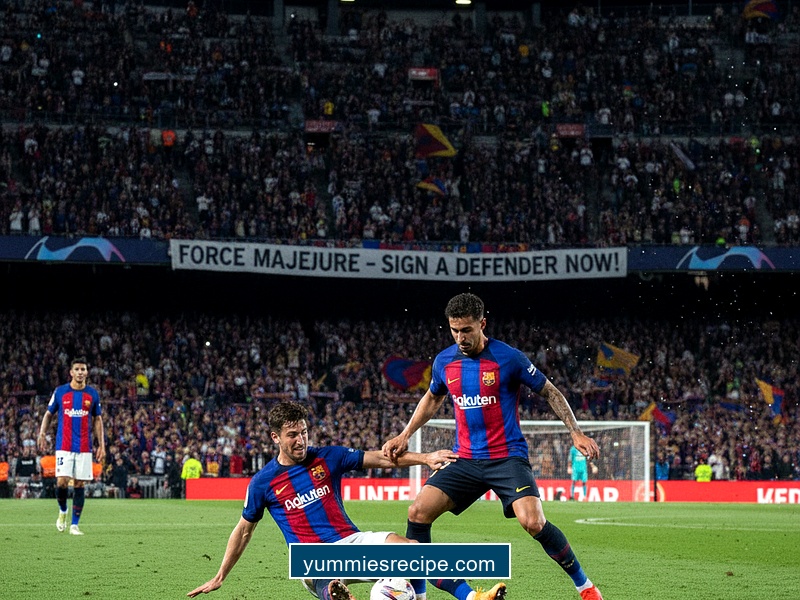
The stretcher comes out, the Camp Nou (or its ghost at Montjuïc) falls silent, and the calculators come out in the boardroom. It has become a macabre ritual in Catalonia. With the confirmation that Barcelona can utilize La Liga’s Article 77 regulations to sign a replacement following yet another long-term injury to a defensive pillar, the club once again finds itself relying on medical misfortune to solve sporting deficiencies.
For the uninitiated, the headline is simple: a player tears an ACL, and the league allows a signing. But the reality is a damning indictment of squad planning. We are witnessing the cannibalization of the future to patch a leak in the present. While Hansi Flick attempts to instill a Germanic verticality to this squad, the foundations remain trembling, built on hamstrings that snap and ligaments that tear.
The Fine Print of Desperation
Most readers glance at "Barcelona allowed to sign replacement" and assume it is a free pass. It is not. The application of Article 77 is a financial tightrope walk that Joan Laporta has normalized to a dangerous degree. This regulation permits a club to use 80% of the injured player's salary cap space to register a new signing. It does not give them extra money; it grants them permission to spend money they likely don't have, or more accurately, cap space they haven't earned.
There is a catch that often goes unreported. This "extra" space is essentially a loan against the following season's salary limit. Whatever Barcelona spends now to plug this defensive gap will be deducted from their operational capacity next summer. It is the footballing equivalent of a payday loan. You get the defender today, but you mortgage the transfer window of July.
"We are no longer watching a club operate within a strategy; we are watching a club operate within a triage unit. Every signing is a tourniquet."
The Ghost of the 2011 Wall
To understand the precipitous drop in standards, one must look back not just at the trophy cabinet, but at the team sheet of the 2010-2011 season. That year, under Pep Guardiola, Barcelona conceded just 21 goals in 38 La Liga matches. The spine of that defense—Carles Puyol, Gerard Piqué, Eric Abidal, and Dani Alves—offered something the current crop cannot purchase: availability.
Puyol, "El Tiburón," was not merely a defender; he was a cultural corrective. In the 2009-2010 season, despite his aggressive style, he played over 40 matches across all competitions. Piqué, in his prime, was a Panzer tank with the feet of a ballerina, clocking 50+ appearances regularly. They defended through possession, yes, but they also possessed a physical robustness that allowed the team to play a high line without fear.
Compare that granite durability to the porcelain reality of today. Ronald Araujo is arguably a more athletic specimen than Puyol ever was. He is faster, taller, and stronger. Yet, Araujo is a Ferrari that spends half the season in the garage. Andreas Christensen offers Piqué-esque distribution but lacks the durability to survive a 60-game season. When you rely on the Article 77 loophole, you are admitting that your primary assets are physically insolvent.
Tactical Regression: From Control to Chaos
The injury crisis forcing this potential signing exposes a tactical regression. In 2009, during the 6-2 demolition of Real Madrid at the Bernabéu, Puyol scored a header, but his greatest contribution was compressing the space. The defense played at the halfway line. They didn't need to make last-ditch tackles because the system strangled the opponent.
Today’s Barcelona defends in panic mode. They rely on "hero ball" defending—last-second blocks, dramatic clearances, and high-risk offside traps. This exerts tremendous biomechanical stress on the players. The high incidence of ACL and muscle injuries isn't just bad luck; it is the physiological cost of a system that exposes defenders to constant high-velocity transitions.
When Eric Abidal was diagnosed with a liver tumor in 2011, the squad absorbed the blow not by panic-buying a mercenary, but by shifting Javier Mascherano—a midfielder—into central defense. It was a solution born of tactical intelligence, not regulatory loopholes. Mascherano went on to produce a masterclass in the Champions League final against Manchester United. Today, the solution is to scour the free-agent market for a warm body.
The La Masia Gamble
There is a cynical argument that this injury allows Barcelona to blood another youngster, seemingly validating the La Masia model. We saw this with Pau Cubarsí. But this is not sustainable development; it is child labor born of necessity. Piqué arrived at Barcelona essentially fully formed after a schooling at Manchester United. Puyol was 21 before he became a regular starter.
Throwing teenagers into the meat grinder of La Liga because the senior "stars" are broken is a dereliction of duty. It risks burnout before the drinking age. If the club uses this injury exception to sign a veteran stop-gap, they block the path of a youth player. If they don't, they risk destroying a youth player through overwork. It is a lose-lose scenario crafted by poor roster construction.
The Market for Band-Aids
So, who fits the profile? The regulations of Article 77 require the replacement to be a free agent (if outside the window) or a domestic transfer. The pool of elite defenders sitting unemployed in the middle of the season is a graveyard of ambition. We are looking at players like Sergio Ramos (a philosophical impossibility), Joël Matip (injury-prone himself), or journeymen looking for a final paycheck.
Contrast this with the recruitment of 2007-2008. Barcelona signed Gabriel Milito and Yaya Touré—players entering their prime. Even when they needed a stopgap in 2001, they signed Patrik Andersson from Bayern Munich. Now, the club is dumpster diving.
The Verdict
Barcelona will likely trigger the clause. They will bring in a defender to hold the line. The press will laud Laporta for his "agility" in the market. But let us not be fooled. A club that relies on injury exceptions to field a competitive team is a club living on borrowed time.
Carles Puyol would have thrown himself in front of a train to stop a goal. The current administration seems content to throw the club’s future salary cap in front of the train to stop the bleeding. The defensive star’s injury is a tragedy for the player, but the club’s reaction is a tragedy for the institution. They are replacing cartilage with cash, and history tells us that is a surgery with a low success rate.