
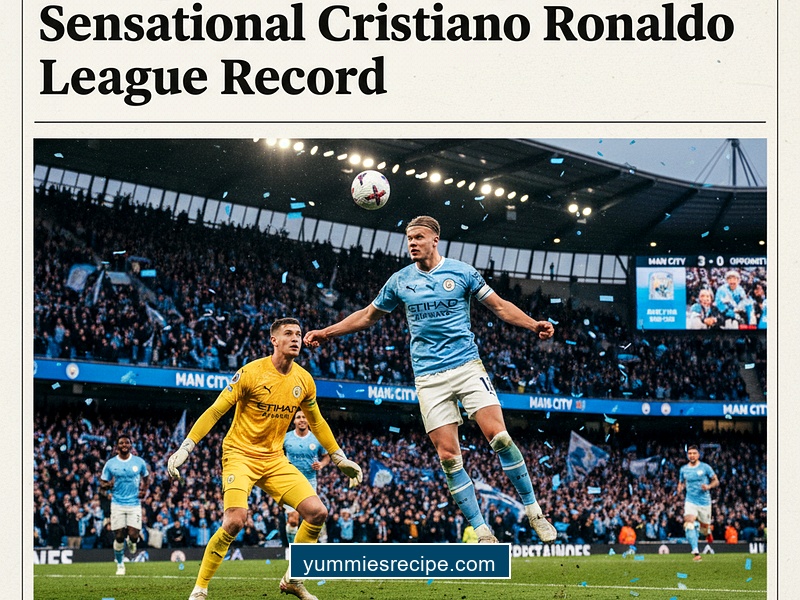
There is a terrifying, almost industrial inevitability to Erling Haaland. When the news broke that the Norwegian struck his 100th goal for Manchester City in his 105th appearance—equaling a record set by Cristiano Ronaldo at Real Madrid—the football world didn’t gasp. We nodded. It was a confirmation of a scheduled event, not a miraculous occurrence.
We are witnessing the gentrification of goal-scoring. The chaotic, visceral joy of the Premier League of the mid-2000s has been replaced by high-performance algorithms, and Haaland is the final boss of this new era. As a columnist who sat in the press box at Old Trafford during the swirling, rain-soaked nights of 2008, comparing the current Manchester City iteration to Sir Alex Ferguson’s last great dynasty is not just an exercise in nostalgia; it is a study in how the sport has fundamentally changed.
The 2008 United vs. The 2024 City: Chaos vs. Control
To truly understand the magnitude of Haaland matching Ronaldo’s century pace, we must contextualize the environment in which these goals are forged. When Cristiano Ronaldo was terrorizing full-backs for Manchester United between 2006 and 2009, he was playing in a system defined by fluid dynamism. Ferguson’s front three of Ronaldo, Carlos Tevez, and Wayne Rooney was a triumvirate of chaos. They interchanged, they dropped deep, and they scrapped.
Ronaldo’s 31-goal season in 2007-08 was considered an anomaly because he was, ostensibly, a winger. He had to beat three men, cut inside, and unleash a thunderbolt from 25 yards. His goals were moments of individual brilliance extracted from difficult situations.
Contrast this with Pep Guardiola’s Manchester City. Haaland is not required to create. In fact, Guardiola seemingly prefers he doesn't. City is a machine built to control space and time, suffocating opponents until the ball arrives in the six-yard box, where Haaland is waiting. He is the terminus. The difference between Ronaldo’s United and Haaland’s City is the difference between a jazz improvisation and a metronome.
"Ronaldo made you fall in love with the game because of the struggle. Haaland makes you question if the game is broken because of the ease."
The Tactical Evolution: From False Nine to Pure Nine
The irony of Haaland’s dominance under Guardiola cannot be overstated. Fifteen years ago, Guardiola was the architect of the "False Nine" revolution at Barcelona. He discarded Zlatan Ibrahimović and Samuel Eto’o to allow Lionel Messi to drop into midfield, creating a numerical overload that hypnotized Europe. For a decade, football hipsters argued that the traditional striker was dead.
Haaland is the resurrection. But he is not the striker of the 90s—he is not Alan Shearer holding up play with his back to goal, nor is he Ruud van Nistelrooy, who was purely a poacher. Haaland is a physical anomaly who combines the box instincts of Van Nistelrooy with the transition speed of Thierry Henry.
Comparative Analysis: The Speed to the Century
The data regarding the speed to 100 goals for a single club across Europe's top five leagues reveals the absurdity of the current standard.
| Player | Club | Games to 100 Goals | Era Context |
|---|---|---|---|
| Erling Haaland | Manchester City | 105 | High-Press / Possession Dominance |
| Cristiano Ronaldo | Real Madrid | 105 | La Liga Counter-Attack Era |
| Luis Suárez | FC Barcelona | 120 | MSN Trio Era |
| Zlatan Ibrahimović | PSG | 124 | Ligue 1 Dominance |
| Ruud van Nistelrooy | Manchester United | 131 | Classic 4-4-2 Premier League |
Looking at this table, the context of Ronaldo’s 105 games at Madrid is vital. He arrived in Spain as a fully formed Galactico in a league where the disparity between the top two and the rest was massive. Haaland has replicated this efficiency in the Premier League, a competition that prides itself on competitive balance (or at least, the marketing of it). To match Real Madrid numbers in the English top flight is a statistical outrage.
The De Bruyne Factor and the Supply Chain
We cannot discuss Haaland’s record without acknowledging the supply line. In 2008, Ronaldo was fed by Paul Scholes, Michael Carrick, and Ryan Giggs. It was a supply line of precision, but often played in transition. Ronaldo often received the ball 40 yards from goal.
Haaland benefits from Kevin De Bruyne, perhaps the greatest passer in Premier League history. The tactical geometry of City creates "cut-back" scenarios that simply didn't exist in the mid-2000s. The concept of "Expected Goals" (xG) didn't drive coaching decisions back then. Players shot from distance. Now, City recycles possession until the probability of a goal exceeds 30%. Haaland is the beneficiary of a decade of analytics evolution.
However, dismissing Haaland as merely a "tap-in merchant" ignores the physical terror he inflicts. I recall watching Arsenal’s "Invincibles" in 2003-04. Thierry Henry bullied defenders with elegance. Haaland bullies them with violence. He runs through center-backs, not around them. When he engages a defender like William Saliba or Gabriel, it looks like a heavyweight fight. He has brought a physicality back to the league that we thought was legislated out of the game.
Is He Better, or Just More Efficient?
This is the uncomfortable question. If we judge purely on output, Haaland is on track to eclipse every record in the book. He could shatter Shearer’s 260-goal record before his 28th birthday if he stays fit and remains in England. But does he possess the majesty of Ronaldo?
No. And he doesn't care. Ronaldo, even in his relentless Madrid years, wanted to entertain. He wanted the step-overs, the chops, the screaming free-kicks. Haaland is utilitarian. If the ball crosses the line, his job is done. He touches the ball fewer times per game than any elite striker in history. In a match against Crystal Palace last season, he touched the ball fewer than 15 times and left with a hat-trick.
This efficiency is impressive, but it feels colder. It lacks the narrative arc of a player growing into a game. It is instant gratification.
The Future of the Record
Haaland surpassing milestones set by legends like Ronaldo, Henry, and Aguero serves as a marker for where football is heading. We are moving toward a game of hyper-specialization. Full-backs are now midfielders; goalkeepers are sweepers; and strikers are pure finishers who are discouraged from leaving the width of the penalty area.
The romantic in me misses the flawed brilliance of a young Wayne Rooney or the arrogance of Eric Cantona. But the analyst cannot help but marvel at the monster Guardiola has unleashed. Haaland hasn't just broken a record; he has broken the logic of the sport. We used to believe that scoring a goal was the hardest thing to do in football. Haaland makes it look like the only thing he knows how to do.
He is not the next Ronaldo. He is something entirely different—a goal-scoring event horizon from which no record can escape.